

Speaker fees in 2027: what rising event costs mean
Last week American Express Global Business Travel (Amex GBT) published its 2027 Global Meetings and Events Forecast, and the report paints a two-sided picture: 93 percent of the meeting professionals surveyed are optimistic about 2027, while at the same time they expect the cost per attendee to rise for every type of meeting. It is based on a survey of 500 meeting professionals in eleven countries, carried out by YouGov in August 2026. The study says nothing about speakers or their fees. For you as a speaker it is still an important signal, because organizers will look harder at every budget line in 2027 and rethink venues and formats. We set out what this means for fees, travel costs and virtual talks, and work through a specialist conference with 300 guests to show what share of the budget goes on speakers.
Last week American Express Global Business Travel (Amex GBT) published its 2027 Global Meetings and Events Forecast, and the report paints a two-sided picture: 93 percent of the meeting professionals surveyed are optimistic about 2027, while at the same time they expect the cost per attendee to rise for every type of meeting. It is based on a survey of 500 meeting professionals in eleven countries, carried out by YouGov in August 2026. The study says nothing about speakers or their fees. For you as a speaker it is still an important signal, because organizers will look harder at every budget line in 2027 and rethink venues and formats. We set out what this means for fees, travel costs and virtual talks, and work through a specialist conference with 300 guests to show what share of the budget goes on speakers.
Amex GBT Forecast 2027: planners stay optimistic, but more cautiously
According to Amex GBT, this is the sixteenth edition of the forecast, which is aimed at people who plan meetings and conferences for companies. 93 percent of them are optimistic about the health of the sector in 2027. A closer look shows a flatter mood, as only 45 percent call themselves “very optimistic”, compared with 62 percent in the 2026 forecast. In Europe the report puts the share of optimists at 91 percent, although Amex GBT itself treats regional results as indicative because they rest on smaller subsamples.
For the third year in a row, a better attendee experience tops the agenda and is named as a priority by 42 percent, while reducing costs comes in joint fourth with 27 percent. One shift from last year stands out. In the 2026 forecast, cost was the biggest challenge in meeting planning, and for 2027 it has dropped to fifth place, which Amex GBT suggests may be because planners now feel better equipped to deal with rising prices.
Cost per attendee rises in 2027 for conferences and every other format
The cost section of the report opens with a look back. According to Amex GBT’s Cost of Business Travel Index, a basket of typical corporate travel services cost 8.3 percent more in the first quarter of 2026 than a year earlier. For 2027 the report expects higher room rates and airfares, and for the key European meetings hubs it warns of rising hotel rates and constrained availability.
A higher total cost per attendee is expected by 91 percent of respondents for product launches, 84 percent for conferences with a trade show and 82 percent for conferences without one. How much costs will rise is not quantified in the report.
How organizers respond to rising event costs
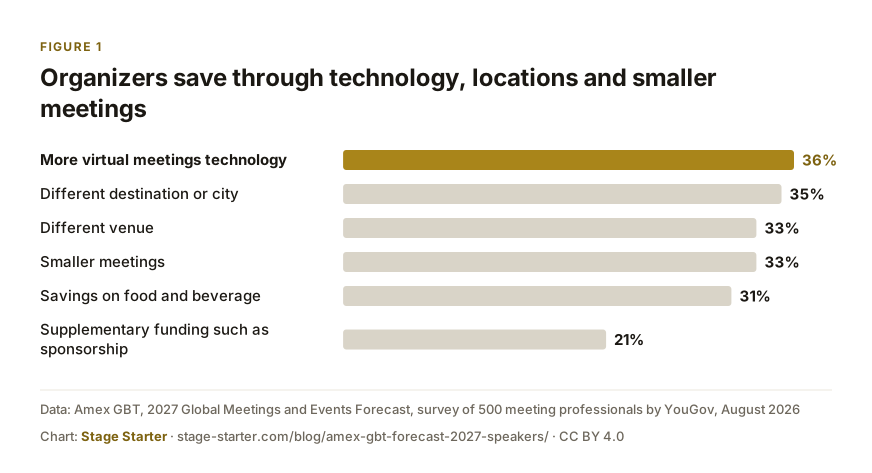
Asked how economic uncertainty is affecting the meetings they plan, respondents mostly point to changes of plan. 36 percent are making more use of virtual meetings technology, 35 percent are changing destination or city, and 33 percent each are changing venue or planning smaller meetings with fewer attendees. 31 percent are cutting food and beverage spend per attendee, while only a quarter of respondents are holding fewer events overall. One in five, 21 percent, are looking for supplementary funding such as sponsorship, and Amex GBT notes that any sponsor will want something in return.
Figure 1
Organizers save through technology, locations and smaller meetings
Source: Amex GBT, 2027 Global Meetings and Events Forecast, survey of 500 meeting professionals by YouGov, August 2026
Data and download
Style
Embed
Data as table
| Label | Value (%) |
|---|---|
| More virtual meetings technology | 36% |
| Different destination or city | 35% |
| Different venue | 33% |
| Smaller meetings | 33% |
| Savings on food and beverage | 31% |
| Supplementary funding such as sponsorship | 21% |
Chart: Stage Starter, CC BY 4.0. Data: Amex GBT, 2027 Global Meetings and Events Forecast, survey of 500 meeting professionals by YouGov, August 2026; the source's terms apply.
Some coverage reports different figures. On October 14, 2026 Hotel Dive cited, as responses to rising costs, 39 percent who want to change destination, 37 percent planning more virtual events and 24 percent changing their accommodation. In the report itself these three figures belong to a different question, the one about the effects of geopolitical instability. Whether the trigger is cost or crisis, organizers respond with different locations and more virtual elements.
A conference budget for 300 guests: where speaker costs sit
The study gives no amounts per attendee, so we work with open assumptions and round numbers. Suppose a specialist conference for 300 guests costs the organizer $1,000 per attendee, everything included from the room to the program. The program has one keynote with a fee of $6,000 and twelve specialist talks without a fee, for which the organizer covers travel and hotel at $500 each. The calculation then looks like this:
- Total budget: 300 guests times $1,000 gives $300,000.
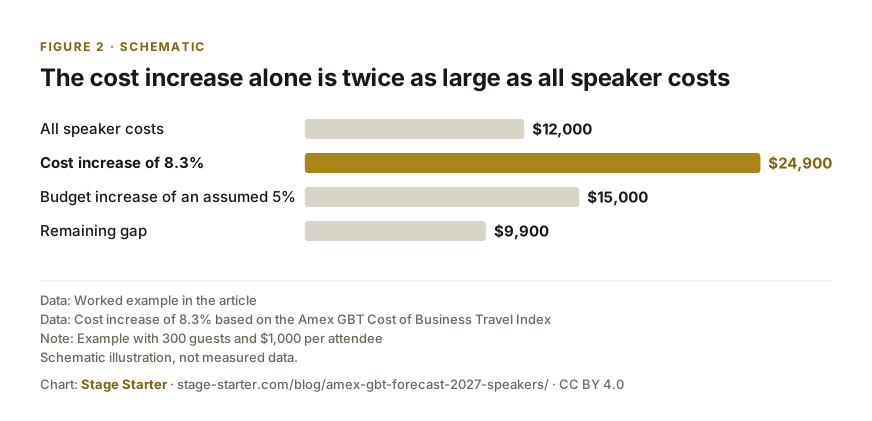
- Speaker costs: a $6,000 keynote fee plus twelve times $500 for travel and hotel gives $12,000, which is 4 percent of the budget.
- Cost increase: if the cost per attendee rises by 8.3 percent, as much as the travel basket in the first quarter of 2026, the conference costs $24,900 more. We chose this figure as a reference point because the report gives none for 2027.
- Budget increase: if the budget grows by an assumed 5 percent, $15,000 more is available, which leaves a gap of $9,900.
Even with assumed amounts, the calculation shows how small the speaker line is in proportion. The cost increase alone is more than twice as large as all speaker costs together, and to close the $9,900 gap through speakers alone the organizer would have to cut their costs by more than 80 percent. It follows that the levers named in the forecast target the large items: venue, catering and the number of attendees.
Figure 2 Schematic
The cost increase alone is twice as large as all speaker costs
Source: Worked example in the article
Source: Cost increase of 8.3% based on the Amex GBT Cost of Business Travel Index
Note: Example with 300 guests and $1,000 per attendee
Schematic illustration, not measured data.
Data and download
Style
Embed
Data as table
| Label | Value ($) |
|---|---|
| All speaker costs | $12,000 |
| Cost increase of 8.3% | $24,900 |
| Budget increase of an assumed 5% | $15,000 |
| Remaining gap | $9,900 |
Chart: Stage Starter, CC BY 4.0. Data: Worked example in the article; Cost increase of 8.3% based on the Amex GBT Cost of Business Travel Index; the source's terms apply.
In our view the keynote fee is a small item in this calculation that can be justified by its value to the program, while the travel costs of twelve specialist speakers form a line that is easy to cut, for example through flat rates, speakers from the region or a virtual link.
Negotiating speaker fees in 2027: attendee experience as the argument
What follows is our own assessment, as the report contains nothing on fees. The strongest signal for fee negotiations is in the chapter on attendee experience: according to respondents, attendees now look above all for more personalized interactions (35 percent), richer and curated networking (31 percent) and hands-on, interactive sessions and workshops (31 percent). A talk that takes questions from the audience, includes an exercise or leads into a workshop therefore serves the planners’ top priority and can be presented in negotiations as a program element with its own value.
When you identify the return-on-investment and create a unique experience, cost isn’t as big a factor. It becomes a value conversation instead of a cost situation.
Lisa Messina, Chief Sales Officer, Visit Orlando, in the forecast
Messina is talking about destinations, and her point is that cost carries less weight once the return is named and the experience stands out. Applied to speakers, a fee conversation becomes easier as soon as you can show what your talk does for the conference’s goal, for example for registrations or for conversations at a sponsor’s stand. For negotiations in 2027 we therefore recommend quoting expenses separately from the fee. An organizer who has to cut travel costs can then keep your fee and still save, for instance if you travel by train or skip a second night in the hotel.
Travel costs and virtual formats: how speakers can plan for 2027
When choosing a destination, respondents rank ease of travel highest (43 percent), ahead of safety for all attendees (41 percent) and cost (34 percent). For speakers in Germany, Austria and Switzerland we think this makes a short journey a selling point, especially for European conferences whose organizers face higher hotel prices.
Virtual elements are already routine for organizers. 83 percent of respondents include virtual and hybrid meetings in all or most of their events, and 36 percent want to make more use of virtual meetings technology in response to inflation. For you this means having a version of your talk ready that also works on camera, and the article on virtual and hybrid conferences describes what changes. The costs of an in-person appearance are itemized in What a conference appearance costs.
How organizers choose speakers: what may shift in 2027
This section, too, is our own assessment. If a third of planners hold smaller meetings, some conferences will run shorter programs, and possibly just as many speakers as before will compete for fewer slots. An abstract that clearly names the benefit for the audience and shows an interactive element then fits the priorities described in the forecast better. If organizers turn to sponsors for funding more often, the number of program slots tied to sponsors may also grow.
Five steps for speakers before the 2027 conference season
- Put a figure on travel costs early: quote them separately from your fee and offer an inexpensive way to travel before the organizer asks.
- Build in an interactive element: add an exercise or a structured question round to your talk.
- Prepare a virtual version: keep a tested camera version of your talk ready.
- Favor stages within easy reach: submit more often to conferences you can reach with a short journey.
- Read calls for papers more closely: check whether a program committee selects the talks or the slot is tied to sponsorship, and ask about the rules for travel expenses.
Frequently asked questions
Does the Amex GBT Forecast 2027 say anything about speaker fees?
No. The report covers budgets, cost per attendee, venues and formats, and speaker fees do not appear in it. Everything this article says about fees is our own assessment.
How much will conference costs rise in 2027?
The report does not give a percentage per attendee. 82 percent of respondents expect a higher cost per attendee for conferences without a trade show, and looking back, Amex GBT reports an 8.3 percent price rise for corporate travel services in the first quarter of 2026.
Should I lower my speaker fee in 2027?
The study gives no grounds for that, as 91 percent of respondents expect their budgets to rise. In our view it makes more sense to quote travel costs separately from your fee and to offer some flexibility on how you travel.
Are virtual talks worth it for speakers in 2027?
83 percent of respondents include virtual and hybrid meetings in all or most of their events, and 36 percent want to make more use of virtual meetings technology because of costs. A tested camera version of your talk helps you stay on the program if an organizer moves parts of the conference online.

Marin Niehues is a management consultant and international speaker. With Niehues Consulting he works with organisations from scale-ups to DAX 40 corporations, and on stage he has spoken at more than 45 conferences in 23 countries.
All articles by Marin Niehues