


How long does it take from a call for papers to the stage? The timeline of a submission to professional conferences
From a call for papers to the stage usually takes two to six months, with a range from a few weeks to a year. A call for papers is the public call with which a conference collects talk proposals, and in our analysis of 2,415 conferences the median time between its close and the start of the conference is 50 days. Before that comes the submission window, after it review, acceptance, program and preparation, seven phases in all. If you want to win clients through the stage, you need this timeline, because it determines when a submission turns into the first conversation with a potential client.
From a call for papers to the stage usually takes two to six months, with a range from a few weeks to a year. A call for papers is the public call with which a conference collects talk proposals, and in our analysis of 2,415 conferences the median time between its close and the start of the conference is 50 days. Before that comes the submission window, after it review, acceptance, program and preparation, seven phases in all. If you want to win clients through the stage, you need this timeline, because it determines when a submission turns into the first conversation with a potential client.
How long does it take from a call for papers to the appearance?
From a call for papers to the appearance usually takes two to six months, spread across seven phases. A professional conference is an event where professionals of an industry or topic hear talks, and its program comes together long before the event. The organizer first sets the date and thematic tracks and then opens the call for papers. Deadline and review follow, then acceptance or rejection and the publication of the program, and preparation and the appearance itself come last. How a call is structured in detail and what a committee decides on is explained in the guide to calls for papers.
From the submitter's point of view nothing visible happens in phases three to five, and that is where most of the time goes.
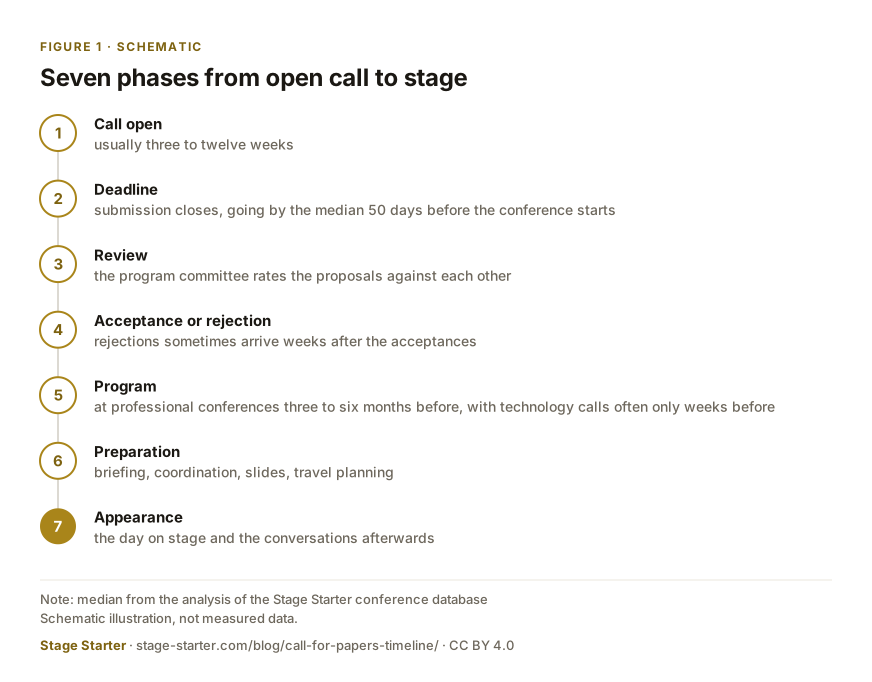
Figure 1 Schematic
Seven phases from open call to stage
Note: median from the analysis of the Stage Starter conference database
Schematic illustration, not measured data.
Data and download
Style
Embed
Data as table
| Step | Name | Explanation |
|---|---|---|
| 1 | Call open | usually three to twelve weeks |
| 2 | Deadline | submission closes, going by the median 50 days before the conference starts |
| 3 | Review | the program committee rates the proposals against each other |
| 4 | Acceptance or rejection | rejections sometimes arrive weeks after the acceptances |
| 5 | Program | at professional conferences three to six months before, with technology calls often only weeks before |
| 6 | Preparation | briefing, coordination, slides, travel planning |
| 7 | Appearance | the day on stage and the conversations afterwards |
Chart and data: Stage Starter, CC BY 4.0. Free to use with attribution and a link.
How long is a call for papers open?
A call for papers is usually open for three to twelve weeks, and hardly any for longer than three months. Nobody can submit before it opens or after the closing date, and the conference usually states the closing date with a time on its website. Submissions go through the conference's own form, by email or through platforms on which many conferences bundle their calls.
One consequence for the timeline is easily overlooked. At most calls the committee only decides after the deadline, and where proposals are reviewed on a rolling basis, the call says so. An early submission therefore usually lengthens the wait for the decision. If a conference has just closed its call, only its next edition remains, which for annual conferences takes place twelve months later. Which months of the year have the most conferences is described in the article on conference season.
How long does the review take?
The review usually takes a few weeks after the deadline, and acceptances go out before the program. After the deadline a program committee, a group of organizers and often external experts that decides on the program, reviews the submissions. It rates all proposals against each other: a proposal has to be better than the others in the same track and the same format. In an anonymous review the committee sees no names, while in a review with names the bio and previous appearances count towards the rating.
Whether the call states a decision date can be found in the call itself. Accepted speakers receive the decision by email or through the platform, and in our experience rejected ones almost always hear too, sometimes only weeks after the acceptances. If no message arrives during this time, that does not yet mean a rejection, and when following up is appropriate is covered in the article Following up after the call for papers.
With the program, the appearance becomes public. Traditional professional conferences finalize it three to six months before the event, technology conferences with an open call often much later. An inquiry a month before the conference therefore runs into a closed program, and a year ahead it comes too early, because nothing has been decided yet.
How much lead time do conferences with an open call have?
Conferences with an open call close submissions, going by the median, 50 days before the conference starts. We measure lead time as the time between the submission deadline and the start of the conference, and our analysis of 2,415 conferences publicly advertising speaking slots for 2026, gives an average of 65 days and a median of 50 days. The median is more reliable because individual conferences with a very long lead time pull the average upwards. For half of the conferences, therefore, no more than a good seven weeks lie between the deadline and the start of the conference.
Technology calls often close close to the event date. For traditional professional conferences, many of which have no open call, a different measure applies: if you inquire there by email, the favorable moment is four to eight months before the event. How lead time is distributed across all conferences is shown in the article How far in advance do you submit?.
What happens between acceptance and appearance?
Between acceptance and appearance there are several weeks of preparation with fixed dates set by the organizer. The speaker briefing, the collection of all information on travel, technology, stage and schedule, often arrives in stages, and with an acceptance months in advance the complete version often only lands in your inbox two to four weeks before the date. At larger commercial events, in our experience the organizer schedules a coordination call of around half an hour three to six weeks beforehand. One to two weeks before the date, at some events the person who will introduce the talk gets in touch, and in the weeks before, the conference's marketing is often under way, for which the speaker records a teaser or gives an interview.
Your own calendar is part of the timeline too. A one-day appearance in another city costs two travel days, or three with a long journey or an evening before, and preparation comes on top. Because the organizer sets the date, two acceptances can fall on the same day. It is best to resolve such a conflict only once both acceptances are in, because withdrawing a submission in advance weakens your position with the organizer the following year.
What the timeline means for sales planning
The appearance is the start of acquisition. As a rule of thumb, an appearance brings around five serious conversations, two meetings come from those, and every third meeting turns into paid work. Follow-up happens within about two weeks of the appearance. If you add the phases before it, many months pass between sending a submission and the first paid contract, and if you plan in quarters rather than weeks, you draw the right conclusions.
A second point concerns volume. In our submissions for clients we reach up to 19 percent acceptances per conference, while 5 percent at most is typical in the market at this volume of submissions, and one to three appearances in the first year is a realistic rule of thumb. Acceptances arrive unevenly, because each conference decides in its own time window. Appearances therefore come in clusters with gaps in between, and a sales plan that assumes one appearance a month misses this mechanism.
The waiting time takes little work but a lot of calendar time. If you need a measurable contribution from the stage to acquisition in the first year, plan submissions early and in waves, because each wave only produces appearances months later, and fill the gaps between the clusters with further submissions.
Stage Starter takes on this work for you: we find the right calls, write the submission and submit it, and we keep the submission waves going all year so that no quarter stays empty. You provide your expertise and give your approval, and working with Stage Starter starts at $999 net per month. The program committee decides on each individual acceptance.
Frequently asked questions
How long does a call for papers last?
A call for papers is usually open for three to twelve weeks. At most calls the decision is only made after the closing date, and the review adds a few weeks to the total. In all, two to six months usually pass before the appearance.
When do you find out whether your submission has been accepted?
The decision usually comes a few weeks after the deadline, with acceptances first and rejections sometimes weeks later. Whether there is a fixed decision date is stated in the call. In our experience almost all submitters receive an answer.
How early should you submit to a professional conference?
For conferences with an open call you submit within the window, which closes, going by the median, 50 days before the conference. For conferences without an open call, four to eight months before the event is the favorable moment for an inquiry. An early submission within the window only speeds up the decision where the committee reviews on a rolling basis.
When are most call for papers deadlines in the year?
Most deadlines fall in the weeks before the two conference peaks, in July and August for the autumn and in February and March for the spring. The reason is the short lead time of 50 days going by the median. When which deadlines close over the year is shown in the article on call for papers deadlines.
What happens if there is no answer after the submission?
No answer in the weeks after the deadline is normal and not yet a rejection. If the call states a decision date, you follow up politely once it has passed. Organizers rarely read such an inquiry as pressure.
When is the conference program published?
Traditional professional conferences publish their program three to six months before the date, because they use it to sell tickets. Technology conferences with an open call often only publish a few weeks beforehand. Accepted speakers learn of their acceptance before publication.
How long does it take from the appearance to the first contract?
In our experience a few weeks to a few months pass from the appearance to the first contract, and correspondingly longer for larger mandates with a buying group. The conversations take place on the day of the conference, and follow-up happens within about two weeks. After that comes the client's buying process with meetings, a proposal and internal alignment.
What happens if I have to withdraw after acceptance?
If you have to withdraw after acceptance, inform the organizer immediately so that they can fill the slot from their waiting list. The earlier the cancellation, the smaller the damage to the program and to your position for the next edition. A substitute speaker from your company is only possible with the organizer's consent, because the committee selected you as a person.
The timeline at the moment of sending
If you know the seven phases and their typical duration, you can see as soon as you send a submission in which quarters appearances become likely, and you can narrow the gaps between the clusters with further waves of submissions. What your submission plan for the next twelve months would look like is something we clarify in an initial consultation.

Marin Niehues is a management consultant and international speaker. With Niehues Consulting he works with organisations from scale-ups to DAX 40 corporations, and on stage he has spoken at more than 45 conferences in 23 countries.
All articles by Marin Niehues