

Checklist for speakers: what to do before the conference and on the day of your talk
A checklist for speakers has three parts: coordination with the organizer before the conference, your bag with tech and documents, and the day of your talk up to the conversations afterwards. Most mishaps on conference stages happen at a few recurring points, such as a missing adapter, a video without sound or a speaking time that turns out shorter than expected. If you tick off these points in advance, you walk on stage calmer and have a clear head after the talk for the people who come up to you. Those conversations are the reason you speak at an industry conference as an expert in the first place.

A checklist for speakers has three parts: coordination with the organizer before the conference, your bag with tech and documents, and the day of your talk up to the conversations afterwards. Most mishaps on conference stages happen at a few recurring points, such as a missing adapter, a video without sound or a speaking time that turns out shorter than expected. If you tick off these points in advance, you walk on stage calmer and have a clear head after the talk for the people who come up to you. Those conversations are the reason you speak at an industry conference as an expert in the first place.
Is there a checklist for speakers before the conference?
Yes, the checklist before the conference covers coordination with the organizer, the deadlines for your materials, rehearsing the talk and planning travel and meetings. It starts with the acceptance, the email in which the program committee accepts your proposal. The program committee is the group of experts who read the submitted proposals for a conference and put the program together. From the acceptance onwards you work with the organizing team, and they send the speaker briefing, the collection of everything speakers need to know, which at many conferences arrives in several stages and is complete only two to four weeks before the event.
These points need to be settled in the weeks before your talk:
- Slot and speaking time: time and room as well as the net speaking time after the introduction and the Q&A.
- Format and audience: whether you have a talk, a workshop or a seat on a panel, and who will be in the room.
- Technology: your own laptop or the presentation computer in the room, the screen's aspect ratio, the type of microphone, sound for videos, a clicker to advance the slides.
- Deadlines: when your slides, short bio and photo are due with the organizer.
- Recording and slides: whether the session is recorded, whether you may use the recording and who receives your slides afterwards.
- Travel: journey, hotel, the speaker dinner the evening before and who covers which costs.
- Contact person: name and phone number of the person responsible for speakers on the conference day.
The article What do I need to clarify with the organizer as a speaker? covers this coordination in detail. Many briefings answer only part of it, and the missing points come only when you ask. If you ask early, you build your talk to the right length and do not have to cut it two weeks before the event.
Rehearsal is part of the preparation. Experienced speakers give their talk at least once in full, out loud and against the clock, because almost every talk takes longer on the first spoken run than planned in your head. You plan the conversations just as early: anyone on the attendee list or in the program who matters for your business gets a short message before the conference, mentioning your session and suggesting a coffee.
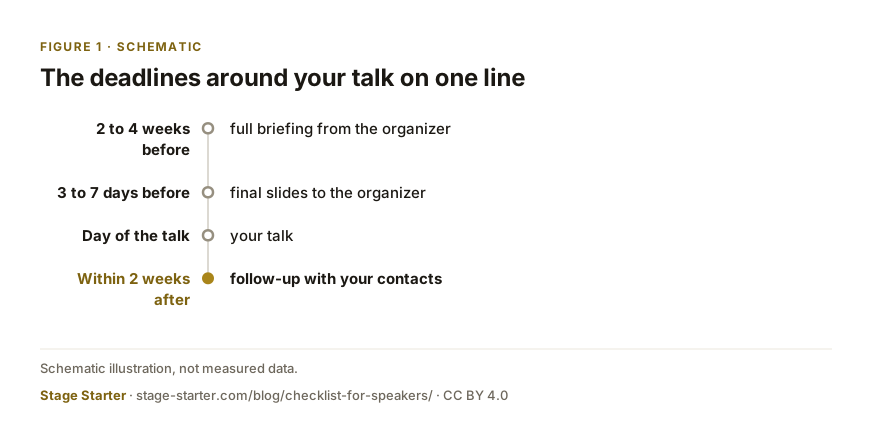
Figure 1 Schematic
The deadlines around your talk on one line
Schematic illustration, not measured data.
Data and download
Style
Embed
Data as table
| Date | Event |
|---|---|
| 2 to 4 weeks before | full briefing from the organizer |
| 3 to 7 days before | final slides to the organizer |
| Day of the talk | your talk |
| Within 2 weeks after | follow-up with your contacts |
Chart and data: Stage Starter, CC BY 4.0. Free to use with attribution and a link.
What should I take to a conference as a speaker?
As a speaker you take your laptop with charger and suitable adapters, your slides additionally as a file on a USB stick and available online, a clicker of your own with a fresh battery and a way for people to reach you after the talk. Equipment in conference rooms varies widely, and whatever you bring yourself you do not have to hunt for on site.
These things belong in your bag:
- Laptop with charger and adapters: adapters from your port to HDMI, ideally two different ones, because rooms provide different cables.
- Slides in three versions: the original file, a PDF as a fallback, and both on a USB stick and in a cloud folder.
- Videos as separate files: embedded videos often play without sound or not at all on someone else's computer, and the separate file saves the slide.
- Clicker: a slide advancer of your own with a spare battery, because the one provided is sometimes missing or works differently.
- Notes on paper: the order of your slides and your key sentences, in case presenter view does not run on the screen.
- A way to reach you: a QR code on the last slide that leads to your profile or a booking page, and business cards for the breaks.
- Documents offline: briefing, schedule and the contact person's number as a file on your phone, because the Wi-Fi in conference venues is often overloaded.
- Personal items: a bottle of water for the stage, a power bank for your phone and a second top in case something goes wrong at the coffee station.
What is on the checklist for the day of the talk?
On the day of your talk the list covers check-in, the tech check, the settings on your laptop, coordination with the moderator and planning the hour after the talk. The day starts at the speaker desk, where you receive your conference badge and usually the current times for the tech check and your slot. How such a day runs as a whole is described in the article How does a conference work for a speaker?.
The tech check is the appointment at which you try out laptop, microphone and slides in the room. Larger conferences set a fixed window for it in the briefing, while at smaller events you often only have the break before your session. In this check you make sure the slides appear in the right format on the screen, videos play with sound, the clicker responds and you can see the confidence monitor without turning away from the audience.
These points belong on the list for the day of your talk:
- Prepare your laptop: notifications and sleep mode off, all other programs closed, charger plugged in.
- Phone on silent: and out of range of the microphone, because radio signals can be audible in some sound systems.
- Brief the moderator: how to pronounce your name, your role and the sentence that introduces you.
- Agree on time signals: who shows you the remaining time and how, with cards, a clock at the edge of the stage or a monitor.
- Quiet time before the slot: no more changes to the slides, because late changes mainly create uncertainty.
- Check your journey home: enough time after the slot so you can have the conversations after the talk.
This preparation is the most effective help against stage fright, because it removes the uncertainties that build up before a talk. What happens in the body before an appearance, and why the nerves stay with experienced speakers too, is covered in the article on stage fright.
What belongs on the checklist after the talk?
After the talk, the list covers conversations with the audience, noting down your contacts, securing photos and the recording, and following up within two weeks. Straight after your session people come up to you with questions, and that window closes with the next break. If you stay in or outside the room during that time, you have the conversations that later turn into assignments.
A proven habit is to note every contact on the same day with two keywords: what you talked about and which next step you agreed. After a conference day with thirty conversations, nobody remembers otherwise who had which problem. Official photos and the recording of your session are easy to get in the first week and hard to get later, and this material becomes the reference for your next submission. How these contacts turn into conversations about assignments in the weeks afterwards is described in the article on following up after the conference.
Who takes preparation and submission off your hands
Before you need a checklist for the day of your talk, months of submission work lie behind you. The right conferences have to be found and their calls for papers answered, the public invitations conferences use to collect talk proposals. Each call needs an abstract, the short description of your talk, and after the acceptance comes the coordination with the organizer from the first part of this list.
Stage Starter takes on this work for you: we find the right calls, write the submission and submit it, and after the acceptance we support the coordination with the organizer up to the conference day. We bring experts onto professional stages where their clients are in the audience. In our own submissions for clients we reach acceptances of up to 19 percent per conference, while the market norm at this volume of submissions is 5 percent at most. The engagement starts from $999 net per month. What the whole path from topic to first stage looks like is shown in the guide to becoming a speaker.
Frequently asked questions
What should I take to a conference as a speaker?
You take your laptop with charger and two adapters to HDMI, your slides as the original file and as a PDF on a USB stick, a clicker of your own with a spare battery and a way to reach you, such as a QR code on the last slide. Add notes on paper, a bottle of water and the briefing offline on your phone.
How early should I arrive as a speaker?
On the day of your talk you are at the venue by the time of the tech check given in the briefing, and in the room at least one break before your slot. If you travel to another city, you arrive the evening before, especially if the speaker dinner takes place then. A one day appearance in another city therefore costs two travel days, three with a long journey.
What should I wear as a speaker at a conference?
You wear what is usual in your industry's audience, one notch more carefully. Clothing with a belt or a firm waistband makes it easier to attach the microphone transmitter, and plain fabrics look calmer on recordings than fine patterns. Jewelry that rattles against the microphone stays off for the talk.
What do I do if the technology fails on stage?
If the technology fails, you switch to your fallback: the PDF on the presentation computer, the slides from your stick or, if necessary, the talk from your notes. The technical team in the room is there for exactly such cases and usually arrives within a few minutes. A calm sentence to the audience bridges the time, and most listeners remember the content afterwards rather than the mishap.
Can I use my own laptop for the talk?
Many conferences allow your own laptop, while large events often play all slides centrally from a presentation computer. Which applies is stated in the briefing, or you clarify it with the organizer before the slide deadline. With the presentation computer you usually lose presenter view, which is why notes on paper make sense.
Do I have to submit my slides before the conference?
At many conferences, yes, usually three to seven days in advance, so the technical team can load them onto the presentation computer. The deadline and file format are in the briefing. Even if you have submitted your slides, you bring them as a PDF on a stick.
How do I prepare the evening before the talk?
The evening before, you run through the talk once out loud, check the tech in your bag and charge all devices. You no longer rework the slides. If there is a speaker dinner, you go, because organizers and other speakers sit together there in a small group.
If you want to speak at industry conferences without organizing submissions and coordination yourself alongside your day-to-day business, we can discuss in an initial consultation which stages fit your topic.

Marin Niehues is a management consultant and international speaker. With Niehues Consulting he works with organisations from scale-ups to DAX 40 corporations, and on stage he has spoken at more than 45 conferences in 23 countries.
All articles by Marin Niehues