

Client acquisition through speaking: how to reach the Day 1 List
Client acquisition through speaking works before the actual buying process, because according to Google B2B buyers start with a shortlist of trusted vendors. Google and the market researchers of National Research Group surveyed 2,063 senior leaders in the US for this and published the results in the October 2025 playbook "Understanding the Empowered Buyer", which Digital Commerce 360 reported on December 5, 2025. Many buyers start with this list, which Google calls the "Day 1 List", and according to the playbook 82 percent ultimately buy from a vendor on it. For experts and speakers this means that a talk reaches decision-makers before they start comparing, and that after the appearance they must find evidence of your expertise online.
Client acquisition through speaking works before the actual buying process, because according to Google B2B buyers start with a shortlist of trusted vendors. Google and the market researchers of National Research Group surveyed 2,063 senior leaders in the US for this and published the results in the October 2025 playbook "Understanding the Empowered Buyer", which Digital Commerce 360 reported on December 5, 2025. Many buyers start with this list, which Google calls the "Day 1 List", and according to the playbook 82 percent ultimately buy from a vendor on it. For experts and speakers this means that a talk reaches decision-makers before they start comparing, and that after the appearance they must find evidence of your expertise online.
Client acquisition through speaking: what the Google playbook shows about the Day 1 List
The playbook rests on a survey of 2,063 senior leaders in the US who had made purchases in enterprise, software as a service, web services and retail in the past six months. It is addressed to advertisers and vendors who want to get onto the Day 1 List and stay there. According to the playbook, B2B buyers are better informed and faster than before: around three in four finish their journey in twelve weeks or less, and 77 percent say their purchase took twelve weeks or less.
The Day 1 List is the shortlist of vendors a buyer already knows and trusts before the formal purchasing process begins. According to the playbook, many buyers start with such a list, and 82 percent ultimately buy from it, which is more than four in five buyers. The playbook names two tasks for vendors, which are to earn a place on the list and to keep it. That the place does not stay by itself is shown by another figure: 58 percent of B2B buyers who purchased in the past six months report having switched vendors in that period.
Caution is needed for the calculation in the German-speaking region. The survey covers buyers in the US. Suppose the order of magnitude also applies to your target group and 200 companies there bought something in the past six months, then around 116 of them switched vendors. This assumption for the example shows that a shortlist is in motion and can take in new names.
Why client acquisition through speaking starts before the buying process
Client acquisition through speaking means that you win business because decision-makers hear you speak at a conference and then put you on their shortlist. A talk reaches buyers in the phase in which they are not yet approaching any vendor but are already forming an impression. Suppose your slot lasts 45 minutes (which lengths conferences award is covered in How long is a conference talk?), then the audience listens to you voluntarily for that long and experiences your thinking in context. That is enough for a complete line of thought with an example.
A conference also brings an external endorsement, because an organizer has chosen your topic for its program and put its reputation behind the choice. Under the name peer validation, the playbook describes that buyers give weight to the opinions of others and want to hear credible voices where they already spend time. In our assessment the selection by an organizer is one form of this endorsement. Why the industry conference works as a sales channel is explained in Why the industry conference works so well as a sales channel.
The five rules of the playbook as a checklist for your talk
The playbook names five rules by which vendors stay interesting to buyers, and because listeners at a conference ask the same questions as buyers online, namely whether a statement is true, whether it fits their situation and whether someone confirms it, these rules transfer directly to a talk.
Proof is the hardest point for consultants, because projects are often confidential and a client rarely allows its name or figures to be mentioned on a conference stage, even though precisely these figures would show the listeners what you can do. A metric before and after a project can be shown without client names if you give only the industry and the size of the company. Relevance is decided at submission. An abstract with a role and a problem addresses exactly the buyers who can end up on your shortlist afterwards.
Client acquisition through speaking needs a plan for twelve weeks
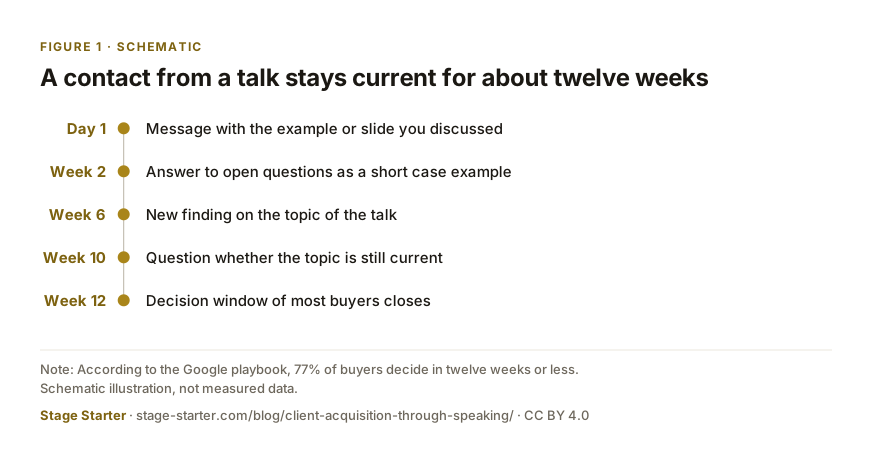
If 77 percent of buyers decide in twelve weeks or less, a contact from a talk is current only for a limited time. Twelve weeks are 84 days. A schedule can distribute them like this:
- The day after the talk, you write to everyone you spoke to with a message containing the example or slide you discussed.
- After two weeks, you send those who had a question an answer in the form of a short case example from a similar project.
- After six weeks, you get in touch with a new finding on the topic of the talk, for example a metric from a current project.
- After ten weeks, you ask whether the topic is still current, because the twelve weeks in which most buyers decide according to the playbook are then almost over.
Figure 1 Schematic
A contact from a talk stays current for about twelve weeks
Note: According to the Google playbook, 77% of buyers decide in twelve weeks or less.
Schematic illustration, not measured data.
Data and download
Style
Embed
Data as table
| Date | Event |
|---|---|
| Day 1 | Message with the example or slide you discussed |
| Week 2 | Answer to open questions as a short case example |
| Week 6 | New finding on the topic of the talk |
| Week 10 | Question whether the topic is still current |
| Week 12 | Decision window of most buyers closes |
Chart and data: Stage Starter, CC BY 4.0. Free to use with attribution and a link.
Client acquisition through speaking requires that buyers can find you online
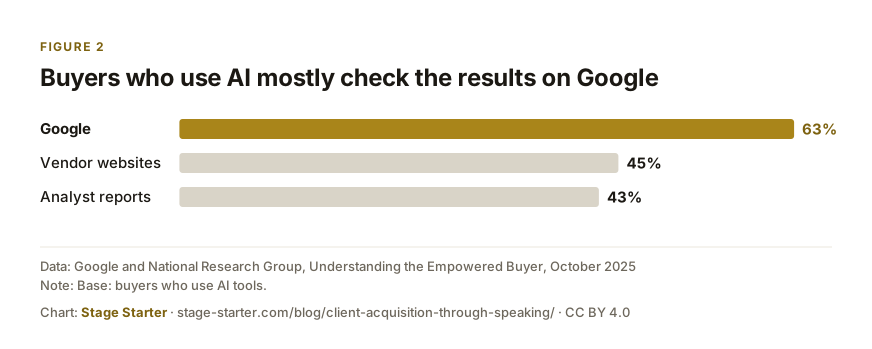
According to the playbook, 60 percent of buyers use AI tools such as ChatGPT or Gemini to expand vendor lists, summarize content or surface competitors. Of the buyers who use AI tools, 63 percent use Google to check the results, 45 percent vendor websites and 43 percent analyst reports. This fits the figure that 94 percent of buyers who searched for a product online used Google Search for it.
Figure 2
Buyers who use AI mostly check the results on Google
Source: Google and National Research Group, Understanding the Empowered Buyer, October 2025
Note: Base: buyers who use AI tools.
For a speaker this means that after a talk someone types in your name and has to find what your appearance proves: a speaker page with topic and case example, the conference's program page with your abstract and, if available, a recording. Anyone who wants to be named by AI assistants as an expert needs the same traces, because they lie outside your own website and confirm your statements.
Five steps for planning client acquisition through speaking
- Define target clients: Choose a role, an industry and a problem you can solve, so that the talk speaks to someone.
- Collect proof: Choose a case with a starting point and a result that you may show without client names.
- Select a conference: Look for events where your target clients sit in the audience and submit there.
- Plan the follow-up: Put the four dates across twelve weeks in your calendar before the talk.
- Secure the traces: After the talk, check whether the program page, speaker page and recording can be found, and ask ChatGPT or Google whom they name on your topic.
Frequently asked questions
How does client acquisition through speaking work?
You give a talk at an industry conference in front of decision-makers from your target group, and some of them put you on their shortlist afterwards. According to Google's October 2025 playbook, many buyers start with such a list, and 82 percent ultimately buy from it. The talk shows how you think. The follow-up afterwards turns the impression into a conversation.
What is Google's Day 1 List?
The Day 1 List is the shortlist of vendors that a B2B buyer knows and trusts before the formal purchasing process begins. The playbook by Google and National Research Group names it as a task for vendors to earn a place on it and to keep it.
How long does a B2B buying decision take?
In the survey of 2,063 senior leaders in the US by Google and National Research Group, 77 percent say their purchase took twelve weeks or less. For client acquisition through speaking this means that you follow up within that period after the appearance.
How do buyers find a speaker after the talk?
Buyers search for the name on Google, because 94 percent of buyers who searched for a product online used Google Search for it. Those who use AI tools check the results in Google Search in 63 percent of cases, according to the playbook. A speaker page, the conference's program page and a recording ensure that they find your expertise proven there.
Do the figures also apply to Germany?
The survey covers senior leaders in the US, and a transfer to the German-speaking region is therefore an assumption. The logic of a shortlist before the buying process is likely to hold here as well, but you should read the percentages as an order of magnitude.

Marin Niehues is a management consultant and international speaker. With Niehues Consulting he works with organisations from scale-ups to DAX 40 corporations, and on stage he has spoken at more than 45 conferences in 23 countries.
All articles by Marin Niehues