


How many submissions does it take to get a conference slot? The maths from practice
In our submissions for clients, one acceptance takes submissions to around five conferences on average, which is just under 15 decided abstracts. An abstract is the short description of a planned talk that a program committee reads, the group that decides on a conference's line-up. It is submitted in a call for papers, the public announcement through which a conference collects talk proposals. Using our two rates, around 7 percent per abstract and up to 19 percent per conference, this article works out how many submissions make an acceptance likely and how much work a year with four to six talks involves.

In our submissions for clients, one acceptance takes submissions to around five conferences on average, which is just under 15 decided abstracts. An abstract is the short description of a planned talk that a program committee reads, the group that decides on a conference's line-up. It is submitted in a call for papers, the public announcement through which a conference collects talk proposals. Using our two rates, around 7 percent per abstract and up to 19 percent per conference, this article works out how many submissions make an acceptance likely and how much work a year with four to six talks involves.
How high is the acceptance rate per abstract and per conference?
In our submissions for clients, acceptance per abstract is around 7 percent and acceptance per conference up to 19 percent. The basis is a representative sample of our submissions for clients, 2024 to 2025: just under two thirds of submitted abstracts have been decided, and of the decided ones around 7 percent were accepted and around 93 percent rejected. Dividing the decided abstracts by the accepted ones gives 14.6, just under 15 abstracts per acceptance.
Figure 1
Around 7% of decided abstracts were accepted
Source: Stage Starter, representative sample of our own submissions for clients, 2024 to 2025
Note: Submitted abstracts = 100%; more than a third were still awaiting a decision on the reference date.
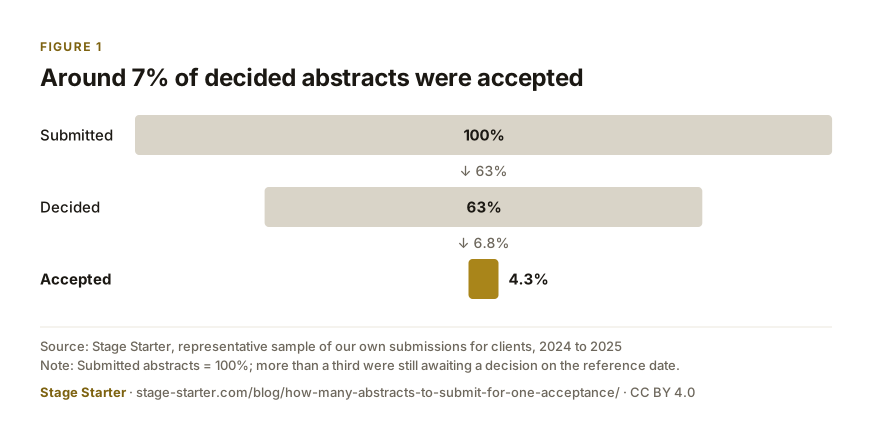
The second rate measures the conference rather than the individual abstract. We often submit several abstracts to one conference, and a single accepted abstract is enough for a yes. Measured against the decided conferences, this gives us up to 19 percent acceptances per conference, while 5 percent at most is typical in the market at this volume of submissions. Mathematically, just under one in five conferences we submit to says yes.
On the reference date, more than a third of the abstracts were still awaiting a decision, because many conferences reply only weeks or months after the call closes. The 7 percent is based on the decided abstracts, and we count open cases only once a reply is in. How the figures are made up and how they compare with other values is covered in more detail in How high is the acceptance rate for a call for papers?
How many abstracts do I need to submit to make an acceptance likely?
After twenty decided abstracts, the chance of at least one acceptance is around 77 percent, and after ten conferences around 88 percent. The average of just under 15 abstracts per acceptance tells you how often it works on average and nothing about the order: the first acceptance can come with the second abstract or only with the fortieth. For planning, the useful question is how large the chance of at least one acceptance is after a given number of submissions. With n attempts at a rate p it is 1 − (1 − p)^n, which rises with every further attempt while the increase gets smaller.
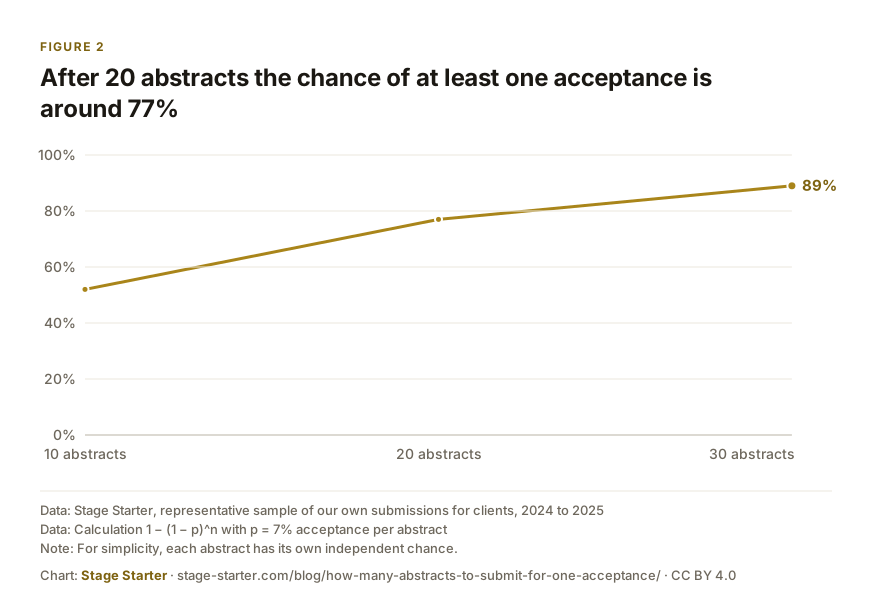
If you work with 7 percent and assume, for simplicity, that each abstract has its own chance independent of the rest, the probability of at least one acceptance is around 52 percent after ten abstracts, around 77 percent after twenty and around 89 percent after thirty. At conference level, with 19 percent, it is around 47 percent after three conferences, around 65 percent after five and around 88 percent after ten. At the typical market rate of 5 percent per conference, ten conferences would reach only around 40 percent.
Figure 2
After 20 abstracts the chance of at least one acceptance is around 77%
Source: Stage Starter, representative sample of our own submissions for clients, 2024 to 2025
Source: Calculation 1 − (1 − p)^n with p = 7% acceptance per abstract
Note: For simplicity, each abstract has its own independent chance.
Data and download
Style
Embed
Data as table
| (%) | Chance of at least one acceptance |
|---|---|
| 10 abstracts | 52% |
| 20 abstracts | 77% |
| 30 abstracts | 89% |
Chart: Stage Starter, CC BY 4.0. Data: Stage Starter, representative sample of our own submissions for clients, 2024 to 2025; Calculation 1 − (1 − p)^n with p = 7% acceptance per abstract; the source's terms apply.
The conference calculation is the more reliable one, because several abstracts at the same conference go before the same committee and are not independent attempts. A topic that fits no program fails with every committee, and the twentieth abstract does not change that either. The calculation describes probabilities, and the program committee decides on every single submission.
Interactive tool
Submission calculator
Enter how many talks you want per year and set your acceptance rate per conference. The calculator shows how many conferences you need to submit to.
This tool needs JavaScript to work.
What determines the rate: fit, sector and abstract
Fit between topic and audience has the greatest effect. The 7 percent is an average across many topics and conferences, and individual submissions sit above or below it. A program committee puts together a program for a particular audience, and a talk whose topic does not concern that audience has little prospect even with a good abstract. That is why conference research comes before every submission, to establish where your topic is in demand.
In the technology and software world, many conferences advertise their speaking slots publicly, and there a submission operation works by volume. Association and industry conferences more often fill their programs by invitation and personal approach, and there we write to the program leads directly in your name, ten to fifteen a week once the conference list is in place.
The abstract also shapes the rate. The committee compares title and description with many other proposals for a few slots, and an abstract that states the benefit for the audience clearly does better in that comparison. How program committees select and how a call runs from announcement to acceptance is described in the call for papers guide.
How much work a year of submissions involves
On paper, 60 to 90 decided abstracts are enough for four to six talks, but an operation aimed at acceptances works with considerably more. Many conferences reply late or not at all, and with each round the operation learns which abstracts land with which committees. A volume-based submission operation therefore reaches at least a hundred submissions to around twenty conferences in the first month and at least fifty a month after that. Sending alone takes one working day per fifteen to twenty submissions when the abstracts are finished and standardized. Anyone who tailors each submission to one conference manages four to six a day and gets a higher rate per submission in return.
Before that comes the work this calculation leaves out. The talk topic has to be shaped, the abstracts and bio have to be written and the conferences have to be found. Our database holds around 22,700 conferences, and on the reference date around 1,500 of them had a call for papers open. Only research establishes which ones suit your topic, and because deadlines shift and new calls appear, it has to be kept up to date continuously.
In our conference database, an average of 81 days lies between submission deadline and conference start, and the reply falls within that span. The submissions are therefore spread across the whole year, and following up with conferences that do not respond comes on top.
Stage Starter takes this work off your hands: we find the right calls, write the submission and submit it, then follow up and accompany you to the stage. You contribute your expertise and approve the talk and abstracts once before the start, and after that not every submission lands on your desk. How many working days a year of doing it yourself takes is worked out in Submit yourself or hire a speaker agency.
What does an acceptance cost: your own work, a bought slot or an agency?
Doing it yourself, an acceptance costs you working days, a bought slot quickly costs €10,000 or more, and with Stage Starter the whole operation starts from $999 net per month. With pay to speak, an organizer sells the speaking slot, usually as part of a sponsorship package, and that quickly costs €10,000 or more for a single speaking slot. No acceptance rate is involved, because the slot is bought, and sponsored sessions are often not marked as such in the program. Paid slots are discussed in detail in Sponsored talks and pay to speak.
Collaboration with Stage Starter starts from $999 net per month, which over twelve months comes to $11,988 net for a whole year of submissions. For that, every step from research to follow-up is with us. If you would like a written plan first, you begin with the Speaker Audit from $549 net, which is credited when you book the agency.
Frequently asked questions
How many abstracts do I need to submit to be accepted?
In our submissions for clients, just under 15 decided abstracts produce one acceptance. With 20 abstracts the calculated chance of at least one acceptance is around 77 percent, with 30 abstracts around 89 percent.
How many conferences say yes to a submission?
In a representative sample of our submissions for clients, 2024 to 2025, up to 19 percent of decided conferences said yes, just under one in five. The typical market rate at this volume of submissions is 5 percent at most. The rate is higher than per abstract because we often submit several abstracts per conference.
How many submissions do I need for four to six talks a year?
At 7 percent acceptance per abstract, it takes around 60 to 90 decided abstracts on paper. Because many conferences reply late or not at all, a volume-based operation plans with at least a hundred submissions in the first month and at least fifty a month after that. In the first year, one to three talks are realistic.
Can I submit several abstracts to the same conference?
Yes, most calls for papers allow several proposals per person, and some limit the number in their submission terms. Several abstracts from different angles give the committee a choice, and one acceptance is enough for a yes. That is why our rate per conference is well above the rate per abstract.
Can I submit the same abstract to several conferences?
Yes, submitting the same talk topic to several conferences is common practice, as long as a conference does not explicitly ask for a new talk that has not been given before. The version is adapted to each audience and each form. If two conferences say yes, you give the talk twice, which increases its value for winning clients.
How long does it take to get a reply to a submission?
The reply usually comes a few weeks after the deadline, and at some conferences only months later. It falls within the gap between deadline and conference, which averages 81 days in our conference database. Some organizers do not respond to rejections at all, which is why following up is part of the operation.
What should I do after a rejection?
After a rejection, you submit the same topic to the next suitable conference and check whether the title and the benefit in the abstract are clear enough. A rejection often only means that the program was full or that a similar talk got the slot. You can apply again for the next edition of the same conference.
What does it cost to have an agency submit abstracts for you?
Collaboration with Stage Starter starts from $999 net per month for the whole operation, from research to follow-up. If you would like a written plan first, you begin with the Speaker Audit from $549 net, which is credited when you book the agency. You approve the talk and abstracts once before the start.
If you would like to know how many conferences suit your topic and which volume of submissions your first year should plan with, we can work that out in an initial consultation.

Marin Niehues is a management consultant and international speaker. With Niehues Consulting he works with organisations from scale-ups to DAX 40 corporations, and on stage he has spoken at more than 45 conferences in 23 countries.
All articles by Marin Niehues