

Speaker agency: what Germany's 2025 event market means for experts
A speaker agency for experts works in a market that keeps growing, according to the Meeting & EventBarometer 2025/26 published on May 6, 2026 by EVVC and GCB together with the German National Tourist Board (DZT): 395.1 million people attended an event in Germany in person in 2025, 4.6 percent more than the 377.6 million in 2024. The number of in-person events stayed constant at 2.02 million, so the growth comes from larger events, and business events with 1,000 or more participants grew in almost every size class by between 0.2 and 4.6 percent. For experts who want to get on a stage themselves, this means that the number of events is the same while each stage reaches more people, and because the number of events is not growing, a planned submission pays off even more than before. A speaker agency takes over this planning if you do not want to do it yourself.

A speaker agency for experts works in a market that keeps growing, according to the Meeting & EventBarometer 2025/26 published on May 6, 2026 by EVVC and GCB together with the German National Tourist Board (DZT): 395.1 million people attended an event in Germany in person in 2025, 4.6 percent more than the 377.6 million in 2024. The number of in-person events stayed constant at 2.02 million, so the growth comes from larger events, and business events with 1,000 or more participants grew in almost every size class by between 0.2 and 4.6 percent. For experts who want to get on a stage themselves, this means that the number of events is the same while each stage reaches more people, and because the number of events is not growing, a planned submission pays off even more than before. A speaker agency takes over this planning if you do not want to do it yourself.
The Meeting & EventBarometer 2025/26 in figures
The Meeting & EventBarometer was initiated by EVVC, the European Association of Event Centres, the GCB German Convention Bureau and the German National Tourist Board (DZT). The European Institute for Conference Business (EITW) produced the study for the 20th time in 2025 on behalf of the three partners. The press release of May 6, 2026 describes it as the only study that examines the entire event market in Germany, the congress sector as well as the event sector.
The figures therefore cover the whole market, and trade conferences with a call for papers make up a part of it that the press release does not quantify. They still show the direction: in-person attendances rose to 395.1 million with an unchanged 2.02 million events, and according to the release the trend is towards larger business events. Business events in almost all size classes from 1,000 participants upwards grew by between 0.2 and 4.6 percent in 2025.
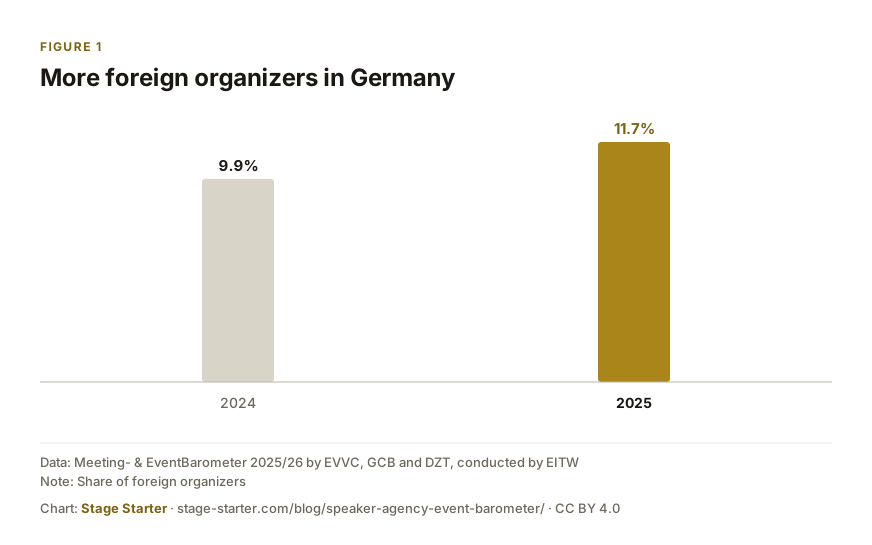
There is also a change among the organizers. According to the barometer, 88.3 percent of all organizing bodies come from Germany, and the share of foreign organizers rose to 11.7 percent in 2025 from 9.9 percent the year before. Among their countries of origin, Austria leads ahead of the United Kingdom and the USA, and Switzerland and the Netherlands follow in fourth and fifth place respectively. Companies form the most important organizer group at 52.5 percent. On sentiment, the release states that 87 percent of organizers rate the event situation as (very) good, while 61 percent of venue providers rate their bookings over the course of the year the same way.
A speaker agency for experts handles research, abstract and submission
A speaker agency for experts is a service provider that gets specialists onto conference stages by researching suitable conferences and writing abstracts, which it submits to the program committees in the expert's name. A speaker bureau is different: it places well-known speakers with organizers for a fee and needs a finished profile to do so. Anyone who first wants to reach the stage looks for the first kind, and how the two models differ in daily practice is described in our article Speaker agency or speaker directory.
For this work, the market the barometer describes is the raw material. Each of the 2.02 million events has an organizer who has to fill a program, and at trade conferences that runs through a call for papers. A call for papers is a conference's public invitation through which speakers apply for a place in the program with an abstract, and how the process is structured is explained in What is a call for papers. The agency follows these invitations and keeps to the deadlines so that the abstract is ready in time and fits the theme of the conference in question.
More audience per event: what the barometer means for speakers
An average can be calculated from the published figures. The press release does not give it itself. Dividing 395.1 million attendances by 2.02 million events gives around 196 attendances per event, and for 2024 the figure is around 187 with the same number of events. This is an average across all sizes and types of event, from the small seminar to the trade fair, in which the differences between formats even out, and it is therefore a guide to the market that says nothing about individual conferences.
For you as a speaker, this leads to an assumption you can test yourself: if the audience per event grows without new program slots appearing, a single slot becomes more valuable, and program committees can choose more selectively among the submissions. The barometer evidences the audience growth and the constant number of events, while the conclusion about selection is our own interpretation, which you can check against your own experience with program committees. It argues for tailoring every abstract to the program of the individual conference.
When a speaker agency pays off for conference talks
Whether a speaker agency is worth it depends on how many talks you want to give in a year, and the calculation is simple. Our founder Marin Niehues started out below 2 percent with his submissions and now reaches around 10 percent, and Sessionize listed him as Most Active Speaker in 2024 and 2025. Assume you want to give six talks a year and also reach around 10 percent, then you need around 60 submissions. If you allow two hours per submission for researching the conference and tailoring the abstract, including the form and the follow-up, you arrive at 120 hours, three full working weeks.
For one talk a year the calculation is smaller. Around ten submissions and twenty hours fit into your own calendar, and because you only have to watch a few conferences for a single talk a year, approaching an organizer directly is often sufficient, as long as your topic fits its program. How the effort of the two routes compares is covered in How to get on a conference stage. The two hours per submission are an assumption, and you can repeat the calculation with your own figure.
How to find a speaker agency that suits experts on trade stages
Five questions help when choosing, and you can put them to any agency:
- Who does the agency work for: does it submit for you in your name, or does it place well-known speakers with organizers?
- Which figures does it disclose: an agency that states its acceptance rate can be checked against it, while a plain list of stage names offers no such yardstick.
- On the abstract: a text written afresh for each conference has better chances than a template sent to every organizer.
- What you approve: you should see every submission beforehand and confirm every acceptance yourself.
- Which languages it covers: with 11.7 percent foreign organizers, the part of the market in which abstracts in English are in demand is growing.
An overview of providers and models is given in the article Speaker agencies in Germany.
International organizers: abstracts in English belong in your planning
The rise in the share of foreign organizers from 9.9 to 11.7 percent is the barometer figure that bears most directly on the work on your abstract, because it shows that the circle of program committees you can submit to is widening beyond the national border, even if a share of just over a tenth of the market remains modest. Austria leads the countries of origin of the foreign organizers, and anyone submitting to an organizer outside the German-speaking region will, as a rule, write the abstract in English. If you have already worked out your topic in German, you write an abstract with the same evidence and a title that works in English. What matters here is covered in Writing a conference abstract in English.
Figure 1
More foreign organizers in Germany
Source: Meeting- & EventBarometer 2025/26 by EVVC, GCB and DZT, conducted by EITW
Note: Share of foreign organizers
Frequently asked questions
What is a speaker agency for experts?
A speaker agency for experts researches suitable trade conferences and writes abstracts, which it submits to the organizers in the expert's name. It differs from a speaker bureau, which places well-known speakers with organizers for a fee. The aim is for the expert to appear in the program of a conference.
How many events were there in Germany in 2025?
According to the Meeting & EventBarometer 2025/26 of May 6, 2026, there were 2.02 million in-person events, the same number as in 2024, with in-person attendances up 4.6 percent to 395.1 million.
Is a speaker agency worth it if I want to give one talk a year?
For one talk a year at an acceptance rate of around 10 percent, about ten submissions are needed, which you can manage yourself with modest effort. For six or more talks, the need rises to around 60 submissions, and an agency then saves several working weeks.
Are foreign organizers relevant for speakers from Germany?
Yes, their share rose to 11.7 percent in 2025 from 9.9 percent the year before, according to the barometer. Austria leads the countries of origin, and for submissions to organizers outside the German-speaking region you need an English abstract tailored to the conference in question.
How do I recognize a trustworthy speaker agency?
A trustworthy speaker agency submits in your name and discloses its figures, and you approve every submission beforehand. It states its acceptance rate and the conferences at which its clients have spoken.

Marin Niehues is a management consultant and international speaker. With Niehues Consulting he works with organisations from scale-ups to DAX 40 corporations, and on stage he has spoken at more than 45 conferences in 23 countries.
All articles by Marin Niehues