

Speaking opportunities: where experts find stages in the US
Speaking opportunities in the US come in eight types of stage, from the industry conference and the professional association to the podcast, and their effect on winning clients varies widely. In Stage Starter's analysis of 2,415 conferences that publicly invite speakers for 2026, 391 are in the US, more than in any other country. Large US conferences often close submissions three and a half to seven months before the event: the Society for Human Resource Management (SHRM) closed its call for Talent 2027 on September 18, 2026, for a conference that begins on April 11, 2027. Regular sessions are usually rewarded with a free pass, while some associations also pay for flights and hotel. For experts who sell their knowledge, this means choosing stages by audience and using small formats to collect the proof that large ones ask for.
Speaking opportunities in the US come in eight types of stage, from the industry conference and the professional association to the podcast, and their effect on winning clients varies widely. In Stage Starter's analysis of 2,415 conferences that publicly invite speakers for 2026, 391 are in the US, more than in any other country. Large US conferences often close submissions three and a half to seven months before the event: the Society for Human Resource Management (SHRM) closed its call for Talent 2027 on September 18, 2026, for a conference that begins on April 11, 2027. Regular sessions are usually rewarded with a free pass, while some associations also pay for flights and hotel. For experts who sell their knowledge, this means choosing stages by audience and using small formats to collect the proof that large ones ask for.
Speaking opportunities in the US: eight types of stage
Speaking opportunities are all the formats in which an organizer gives you time in front of an audience you would not otherwise reach. In the US you can tell eight types apart, and they differ as much in effort and audience as in lead time.
The classic stage for experts is the industry conference with an open call for papers, a public invitation through which a conference collects session proposals from which a program committee then selects its program. Whoever speaks there has been chosen. Conferences run by professional associations form a market of their own in the US, because they bring together the people who make decisions in an industry. SHRM, for example, lists deadlines for several events a year on its call for presentations page and requires every topic to align with its competency model, the SHRM BASK.
Trade shows with a conference program, such as CES by the Consumer Technology Association, draw a large audience but, according to the organizer, offer only limited speaking slots. Meetups and user groups are recurring evenings of a professional community in one city, where members give talks to one another. Podcasts reach a large audience without travel: according to The Infinite Dial 2026 by Edison Research at SSRS, released on March 13, 2026, 58 percent of Americans aged 12 and older consume podcasts monthly, an estimated 167 million people, and 45 percent do so weekly. Webinars hosted by associations or partners come next, followed by corporate events such as customer days and partner summits. The eighth type is the panel, where you discuss a topic with other practitioners under the guidance of a moderator.
Where to find speaking opportunities in the US
Most industry conferences collect proposals through submission platforms. On its homepage, Sessionize reports more than 12,000 events that have used the platform and over 300,000 speakers who apply through it. For association conferences, the association's own website is the first place to look, where the call usually appears as "Call for Presentations" or "Call for Proposals". At trade shows you find it with the conference program, at CES as the "Call for Speakers".
The search works best as a routine. You list the associations your clients belong to and check their event pages once a quarter. You also look at last year's program of every conference you consider, because it shows whom the organizer puts on stage, and you follow the organizers on LinkedIn so that you see new calls when they are announced. How US conferences compare with European ones and what applies to travel and fees is covered in Speaking at conferences in the US.
How to prioritize speaking opportunities by impact on winning clients
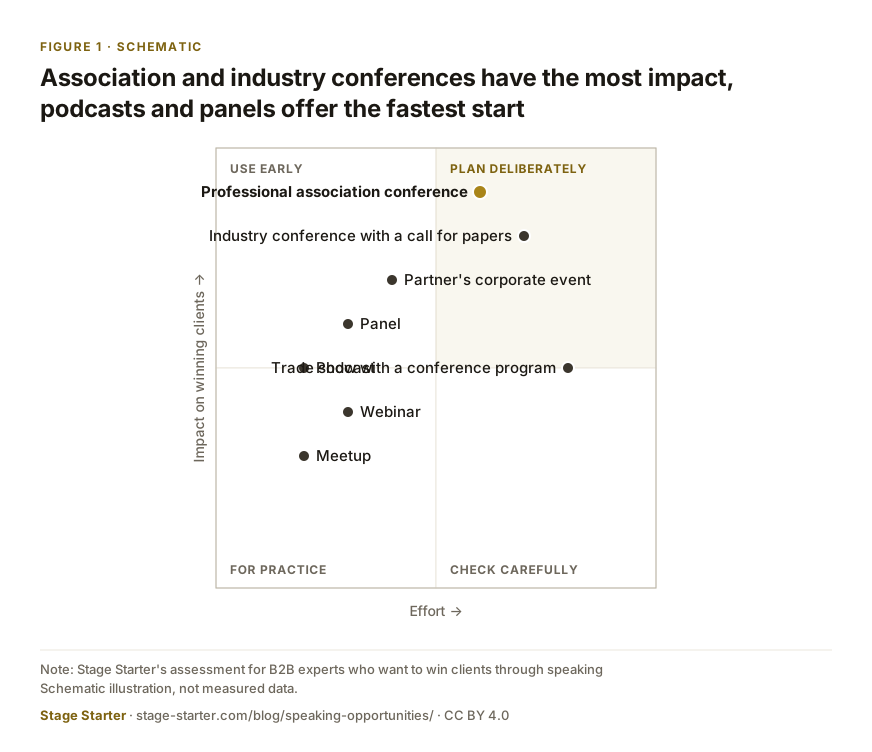
A stage helps you win clients when decision-makers from your target group sit in the room, when there is time for a conversation after the session and when your name can be found afterwards in the program or a recording, so that someone who heard you can still reach out weeks later when a project comes up. The matrix places the eight stages according to our assessment for B2B experts. The values are a schematic, and your own industry can shift individual points, for instance if your clients spend most of their time at trade shows.
Figure 1 Schematic
Association and industry conferences have the most impact, podcasts and panels offer the fastest start
Note: Stage Starter's assessment for B2B experts who want to win clients through speaking
Schematic illustration, not measured data.
Data and download
Style
Embed
Data as table
| Name | Effort | Impact on winning clients |
|---|---|---|
| Professional association conference | 6 | 9 |
| Industry conference with a call for papers | 7 | 8 |
| Partner's corporate event | 4 | 7 |
| Panel | 3 | 6 |
| Podcast | 2 | 5 |
| Webinar | 3 | 4 |
| Meetup | 2 | 3 |
| Trade show with a conference program | 8 | 5 |
Chart and data: Stage Starter, CC BY 4.0. Free to use with attribution and a link.
A simple calculation shows why the make-up of an audience matters more than its size. Suppose 200 people attend a webinar and 5 percent of them belong to your target group: you reach ten potential clients. Suppose 80 people sit in a breakout session at an association conference and 30 percent belong to your target group: you reach 24, and you can talk to them in person afterwards. Now assume, purely as an example, that one engagement from such a room is worth $30,000 to your business. A single new client from the session then pays for several trips, while the webinar has to produce the same client from fewer than half as many prospects.
The trade show sits in the lower right of the matrix because, in our assessment, travel and preparation take a lot of effort and visitors moving between halls and meetings have little time for a conversation after a session. It pays off when your clients exhibit there anyway.
Lead time: when to apply for speaking opportunities
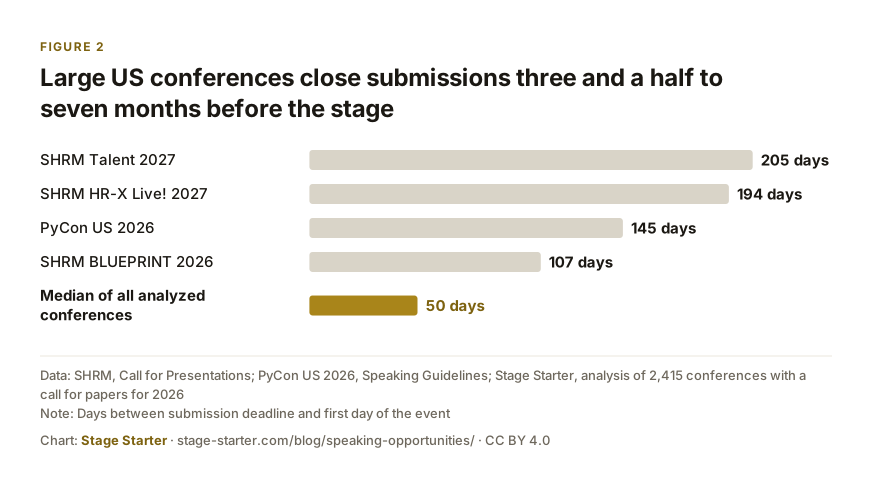
In Stage Starter's analysis, the submission deadline closes a median of 50 days before the conference starts. Large US conferences plan much earlier, as their official deadlines show.
Figure 2
Large US conferences close submissions three and a half to seven months before the stage
Source: SHRM, Call for Presentations; PyCon US 2026, Speaking Guidelines; Stage Starter, analysis of 2,415 conferences with a call for papers for 2026
Note: Days between submission deadline and first day of the event
Data and download
Style
Embed
Data as table
| Label | Value (days) |
|---|---|
| SHRM Talent 2027 | 205 days |
| SHRM HR-X Live! 2027 | 194 days |
| PyCon US 2026 | 145 days |
| SHRM BLUEPRINT 2026 | 107 days |
| Median of all analyzed conferences | 50 days |
Chart: Stage Starter, CC BY 4.0. Data: SHRM, Call for Presentations; PyCon US 2026, Speaking Guidelines; Stage Starter, analysis of 2,415 conferences with a call for papers for 2026; the source's terms apply.
SHRM closed submissions for Talent 2027 in the Denver metro area on September 18, 2026, and the conference runs from April 11 to 14, 2027. For HR-X Live! in Chicago, which runs from June 27 to 30, 2027, SHRM accepts proposals until December 15, 2026. PyCon US, the Python community's conference, accepted proposals from October 31 to December 19, 2025, and took place in Long Beach, California, from May 13 to 19, 2026. At SXSW in Austin, public voting on PanelPicker proposals ran, according to SXSW, from August 5 to 23, 2026, for a festival held March 15 to 21, 2027, with final sessions chosen by the public, the SXSW Advisory Board and SXSW staff. If you want to speak in spring 2027, you submit in fall 2026, and the first deadlines for summer 2027 are open now.
What speaking opportunities in the US pay
Regular sessions at industry conferences in the US are usually given without a fee. What an organizer covers instead is set out in the terms of its call, which you read before submitting because these benefits differ widely from one conference to the next. CES states on its speaker page that confirmed speakers receive a complimentary premium pass and that CES does not pay speakers to take part in the conference program or to travel to the show. SHRM offers more in its speaker benefits sheet: speakers, including co-presenters, receive complimentary registration, round-trip economy airfare and a hotel stay for the night before and the night of the presentation, plus an optional $400 stipend after the conference for additional expenses. According to its guidelines, PyCon US compensates tutorial instructors and offers speakers travel grants based on financial need.
Fees are paid mainly at corporate events and for keynotes. The models are explained in How do speakers get paid?. If a US organizer offers you a fee as a non-US speaker, you clarify immigration status and tax withholding before you accept, because separate rules apply to both.
From your first small talk to the main stage
The path to a large stage runs through proof. A program committee checks whether you can deliver a topic in front of an audience, and small formats give you that evidence.
- Start with podcasts and panels, because they need little preparation and leave you with a recording.
- Test your talk in front of a professional audience at meetups and in webinars, as described in small stages as a starting point.
- Use those recordings and a clear session description to submit to association and industry conferences.
- Accepted sessions lead to invitations for keynotes and corporate events.
Because large associations close their calls three and a half to seven months ahead, half a year easily passes between submission and stage. You therefore submit while the small appearances are still under way.
The role of a speaker agency
A speaker agency for experts takes on the work between the idea and the stage. Stage Starter develops your talk and finds the right conferences among more than 23,000 events we track. We write the abstracts, submit in your name and follow up with the organizers. In a representative sample of our submissions for clients, 2024 to 2026, we reach up to 19 percent acceptances per conference, against a market norm of 5 percent at most, and around 7 percent per abstract. Across 20 conferences, a rate of 19 percent works out to a better than 98 percent chance of at least one acceptance, compared with around 64 percent at 5 percent. The program committee always makes the final selection.
Frequently asked questions
Where can I find speaking opportunities in the US?
You find them on submission platforms such as Sessionize, on the websites of professional associations under "Call for Presentations" and at trade shows in the conference program. In Stage Starter's analysis of 2,415 conferences with a public call for papers for 2026, 391 are in the US.
How far in advance should I apply to speak at a US conference?
Large US conferences often close submissions three and a half to seven months before the event, SHRM Talent 2027 for example 205 days ahead. Across all conferences in Stage Starter's analysis, the median is 50 days.
Do US conferences pay speakers?
Regular speakers usually receive a free pass and no fee, and CES states that it pays neither a fee nor travel. Some associations cover more: SHRM pays for economy airfare and two hotel nights and offers an optional $400 stipend.
Which type of stage brings in the most clients?
The most clients come from a stage where decision-makers from your target group sit in the room and there is time to talk after the session. For B2B experts, that usually means professional association conferences and industry conferences.
Are podcasts a good way to start speaking?
Podcasts are a good way to start because they reach a large audience without travel and give you a recording for later submissions. According to The Infinite Dial 2026, 58 percent of Americans aged 12 and older consume podcasts monthly.

Marin Niehues is a management consultant and international speaker. With Niehues Consulting he works with organisations from scale-ups to DAX 40 corporations, and on stage he has spoken at more than 45 conferences in 23 countries.
All articles by Marin Niehues