


What is a professional conference?
A professional conference is a one-day or multi-day event for a professional audience, built around a curated program of talks. An organizer selects the speakers, sorts their sessions into tracks and sells tickets for them. This curation sets it apart from the trade fair, where exhibitors buy stand space, and from the barcamp, whose program the participants set themselves on the morning. If you want to classify a specific event, start with a single question: who is paying for this? The answer tells you about the audience, the selection process and the fee logic, and therefore whether a talk makes business sense for you.
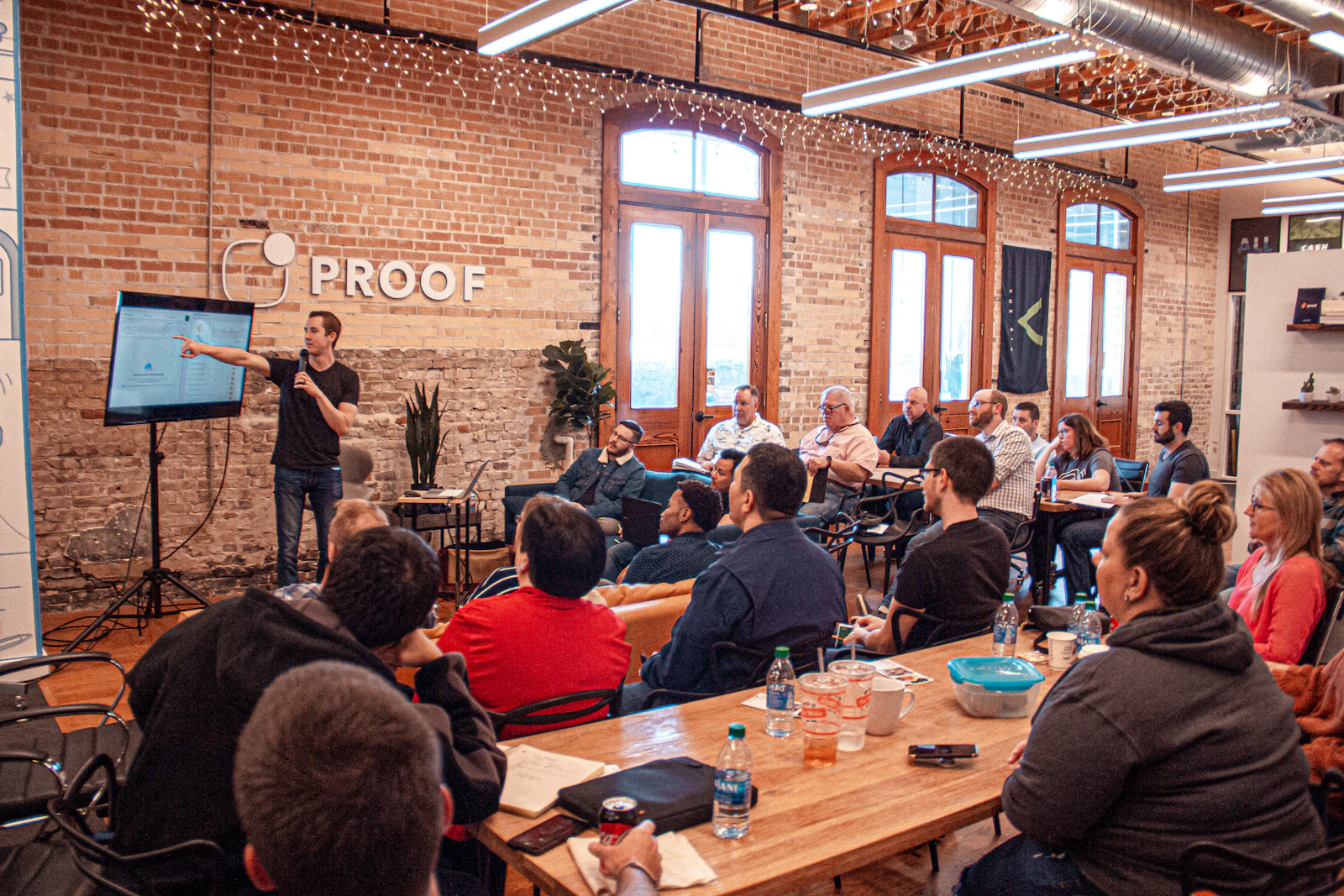
A professional conference is a one-day or multi-day event for a professional audience, built around a curated program of talks. An organizer selects the speakers, sorts their sessions into tracks and sells tickets for them. This curation sets it apart from the trade fair, where exhibitors buy stand space, and from the barcamp, whose program the participants set themselves on the morning. If you want to classify a specific event, start with a single question: who is paying for this? The answer tells you about the audience, the selection process and the fee logic, and therefore whether a talk makes business sense for you.
What makes a professional conference?
A professional conference is defined by a selected program, a professional audience and a fixed rhythm of sessions and breaks. Someone has put the program together, usually through an open call for papers, through direct invitations or both. The audience attends for professional reasons and wants to develop their expertise. The structure consists of fixed time slots in which sessions run in parallel in several rooms, broken up by breaks in which participants talk to each other. Most professional conferences last one or two days, while large industry gatherings can run for three to five.
The market they take place in is large: the Meeting- & EventBarometer counts around 2.02 million in-person events with 378 million attendees in Germany in 2024, and professional conferences form one segment of it next to seminars, meetings and corporate events.
The program is sorted into tracks, meaning thematic strands that take place at the same time in different rooms. If you submit as a speaker, you choose one of these tracks and thereby help determine who sits in your session. On the main stage the keynote, the opening or headline talk, runs without competition, while for most of the day participants decide for themselves which room to go to.
The time between sessions is part of the product. The conference sells coffee breaks and lunch just as it sells sponsor space and the evening program. For anyone who wants to win clients through the stage, the commercially most interesting part of the day happens in these breaks, because that is when the people who sat side by side in the dark during the sessions can be approached.
How does a professional conference differ from a trade fair, congress, symposium or barcamp?
The formats differ in what sits at the center and who sets the program: at a professional conference it is the curated program of talks, at a trade fair the exhibition floor, at a barcamp the participants' vote.
At a trade fair the stands are the focus. Vendors buy space to show their products, and the supporting program on the stages serves to draw visitors onto the floor. Anyone speaking there has often obtained the slot through a sponsorship, and the audience knows it.
A barcamp reverses the curation. There is no program fixed in advance; instead, participants propose sessions on the morning and vote on them. Access to the stage is almost free, and preparation and commitment are correspondingly lower. As a practice space it is useful, but it counts for little in a later submission, because nobody selected you. A meetup is the evening format of a local community, usually with one or two talks, thirty to fifty people and no ticket price.
The congress is the event of an association or a professional society, usually larger and more formal, with committees, awards and professional policy contributions alongside the specialist program. A symposium concentrates on a single topic, brings together a small number of invited experts and comes from academia and medicine. The corporate event, meaning a customer day, partner summit or company trade show, is hosted by a single company for its own customers, partners or staff.
In practice, these differences decide whether there is any route onto the stage at all, who sits in the room and whether your talk is read there as an achievement or as a bought advertising slot.
What types of professional conference are there?
Professional conferences can be sorted into three basic types by how they are financed: community-driven, commercially run and company-owned. This classification tells you more than size or level of fame.
Community-driven conferences are organized by a community, a user group, an association or an open-source project. The money comes from tickets and membership fees, plus sponsorship. A volunteer program committee selects the sessions, and the first review round is often anonymous, meaning without looking at bio or list of references. That this form helps newcomers is documented: in a controlled experiment at a computer science conference, reviewers who could see the names rated submissions by famous authors favorably significantly more often than their colleagues in the anonymous process. The implicit contract is contribution instead of payment, and fees are rare.
Commercially run conferences belong to a company that runs events as a business model. The budget comes from ticket sales and sponsorship packages, and the speakers are part of the product being sold. An internal program team selects, often with external advisers and with a commercial brief behind them. Quality of content is the prerequisite here, and on top of that comes the question of whether a session helps the organizer sell tickets.
Company-owned events are financed by the hosting company from its marketing budget. There is usually no open call at all; speakers get into the program through relationships and recommendations. Fees are common here. The audience is experienced and business-minded and already belongs to the organizer's customer base.
Fees, travel costs and the special case of pay to speak
There are five common forms of payment between you and an organizer: pay to speak, no payment at all, partial coverage of travel costs, full coverage of travel costs and the fee. They differ in who pays whom and in which direction an obligation arises as a result.
The most revealing case is the first. With pay to speak you buy your stage slot through a sponsorship package or a "thought leadership" tier, and you can easily pay €10,000 or more for a single speaking slot. Such offers are worded to look like an invitation until a payment demand appears in the second email, and sponsored sessions are often not labeled as such in the program. For experts who want to win clients through their expertise, it is the weakest route, because the audience reads a bought slot as advertising as soon as it recognizes one. What you can do instead is described in the article Do I have to pay for the stage?.
At the other end is full coverage of travel costs. If a conference pays for flights and hotel, it has a budget for its program and usually a professional program team. Fees are paid mainly by corporate events and by conferences that specifically invite keynote speakers, and they assume that your name alone justifies a budget line. For client acquisition, a single engagement won from a talk outweighs any fee anyway.
Attendance figures, ticket prices, program structure
The last line is the most important. A conference with five thousand visitors whose parallel tracks bring forty people per room is, for you, an event in front of forty listeners. The figure on the homepage is part of the organizer's marketing, and your planning goes by the room. How many professional conferences there are in the first place is put into context in the article How many professional conferences are there in Germany?.
Which professional conference suits you?
The professional conference that suits you is the one where your buyers sit, and that is rarely the best known. For business, who sits in the room counts for more than the number of heads. A small session with sixty managing directors and division heads opens up more than a main stage in front of five hundred career starters, because managing directors can approve a commission after your talk.
That is why a conference's sponsor list is more revealing than its reach figures. Which companies pay to stand in front of this audience, what roles the speakers of previous years held and how high the ticket price is: these details paint a far more reliable picture of the audience than any self-description by the organizer. Between two sessions there are ten minutes or three quarters of an hour, and that gap decides whether three rushed conversations follow your talk or an afternoon full of connections.
This research is laborious, because it runs separately for each event and has to be done again year after year. Stage Starter takes this work off your hands: we find the right calls, map the conferences in your field, write the submission and submit it. The collaboration starts from $999 net per month. The whole route from topic to stage is described in the guide to becoming a speaker.
Frequently asked questions
What is the difference between a conference, a congress and a symposium?
A conference and a congress both describe a professional gathering with a program of talks, and congress is usually the term for the large events of associations and professional societies, often with a more formal setting. A symposium is narrower, concentrates on a single topic and brings together a small number of invited experts. For your assessment, what counts beyond the name is who finances the event and who selects the speakers.
What other terms are used for a professional conference?
In English a professional conference is usually just called a "conference", more precisely an "industry conference" or "professional conference", less often a "trade conference". In German it is a "Fachkonferenz" or "Tagung", while a trade fair is a "Messe". If you submit internationally, look for "call for papers" or "call for speakers".
Is a convention the same as a conference?
In everyday usage the two overlap heavily. In the United States, "convention" often refers to the large annual meeting of an association, with a trade floor and a professional policy element next to the specialist program.
How long does a professional conference last?
Most professional conferences last one or two days, and large industry gatherings three to five. A single talk in the program usually lasts 20 to 45 minutes. As a speaker, a one-day talk in another city means two travel days.
How can I tell whether a conference is reputable?
A reputable conference publishes the program of previous years with the names and roles of past speakers, selects transparently through an open call or a named program team, and states ticket prices and organizer openly. Recordings of previous talks and a sponsor list with well-known companies are further good signs. If a slot can only be obtained against payment, it is an advertising slot.
Do I have to pay admission if I speak at a conference?
As a speaker you get free access to the entire event. Each conference handles travel and accommodation separately, and community conferences cover them less often than commercial ones.
How do I find professional conferences in my sector?
You find professional conferences in your sector through associations, submission platforms, the programs of previous years and the speaker lists of events you already know. The interesting ones often sit just next to your own field, at events whose audience has a problem your expertise addresses. How to run this search systematically is shown in the article Finding conferences.
If you want to know which conferences in your field are an option for you, we can work that out in an initial consultation.

Marin Niehues is a management consultant and international speaker. With Niehues Consulting he works with organisations from scale-ups to DAX 40 corporations, and on stage he has spoken at more than 45 conferences in 23 countries.
All articles by Marin Niehues