


Write a conference abstract: what DMEA 2027 scores most
To write a conference abstract is to show a program committee, in 3,000 to 3,500 characters, that your talk meets the published criteria. DMEA 2027, whose trade fair runs from 13.04.2027 to 15.04.2027, opens its call for papers on July 1, 2026 and accepts abstracts until September 22, 2026, to be assessed against five published criteria weighted between 15 and 30 percent. According to the “Become a Speaker” page of DMEA, the abstract also follows six prescribed sections, from the research question to the outlook. Because the weighting is public, you can score your own abstract before you submit it, and the five criteria make a useful checklist for any other call for papers.
To write a conference abstract is to show a program committee, in 3,000 to 3,500 characters, that your talk meets the published criteria. DMEA 2027, whose trade fair runs from 13.04.2027 to 15.04.2027, opens its call for papers on July 1, 2026 and accepts abstracts until September 22, 2026, to be assessed against five published criteria weighted between 15 and 30 percent. According to the “Become a Speaker” page of DMEA, the abstract also follows six prescribed sections, from the research question to the outlook. Because the weighting is public, you can score your own abstract before you submit it, and the five criteria make a useful checklist for any other call for papers.
DMEA 2027: call for papers from July to September 2026
On its “Become a Speaker” page, DMEA announces that the call for papers for DMEA 2027 begins on July 1, 2026 and ends on September 22, 2026, which leaves 83 days for submission, just under twelve weeks. The fair itself takes place from 13.04.2027 to 15.04.2027. The page links the Bundesverband Gesundheits-IT (bvitg), the German health IT association, as organizer, and the copyright notice names Messe München GmbH.
A call for papers is an organizer’s public invitation to submit talk proposals by a deadline. How the process works in general is explained in our article What is a call for papers?. DMEA distinguishes four formats. A session in the conference program lasts up to 60 minutes and usually consists of three talks of 10 to 15 minutes each, with a maximum of two presenters per talk. Seminars last up to 180 minutes with three talks of 15 to 30 minutes. A panel runs for up to 45 minutes with a moderator and up to four panellists, and the wild card is meant for topics that fit neither a theme nor a standard format, where the program team or the jury decides on the format.
Participation is free of charge according to DMEA, and the conference program is held in German and English. The page advises against submitting the same talk in several categories. Session chairs select the talks, and session coordinators handle the final planning of the sessions.
Write a conference abstract: the six sections DMEA prescribes
An abstract is the written summary of a talk on which a program committee decides whether it enters the program. What belongs in one is described in our article What is a conference abstract?. DMEA prescribes the order of the sections:
- Title
- Introduction, motivation and research question
- Materials, methods and tools
- Description of the solution
- Results, experiences and lessons learned
- Discussion and outlook
In our assessment this structure follows the course of a case study, which begins with the question and leads through the method to the result. If you usually open a talk with the solution, you have to rethink here, because the committee expects the solution only in the fourth section. The length requirement is 3,000 to 3,500 characters including spaces. At roughly seven characters per word, an estimate for running text, that comes to about 430 to 500 words. If we assume the title has ten words, that leaves on average about 85 to 100 words for each of the five text sections, which is enough for one statement with a figure and a piece of evidence and leaves little room for detours.
The five DMEA assessment criteria and their weighting
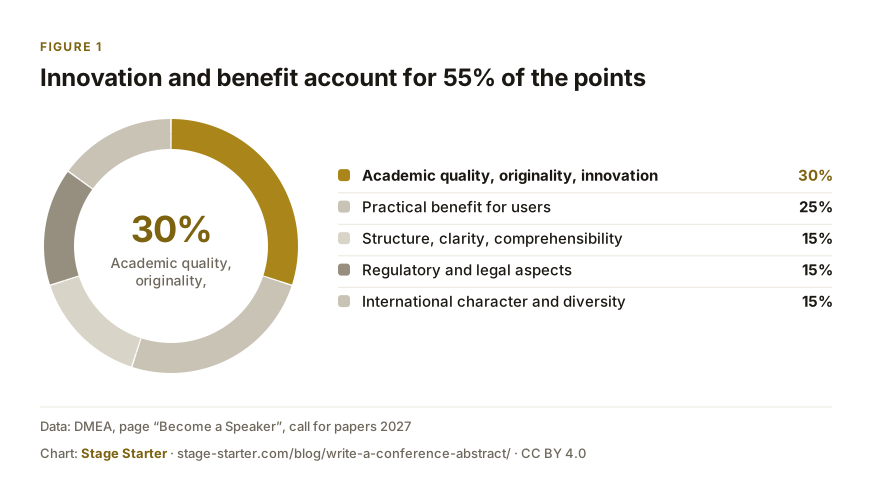
DMEA names five criteria and gives each a fixed weight.
Figure 1
Innovation and benefit account for 55% of the points
Source: DMEA, page “Become a Speaker”, call for papers 2027
Data and download
Style
Embed
Data as table
| Part | Value | Share |
|---|---|---|
| Academic quality, originality, innovation | 30 | 30% |
| Practical benefit for users | 25 | 25% |
| Structure, clarity, comprehensibility | 15 | 15% |
| Regulatory and legal aspects | 15 | 15% |
| International character and diversity | 15 | 15% |
Chart: Stage Starter, CC BY 4.0. Data: DMEA, page “Become a Speaker”, call for papers 2027; the source's terms apply.
The weights add up to 100 percent. The two content criteria, innovation and benefit, account for 55 percent of the points, and the remaining 45 percent belong to the three criteria clarity, regulation and international reach. Careful work on the text can influence them to a large extent.
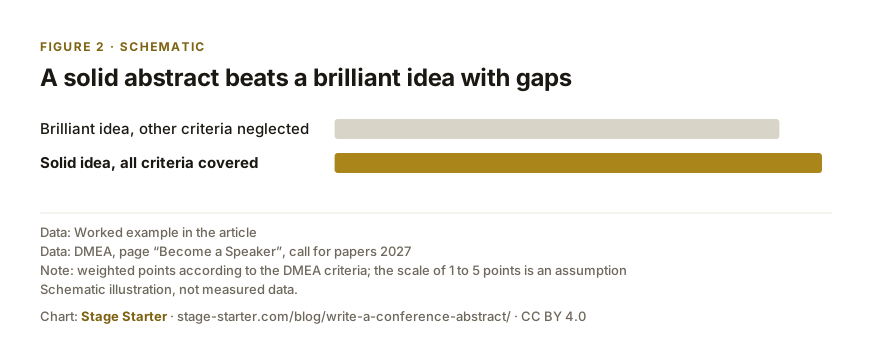
A worked example shows the difference. Suppose an assessor awards 1 to 5 points per criterion, where DMEA names no scale and the assumption is ours. An abstract with a brilliant idea earns 5 points for innovation and benefit but neglects the other three criteria and earns 2 points on each, which gives 0.55 times 5 plus 0.45 times 2 when weighted, or 3.65. An abstract with a solid idea earns 4 points on the content criteria and also 4 points on the other three, and it reaches 4.0. It comes out ahead although its idea was rated lower. For speakers it follows that an abstract that answers all five criteria has a good chance against a cleverer but incomplete proposal.
Figure 2 Schematic
A solid abstract beats a brilliant idea with gaps
Source: Worked example in the article
Source: DMEA, page “Become a Speaker”, call for papers 2027
Note: weighted points according to the DMEA criteria; the scale of 1 to 5 points is an assumption
Schematic illustration, not measured data.
How to write your abstract to the criteria
The criteria translate into working steps that apply beyond DMEA, because every program committee assesses against criteria even if not every organizer publishes them. Which ones are typical is covered in our article What a program committee looks for in an abstract.
- Use the criteria as a grid: Write the five criteria and their weights above an empty document and assign each paragraph the criterion it serves. A sentence that serves no criterion is cut.
- Start with the results section: Innovation and benefit together bring 55 percent of the points, and both show in the results. Take a figure or a finding from one of your own projects and describe what the user can do differently afterwards.
- Address regulation and international reach explicitly: One or two sentences on the legal questions of your topic and on whether the solution works in other countries take little space and together cover 30 percent of the assessment. A co-presenter from another country can support the second point, because up to two presenters per talk are allowed.
- Write the title last: It comes first and shapes the impression the committee takes of the rest. How a title should look is shown in our article Your talk title decides whether your abstract gets read.
- Count the characters: Cut to 3,000 to 3,500 characters including spaces and check the number in your word processor before you submit.
- Have it read against a scoring grid: Give the abstract to two colleagues and ask them to rate each criterion from 1 to 5. Where both score low, you revise that section.
Plan the deadline backwards, because starting on July 1, 2026 leaves about twelve weeks until September 22, 2026, and the abstract benefits from a week of distance before the final read-through. When other conferences collect their talk proposals is covered in our article Call for papers deadlines: when most conferences collect talk proposals.
Frequently asked questions
How do I write a conference abstract that gets accepted?
You write the abstract along the organizer’s published criteria. For DMEA 2027 these are six sections from the research question to the outlook in 3,000 to 3,500 characters. Begin with the results from your practice, because that is where innovation and benefit are decided, with 55 percent of the points between them.
How long may an abstract for DMEA 2027 be?
According to DMEA, an abstract must be between 3,000 and 3,500 characters long, spaces included, which at roughly seven characters per word corresponds to about 430 to 500 words. If you fall below or exceed that range, you break the rule on the page.
Until when can I apply as a speaker for DMEA 2027?
The call for papers of DMEA 2027 runs from 01.07.2026 to 22.09.2026 and leads to the fair of 13.04.2027 to 15.04.2027, with submission free of charge according to DMEA. The conference program is held in German and English.
What criteria does DMEA use to assess an abstract?
DMEA assesses against five criteria with fixed weights. Academic quality and level of innovation count for 30 percent and practical benefit for 25 percent, while the clarity of the abstract, regulatory aspects and the contribution to the international character of the session receive 15 percent each.
How long is a talk in the DMEA conference program?
A session in the conference program lasts up to 60 minutes and usually consists of three talks of 10 to 15 minutes each. A maximum of two presenters per talk is allowed. Seminars last up to 180 minutes, and a panel up to 45 minutes.

Marin Niehues is a management consultant and international speaker. With Niehues Consulting he works with organisations from scale-ups to DAX 40 corporations, and on stage he has spoken at more than 45 conferences in 23 countries.
All articles by Marin Niehues