

What happens after the conference, and where the business comes from
After the conference, the business is made in the first two weeks, when you follow up on the most important conversations within a few days and with concrete details. Two clocks run during this time: your memory of the conversations fades within days, and after a few weeks the event's material becomes hard to get hold of. The visible conversations take place in a quarter of an hour at the edge of the stage, and the people with budget are rarely standing there. Whatever comes after that is done by nobody but you, because it has neither an appointment nor a client.
After the conference, the business is made in the first two weeks, when you follow up on the most important conversations within a few days and with concrete details. Two clocks run during this time: your memory of the conversations fades within days, and after a few weeks the event's material becomes hard to get hold of. The visible conversations take place in a quarter of an hour at the edge of the stage, and the people with budget are rarely standing there. Whatever comes after that is done by nobody but you, because it has neither an appointment nor a client.
Who comes up to the stage after the talk?
After the talk a small group comes up to the stage, while the larger part of the room heads to the next session. The group at the front puts talking to you ahead of the next session, the coffee or the emails that have been piling up since the morning.
The conversations that follow run in three patterns. In the first, someone tells you the session was useful, perhaps names the point that stuck, and wants nothing else. In the second comes a question that would have been too specific for the Q&A, and behind a very narrow question there is usually a problem the person is working on right now. In the third, someone describes their situation, tells you what is not working in their company and checks whether you understand it.
This quarter of an hour allows no depth. Anyone who sinks into the first conversation loses the four people waiting behind, who move on after two minutes. What happens at the edge of the stage is therefore almost always an appointment. The article on the course of a conference from the speaker's perspective places this window in the rest of the day.
How do I reach the decision-makers who stayed in their seats?
You reach decision-makers who did not come forward in the informal spots of the conference or in the days afterwards, with a message that refers to your session. Senior people with budget often do not come to the front after a session at all. One has to get to the next meeting, another wants to think before talking, and some prefer to be introduced rather than join a cluster in front of the stage.
They were visible all the same. They sat near the front, asked a considered question in the Q&A, are greeted by name between sessions or appear in the program themselves, as a sponsor or on the advisory board. You meet them in the coffee queue, at the evening reception or at breakfast the next morning, when no program sets the pace. After the conference, three routes lead to them: an introduction by the organizer or a mutual contact, a connection request that refers to their question from the room, and the offer to send the recording or a document from the session.
Anyone who compiles their contact list in the evening from business cards works with the group that came forward. The other group does not appear on that list, although it sat in the same room. The article on how the audience at industry conferences works sorts these roles in detail.
How quickly do I need to get in touch after the conference?
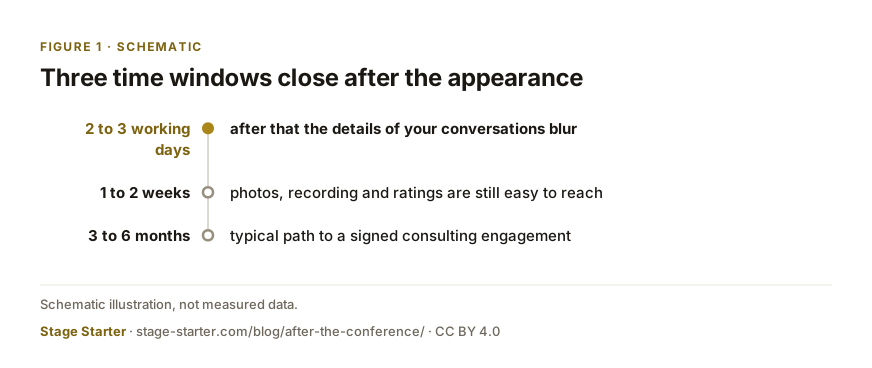
Get in touch with your most important contacts within two to three working days, while you still remember the details of the conversation, and follow with a second contact after around two weeks. By the evening of the conference day you have had a dozen conversations, watched two sessions and spoken with the organizer. Two days later, all that remains of a single conversation is the person, the topic in broad strokes and a feeling of whether it went well. Hermann Ebbinghaus already showed in his memory experiments that most forgetting happens in the first hours and days, and a replication study from 2015 confirmed his curve. Gone are the figure someone mentioned, the internal project name and the remark about the board that has to decide something in March.
These details are the material for a message someone replies to. Without them you write that it was nice to meet, and the recipient reads it as friendly mass mail that could have gone to anyone in the room. What belongs in a good first message is covered in the article on follow-up after the conference.
Figure 1 Schematic
Three time windows close after the appearance
Schematic illustration, not measured data.
Data and download
Style
Embed
Data as table
| Date | Event |
|---|---|
| 2 to 3 working days | after that the details of your conversations blur |
| 1 to 2 weeks | photos, recording and ratings are still easy to reach |
| 3 to 6 months | typical path to a signed consulting engagement |
Chart and data: Stage Starter, CC BY 4.0. Free to use with attribution and a link.
Why everyone gets the same message
A well-attended appearance typically leaves around five serious conversations, plus a few dozen connection requests and several business cards whose faces you can no longer place. Anyone who tries to write something personal to each of them works a whole evening and never reaches the three messages that matter. The obvious alternative is one template for everyone, and it reaches nobody.
The contacts from an event can therefore be sorted into three levels of relevance, from qualified conversations to good but open ones to loose encounters. The sorting creates an order: the top level is short and gets real work, and far less is needed for the two lower ones.
Behind this lies the question that decides the reply rate: what exactly should the other person say yes to? Someone who watched you work for forty minutes brings trust, but has known you for half a day. That is not enough for a large engagement, and a non-committal get-to-know-you call has too little reason behind it. Without an offer in between, with a clear result and a manageable price, the best contacts of an event stay stuck at this threshold.
What happens to the recording, photos and ratings?
The recording, photos and ratings are easiest to get in the first two weeks; after that they disappear into archives nobody retrieves them from. The official photos sit with the photographer for a few days. The recording is at hand the week after, because the organizer is sorting the material anyway, and the request for it goes to the organizer. Many conferences send the results of the attendee survey to speakers once, usually within the first two weeks.
For the conference these are loose ends, but for you they are the raw material that keeps an appearance working for months: the video on your own website, the photo of the full room and the feedback that shows which passage landed.
Why the return gets left behind in this particular week
The week after a conference is the worst week of the quarter for extra work. You were away for three days, your inbox is full, two engagements have been waiting for you, and the appearance feels done. The follow-up has no client and no deadline, and nobody notices when it does not happen. After two weeks a message is a cold start with greetings from a room the recipient vaguely remembers, and the head start the stage gave you is used up.
Submission, preparation, travel and the appearance cost several days, yet turning that effort into contacts takes only a few hours. Stage Starter takes on the part before the stage for you: we find the right calls, write the submission and submit it. That leaves you the hours for follow-up, in which contacts turn into commissions. A single commission from one talk is worth more than any fee, as the overview of speaker fees shows.
The work before the appearance has spectators, because the submission is accepted and a room applauds. The work afterwards happens in an inbox, on a Tuesday evening and without feedback. This asymmetry explains why so many consultants consider the stage a weak channel: they measure a result they never produced, because the chain between applause and commission breaks at a point nobody looks at.
How you can get onto the stages where your clients sit with an agency is something we can clarify in an initial consultation.
Frequently asked questions
When should I get in touch after a conference?
Within two to three working days, while the other person still has the conversation in mind. For the few contacts with a concrete concern, a message on the evening of the conference or the next day is worthwhile. A second contact follows after around two weeks.
What should I write in a follow-up email after a conference?
A good follow-up email picks up a detail from your conversation and proposes a concrete next step with a clear result. It is short enough to be read on a phone. An email without a detail from the conversation reads as mass mail and goes unanswered.
How do I reach decision-makers who did not approach me after the talk?
Through an introduction by the organizer or a mutual contact, through a connection request that refers to their question from the room, or through the offer to send the recording. At the conference itself, you meet them at the reception or at breakfast the next morning. The reference to the session gives the contact its reason.
What do I do with people who only connected with me?
With a connection and no conversation, the connection itself is already the result. It keeps you in view if you are visible there anyway. Anyone who writes something personal to each of these contacts uses up time that the few interesting conversations need.
How many clients does a conference talk bring?
An appearance typically brings around five serious conversations, two meetings from them, and one in three meetings turns into paid work. Across four to six appearances a year, this adds up to a reliable number of new engagements. The precondition is following up within the first two weeks.
How long does it take from conference contact to commission?
For consulting engagements, three to six months typically pass from the conversation at the stage to the commission. Smaller assignments with a clear result and a manageable price come together faster. Large engagements go through the usual B2B decision process with several people involved, which marketing research has described since Webster and Wind as a buying center with distributed roles.
How do I reuse my talk on LinkedIn afterwards?
A single talk produces several posts, for example on a core thesis, on a question from the room or on a clip from the recording. This reaches people who were not in the room and reminds those who were. How this works in detail is described in the article on turning a talk into content.
How do I know whether an appearance was worth it?
Revenue usually shows only months later, but earlier signals show sooner: how many direct contacts came about, how many of them reply and how many meetings follow. If these figures stay low across several events, either the audience is wrong or your session addresses the wrong role in the room.
Is it worth writing to the organizer after the event?
It is worth it, and it costs little. A short thank-you that names something concrete sticks, because concrete thanks are rare in the post-event inbox. Organizers decide on next year's program and recommend speakers to each other.

Marin Niehues is a management consultant and international speaker. With Niehues Consulting he works with organisations from scale-ups to DAX 40 corporations, and on stage he has spoken at more than 45 conferences in 23 countries.
All articles by Marin Niehues