

Event trends 2026: what speakers can learn from the PCMA survey
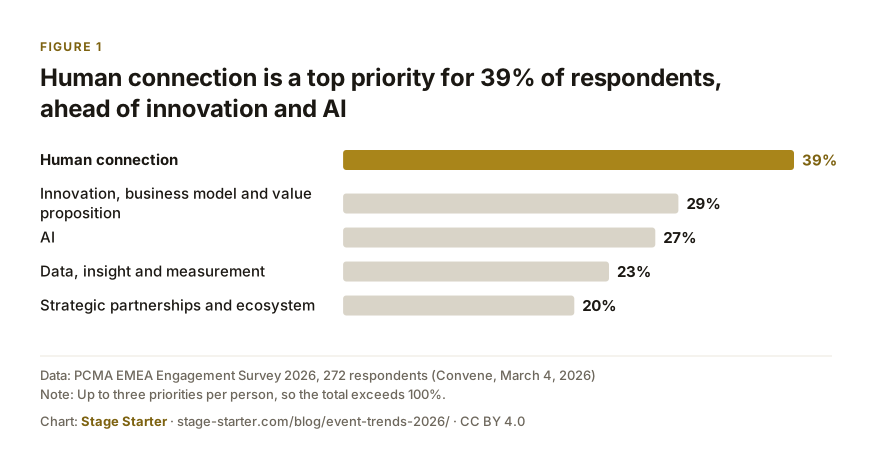
Among the event trends 2026, the PCMA EMEA Engagement Survey 2026 puts human connection first: of 272 event industry professionals surveyed, 39 percent named human connection as one of their organization's three top priorities, 6 percentage points more than the year before, as Convene, the magazine of the Professional Convention Management Association (PCMA), reported on March 4, 2026. AI follows with 27 percent in third place among the priorities and ranks first among the skills respondents want. For speakers, this means that organizers are planning programs in which exchange counts, and a talk with room for conversation and with expertise on AI in your own field fits these expectations.

Among the event trends 2026, the PCMA EMEA Engagement Survey 2026 puts human connection first: of 272 event industry professionals surveyed, 39 percent named human connection as one of their organization's three top priorities, 6 percentage points more than the year before, as Convene, the magazine of the Professional Convention Management Association (PCMA), reported on March 4, 2026. AI follows with 27 percent in third place among the priorities and ranks first among the skills respondents want. For speakers, this means that organizers are planning programs in which exchange counts, and a talk with room for conversation and with expertise on AI in your own field fits these expectations.
The event trends 2026 according to the PCMA EMEA Engagement Survey
An event trend is a noticeable change in what organizers and attendees expect from conferences. One current source is the article Human Connection Is the Glue by Michelle Russell, editor in chief of Convene, of March 4, 2026. It evaluates the PCMA EMEA Engagement Survey 2026, in which 272 professionals took part. The survey ran in January and early February 2026, and according to the article 72 percent of respondents are from Europe and 16 percent from North America. The largest groups by role are managers at 38 percent, directors at 24 percent and owners or chief executives at 18 percent, and average professional experience is 17 years.
Respondents were asked for the three most important priorities of their own organization. Converting the percentages into numbers of respondents gives this picture:
The column with the numbers of people is our conversion and not a value from the survey. Respondents could choose three priorities, which is why the percentages do not add up to 100.
Figure 1
Human connection is a top priority for 39% of respondents, ahead of innovation and AI
Source: PCMA EMEA Engagement Survey 2026, 272 respondents (Convene, March 4, 2026)
Note: Up to three priorities per person, so the total exceeds 100%.
Data and download
Style
Embed
Data as table
| Label | Value (%) |
|---|---|
| Human connection | 39% |
| Innovation, business model and value proposition | 29% |
| AI | 27% |
| Data, insight and measurement | 23% |
| Strategic partnerships and ecosystem | 20% |
Chart: Stage Starter, CC BY 4.0. Data: PCMA EMEA Engagement Survey 2026, 272 respondents (Convene, March 4, 2026); the source's terms apply.
The author sees a contrast in this: the more digital tools and AI become available, the more important relationships between people and trust become in her reading. As the biggest obstacles for the industry, respondents name lack of time and workload according to the article, as solutions first more time and then AI along with training, and exchange among professionals is again seen as the key.
What the event trends 2026 mean for you as a speaker
The respondents work at organizers, hotels, associations and service providers, that is, on the side of the industry that plans events. This is our reading: their priorities say nothing about any single conference, but they indicate a direction in which programs are built. Two consequences for speakers suggest themselves.
First, the priority of human connection suits a talk that starts conversations, in which the audience tries something, asks questions or discusses with a neighbor, and which gives people a reason to talk to you at the edge of the stage afterwards. How a specialist audience listens and what it expects from speakers is described in the article Who sits in the audience at an industry conference, and how do they listen?.
Second, the top ranking of AI among the skills respondents want shows that the industry itself wants to learn to work with AI tools. Speakers who master AI in their own field and can show it with examples therefore meet an audience for whom this topic matters. The survey names skills and not talk topics, so this is a pointer and not a requirement for your abstract. Which topics dominate business events overall is shown by the analysis of 2,415 conferences in the article Which topics dominate business events and conferences.
The limits of the survey belong here too. It rests on 272 responses, and the article reports the origin of respondents only by region. For organizers in German-speaking Europe, the weighting of priorities may therefore look different from the overall picture across Europe and North America, and a look at the call of the conference you want to submit to remains necessary.
A calculation: what encounters at a conference are worth to speakers
Suppose you give six talks a year and hold three personal conversations after each with people who care about your topic. That makes 18 conversations a year from which follow-up contacts, inquiries or recommendations can arise. These figures are a worked example, and how many inquiries result depends on your offer.
How closely a talk and business are linked is described by Stage Starter in the article Why the industry conference works so well as a sales channel. Marin Niehues, the founder, has spoken at more than 45 conferences in 23 countries on six continents and was named Most Active Speaker by Sessionize in 2024 and 2025.
How to use the event trends 2026 for your abstract and your talk
- Plan conversations into the talk: build in a question to the audience or a short exercise and say at the close where people can find you afterwards.
- Reserve time around the stage: arrive before your slot and stay afterwards, because the conversations happen in the room and in the foyer.
- Formulate the benefit of the exchange: write in the abstract which questions the audience can clarify after the talk and what they take away from a conversation.
- Show AI in your own field: if your subject touches AI, give one concrete example from your work in which you used a tool, and what it changed.
- Get in touch after the conference: write within a few days to the people you spoke with and refer to your conversation.
Whether conferences take place in person, hybrid or online influences how you carry out these steps, and how formats are distributed is shown in the article In person, hybrid or online: how conference formats are distributed today.
Frequently asked questions
What are the most important event trends 2026?
According to the PCMA EMEA Engagement Survey 2026, human connection tops the priorities of 272 event industry professionals with 39 percent. Innovation and evolution of the business model follow with 29 percent and AI with 27 percent. Among the skills respondents want, working with AI tools ranks first.
Who answered the PCMA EMEA Engagement Survey 2026?
272 business events professionals answered, 72 percent from Europe and 16 percent from North America. The survey ran in January and early February 2026, and Convene published the results on March 4, 2026.
What role does AI play at conferences in 2026?
For 27 percent of respondents, AI is among the three most important priorities of their organization, and working with AI tools is the skill most often wanted. The author of the article also sees that human relationships become more important the more digital tools are available.
What does the trend towards human connection mean for speakers?
According to the survey, organizers value exchange, so talks that plan in questions, exercises or conversations around the appearance fit. If you stay available after the talk, you use this expectation for follow-up contacts.
Should I change my abstract because of the event trends 2026?
Check whether your abstract states the benefit for the audience and the room for exchange, and add a concrete example of AI in your field if needed. The survey asks industry professionals and points in a direction, while the call of the respective conference remains the yardstick.

Marin Niehues is a management consultant and international speaker. With Niehues Consulting he works with organisations from scale-ups to DAX 40 corporations, and on stage he has spoken at more than 45 conferences in 23 countries.
All articles by Marin Niehues