

Following up after a call for papers: what happens between submission and acceptance
After a call for papers, you follow up on an open call only once the announced decision date has passed, and on the direct email route once, after two weeks. A call for papers is the open invitation a conference uses to collect talk proposals, and the decision lies with a program committee, the group that reviews every submission and puts the program together. The committee starts only after the deadline, and a reply usually takes several weeks. A message during the review changes nothing about the assessment, whereas a single, well-timed follow-up on the email route is part of the normal process.
After a call for papers, you follow up on an open call only once the announced decision date has passed, and on the direct email route once, after two weeks. A call for papers is the open invitation a conference uses to collect talk proposals, and the decision lies with a program committee, the group that reviews every submission and puts the program together. The committee starts only after the deadline, and a reply usually takes several weeks. A message during the review changes nothing about the assessment, whereas a single, well-timed follow-up on the email route is part of the normal process.
What happens after a call for papers closes?
After a call for papers closes, the submission window shuts, and only then does the review begin, in which the committee goes through every proposal and ranks them against each other. The sequence is the same at almost every conference: the organizer publishes the call, speakers submit within the deadline, and then come review, decision and notification. Once the deadline passes, your submission is frozen. What counts now is what is in the form, and changes happen only if the committee asks for them.
In an anonymous review, which is common at community-run conferences, the committee assesses title and abstract (the short description of the talk) without knowing the names. In a review with names, your bio and previous appearances count as well, which is more frequent at commercial conferences because the organizer wants to be sure that speakers deliver.
The assessment is comparative. The committee ranks your proposal against all the others submitted for the same topic area, and the program emerges from that ranking. The article What a program committee looks for describes which criteria count, and the call for papers guide shows how the whole process works, from the call to the stage.
How long does it take to hear back after a call for papers?
You usually hear back a few weeks after the deadline, and many conferences state the notification date in the call itself. Two things set the pace: who sits on the committee and how many proposals have come in.
At community conferences, volunteers read the submissions in their spare time, while at commercial conferences the committee is made up of the organizer's staff and external industry experts. In our experience a mid-sized conference easily receives 300 submissions, and even a first pass of two minutes per proposal, checking only whether it fits the tracks and the audience, takes around ten hours of reading.
Very large conferences give each thematic strand, known as a track, its own committee under a track chair, with a program chair above them all, and each of these levels lengthens the road to a decision. Most conferences with an open call notify rejected speakers too, often weeks after the acceptances. If the program is online and you have heard nothing, your submission has been declined for this edition.
Who gets in touch, and in what role
You reach the committee almost only through your submission, whereas the organizers, the team responsible for schedule, venue and logistics, can be contacted directly. The email signature shows a sender's function. A conference owner stands for the organizer, a program director or track chair for the program, and a speaker relations manager for the operational team. If someone from the program side gets in touch with a question about title, format or length, that is a good sign, because a committee asks such questions about proposals it is seriously considering.
At smaller conferences the two coincide. A curated industry conference run by an owner with one or two employees is organized by the same people who read the submissions. There, the personal impression matters even before acceptance, and an existing relationship counts. The conference's team page shows you which situation you are in: if only one or two names appear there, the same people usually sit on the committee.
When does it make sense to follow up with the organizer?
Following up makes sense on the direct email route after two weeks without a reply, and on an open call once the announced decision date has passed without news.
On the email route, following up is expected. After two weeks without a reply, you send a short, friendly message that refers to your first email, and you leave it there: if there is still no answer, you stop, because a third message leaves a poor impression. Silence on this route means the request did not get through for this edition, whether because of a full inbox or a full program. Next year you write again, this time with further references. The article Writing to organizers directly explains how such a first approach is built.
A good follow-up email to a conference organizer is short and visibly connects to your first message. It names the title of the proposed session and the date of your first email, adds at most one new piece of information, such as an appearance confirmed in the meantime or a link to a topic the conference has just announced, and ends with a question that can be answered in one sentence. On an open call, it asks about the status of the decision and nothing else. Justifications, a second version of the abstract or hints about your own urgency do not belong in it.
Stage Starter takes this work off your hands: we find the right calls, write the submission and submit in your name, follow up at the right moment with a single message and accompany accepted talks all the way to the stage. You contribute your expertise and give your approval.
After a rejection, a question to the organizer is realistic in three situations: you have spoken at the conference before, you know someone on the program committee, or the conference has a single organizer. The question asks briefly and factually what was missing and does not challenge the decision. How to handle a rejection overall is covered in the article Rejected as a speaker.
When following up does harm
During the review of an open call at a larger conference, a message does not reach the committee. It reads anonymously or at a distance from the organization, and before acceptance only the submission with its bio counts. A query in between gives the committee no new information and costs the organizer attention at the very phase when the team is busiest.
Organizers remember names and talk to each other, and a contact you strain by pushing is missing later, when you come back with a list of references.
A missing acceptance is not always explained by the proposal itself. At conferences whose program is partly shaped by sponsors, places sit alongside the call that go to paying companies, and such a place quickly costs €10,000 or more for a single speaking slot. These sponsored sessions are often not labeled in the program, so you are competing with places you never see, and a follow-up brings no clarity in such cases.
What do acceptance, rejection and waitlist mean in a call for papers?
An acceptance means your proposal is on the program, a rejection means it is out for this edition, and a place on the waitlist means it sits just below the acceptance line and moves up if a speaker drops out. Each conference decides for itself whether it keeps a waitlist, and it usually tells you with the notification. In practice a waitlist place ties you up until shortly before the conference, so ask until when the organizer fills vacant slots.
With the acceptance, the committee's selection decision has been made; changes after that concern slot, format or schedule and come from the organizer. From now on, what counts is the relationship with the organizers, who accompany you through the alignment call, the meeting that coordinates your session, the speaker briefing and the travel booking. The abstract promised a talk, and you build the session behind it only now, in the weeks or months before the appearance. The article What to clarify with the organizer covers the points to settle during this phase.
The wait can be put in context. In our submissions for clients we reach up to 19 percent acceptances per conference, whereas 5 percent at most is typical in the market at this volume of submissions. With n submissions at a rate p, the chance of at least one acceptance is 1 − (1 − p)^n: if you submit to twenty conferences at 5 percent, you have a chance of around 64 percent of at least one acceptance, and at 19 percent it rises above 98 percent. Rejections are therefore part of the normal course of every submission round.
Frequently asked questions
How long does it take to get a reply after a call for papers?
The reply usually comes a few weeks after the deadline, because the review only begins then. Many conferences state the notification date in the call. Most notify rejected speakers too, often weeks after the acceptances.
Can I ask the organizer after I have submitted?
On the direct email route, a short follow-up email after two weeks is customary, whereas a third message does harm. On an open call, you ask only once the announced decision date has passed. During the review, a message changes nothing about the assessment.
When is the right time to follow up?
The right time is two weeks without a reply on the email route, and a few days after the announced decision date on an open call. If the call gives no date, you wait until the program is published. A single follow-up is enough in both cases.
How do I write a follow-up email to a conference organizer?
A follow-up email is short, names the title of your session and the date of your first message, and asks a question that can be answered in one sentence. It adds at most one new piece of information, such as an appearance confirmed in the meantime. Justifications and a revised version of the abstract do not belong in it.
Can I still change my submission after the call for papers closes?
Until the deadline, most platforms let you edit or withdraw a submission. After that it is frozen, and changes to title, format or length happen only if the committee asks for them. You can withdraw a submission at any time, and a short note to the organizer is then good practice.
Does silence after a submission mean I was rejected?
If the program is online and you have heard nothing, your submission has been declined for this edition. Most conferences with an open call notify rejected speakers as well, only often later than the accepted ones. On the direct email route, silence after a follow-up means the request did not get through for this edition.
What is a waitlist in a call for papers?
The waitlist holds proposals that sit just below the acceptance line and move up if an accepted speaker cancels. Not every conference keeps one, and if you are on it, you learn this with the notification. Ask until when vacant slots are filled, so you can plan your calendar.
What does an acceptance to a call for papers mean?
An acceptance means your proposal is on the program and the selection decision has been made. After that, you work with the organizers and build the session your abstract promised. Changes to slot or format now come from the organizer.
Following up as part of a submission pipeline
If you have several submissions running in parallel, the phase between submission and acceptance becomes the normal state, with some decisions coming early and others late. Whether an ongoing submission pipeline that handles this phase for you is worthwhile for your topic is something we clarify in an introductory call.

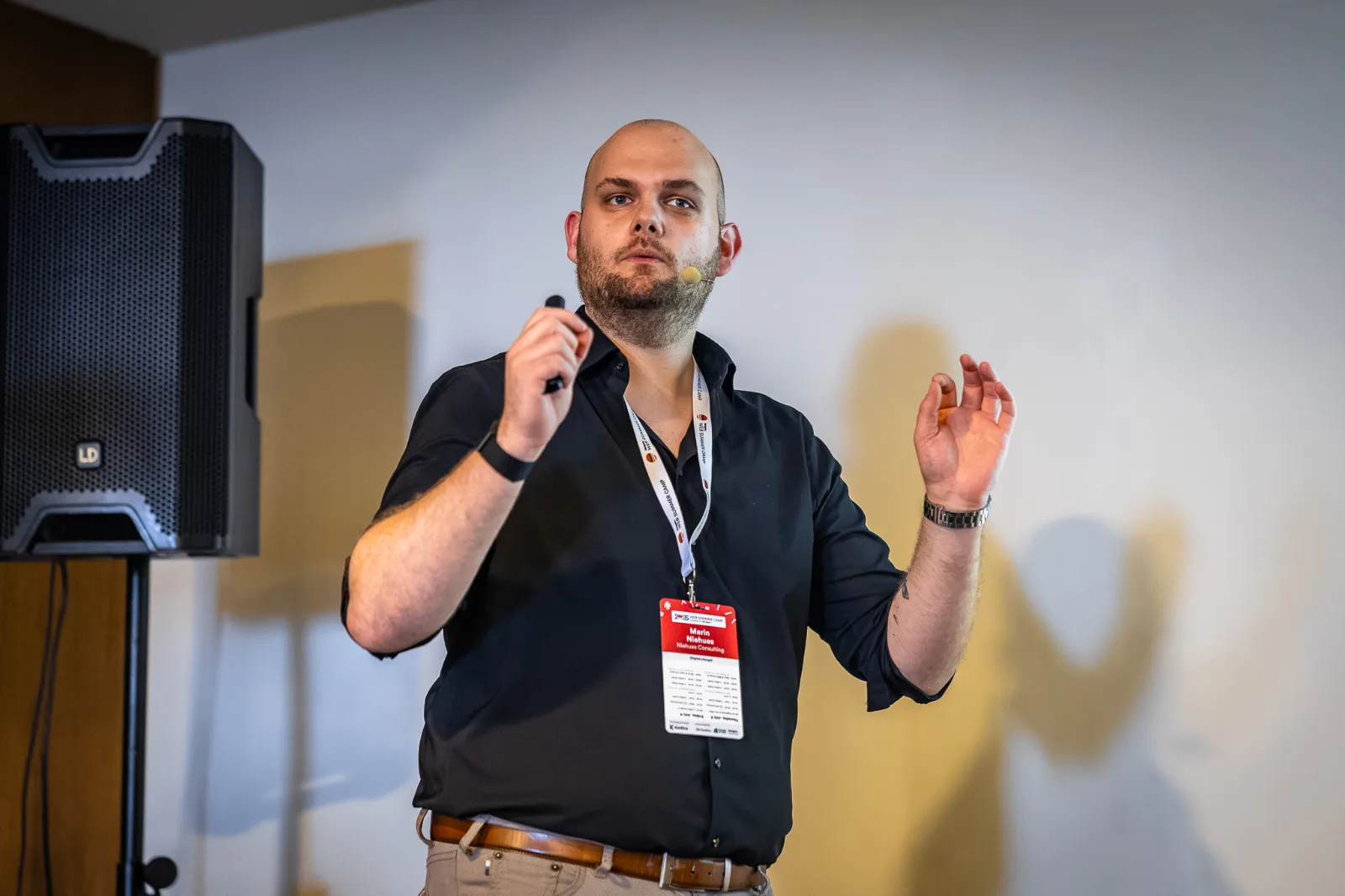
Marin Niehues is a management consultant and international speaker. With Niehues Consulting he works with organisations from scale-ups to DAX 40 corporations, and on stage he has spoken at more than 45 conferences in 23 countries.
All articles by Marin Niehues