

How quickly can a speaker agency get you onto your first conference stage?
Plan for three to six months from your approval to your first stage when a speaker agency submits on your behalf. Most of that time is set by the conference: in our conference database, an average of 81 days lies between the close of a call for papers, the public announcement through which a conference collects talk proposals, and its first day. Before that come the preparation of your talk and the submission, and in between sits the decision of the program committee, the group that decides on a conference's line-up. How early the first acceptance arrives depends above all on the number of parallel submissions, and this article uses our own acceptance rates to show how far they pull the start forward.

Plan for three to six months from your approval to your first stage when a speaker agency submits on your behalf. Most of that time is set by the conference: in our conference database, an average of 81 days lies between the close of a call for papers, the public announcement through which a conference collects talk proposals, and its first day. Before that come the preparation of your talk and the submission, and in between sits the decision of the program committee, the group that decides on a conference's line-up. How early the first acceptance arrives depends above all on the number of parallel submissions, and this article uses our own acceptance rates to show how far they pull the start forward.
How long does it take a speaker agency to get you onto your first stage?
From your approval to your first stage, plan for three to six months, made up of four stages. It starts with preparation: the talk gets its structure, and the abstracts are written, the short descriptions of the planned talk with which you apply to a conference. Submission follows, to conferences that currently have a call for papers open. Every call has a deadline, and anyone who misses it waits for the next edition of the conference.
The third stage is the wait for the decision. The program committee usually reviews the proposals after the deadline and replies weeks or months later. The fourth stage is the gap until the conference itself. The total duration is the sum of these parts, and the first one is the part you can influence most, because the other three run to the organizers' schedule. The article on the timeline from call for papers to stage describes the sequence in detail.
Stage Starter takes this work off your hands: we find the right calls, write the submission and submit it, then follow up until you are on stage. You contribute your expertise in a few conversations and approve the talk and abstracts once before the start, and the individual submissions then go out without further approval. Preparation is complete as soon as your approval is in, and the earlier it comes, the earlier the first submission goes out. What happens in the first three months is described in Working with a speaker agency: the first 90 days.
How many days lie between a call for papers deadline and the conference?
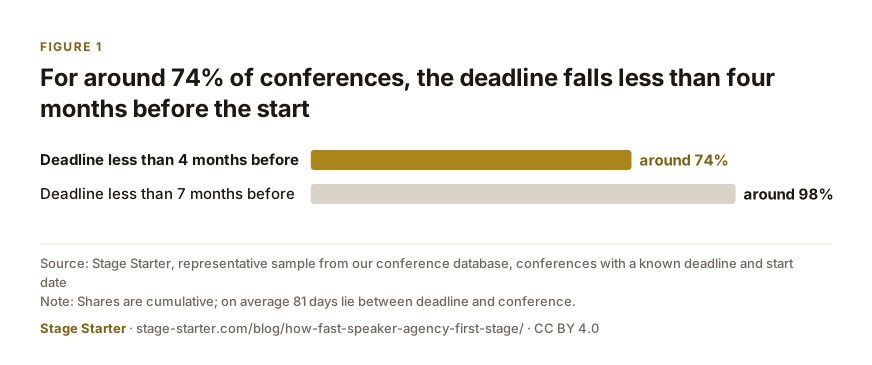
On average, 81 days lie between the submission deadline and the first day of the event, a little under three months. That is the result of our analysis of 9,912 conferences in our conference database for which both dates are known. For 7,357 conferences, around 74 percent, the deadline falls less than four months before the start, and for 9,718, around 98 percent, less than seven months. Only 194 conferences begin seven months or more after the deadline.
Figure 1
For around 74% of conferences, the deadline falls less than four months before the start
Source: Stage Starter, representative sample from our conference database, conferences with a known deadline and start date
Note: Shares are cumulative; on average 81 days lie between deadline and conference.
A worked example shows what the average means. If a call closes in mid-December, a gap of 81 days puts the start of the conference in early March. Individual conferences fall well before or after that, which is why an agency plans with the whole distribution and deliberately puts conferences with a short lead time into the first round.
For getting started, the position of the deadlines matters as much as the gap. The big waves of conferences come in spring and autumn, and with a lead time of just under three months, the calls for spring conferences close in winter and those for autumn conferences in summer. If your abstracts are ready before one of these waves of deadlines begins, you reach the largest number of open calls. Open calls exist all year round all the same: of the around 22,700 conferences in our database, around 1,500 had a call for papers open on the reference date.
How many submissions does a first acceptance take?
In our submissions for clients, roughly one in five decided conferences says yes, which corresponds to just under fifteen decided abstracts. Of the abstracts Stage Starter has submitted for clients, just under two thirds have been decided, and around one in fifteen of those was accepted, which is around 7 percent acceptance per abstract. At conference level the rate is higher, because we often submit several abstracts per conference and one acceptance is enough. Just under one in five decided conferences said yes, which gives us up to 19 percent acceptances per conference, while 5 percent at most is typical in the market at this volume of submissions. How to put such rates in context is covered in How high is the acceptance rate for a call for papers?
For the question of timing, what counts is how many conferences are deciding on your proposals at the same time. The chance of at least one acceptance across n conferences with a rate p is 1 − (1 − p)^n. With ten conferences and 19 percent, that gives 1 − 0.81^10, around 88 percent, while at the typical 5 percent it is 1 − 0.95^10, around 40 percent. Because each submission runs through its own reply time in parallel with the others, the first acceptance arrives sooner when the submissions are spread widely. A good third of our abstracts are still awaiting a decision, because many conferences reply only weeks or months after the deadline.
Is pay to speak a faster route onto the stage?
A bought speaking slot is fixed sooner than an acceptance through an open call, and in return it quickly costs €10,000 or more for a single speaking slot. Pay to speak means that an organizer sells speaking slots for money, usually as part of a sponsorship package or against a participation fee for speakers. The organizer's offer then decides the date, and deadlines and program committees play no part. Sponsored sessions are often not marked as such in the program. The specialist audience still reads bought slots as advertising as soon as the content or a label gives the sponsor away, and with sales pitches that happens in the first few minutes. The article on sponsored talks and pay to speak explains when a paid slot pays off for winning clients.
What you contribute to your first stage
An agency works in your name and needs two things from you. The first is your expertise, because the examples and the stance that a program committee looks for in an abstract come from your practice. The second is the approval of talk and abstracts, which you give once before the start. After that Stage Starter submits in your name without every submission landing on your desk. You hold the conversations after the talk yourself, because they are about your offer.
How to recognize a credible offer on timing
A credible offer separates the preparation from the gap until the conference and gives a range for both. It discloses its own acceptance rate, with the number of decided submissions as its basis, and states the number of conferences with which the start is planned. A reputable agency does not guarantee a talk or a date, because the program committee decides. The speaker agency guide sets out the services and pricing models on the market.
For a sense of volume: in the first year, one to three talks are realistic, and in the following years four to six, which cover the share of your client acquisition that the stage takes on. The first acceptance often arrives months before the first talk, because the gap until the conference lies between the two, and you use it to refine the talk.
Frequently asked questions
How long does it take a speaker agency to secure the first talk?
Plan for three to six months from your approval to the first talk. Most of that is the gap between submission deadline and conference start, which averages 81 days in our conference database. Before that come the preparation of talk and abstracts and the wait for the decision.
When is the best time to start with a speaker agency?
The best time is as soon as your topic is settled and you have time in the following months for talks and the conversations that follow them. Open calls exist all year round, and on the reference date around 1,500 calls for papers were open in our database. If you are aiming at spring conferences, you need your abstracts in winter, for autumn in summer, and starting around two months before these waves of deadlines leaves time for the preparation.
Can a speaker agency guarantee the date of your first talk?
No, the conference's program committee decides on every acceptance. An agency steers the number of submissions, the quality of the abstracts and the choice of conferences, and these levers determine how early the first acceptance arrives. In our submissions for clients the rate is up to 19 percent acceptances per conference, while 5 percent at most is typical in the market at this volume.
How many submissions are needed before the first acceptance?
In our submissions, roughly one in five decided conferences says yes, which corresponds to just under fifteen decided abstracts. Mathematically, the chance of at least one acceptance across ten conferences at 19 percent each is around 88 percent. At the typical 5 percent it is around 40 percent.
Is it faster if I buy a speaking slot?
The date of a bought slot is fixed sooner, and in return it quickly costs €10,000 or more for a single speaking slot. Collaboration with Stage Starter starts from $999 net per month for the whole operation. A bought slot only pays off if the room is full of the decision-makers who buy your service and the talk still comes across as a specialist contribution despite the sponsor.
When will I find out whether my submission has been accepted?
The reply usually comes a few weeks after the deadline, and at some conferences only months later, because the program committee reviews the proposals together once the call has closed. Some organizers do not respond to rejections at all. An agency keeps track of every open submission and follows up when the announced decision date passes.
How many talks are realistic in the first year?
In the first year, one to three talks are realistic, and in the following years four to six. The difference arises because in the first year the preparation and the conferences' lead time take up part of the months. From the second year on, submissions and talks run side by side.
If you would like to know which conferences suit your topic in the coming months and when your first stage would be realistic, we can work that out in an initial consultation.

Marin Niehues is a management consultant and international speaker. With Niehues Consulting he works with organisations from scale-ups to DAX 40 corporations, and on stage he has spoken at more than 45 conferences in 23 countries.
All articles by Marin Niehues