

How to get speaking engagements: organizers want measurable value
Anyone wondering how to get speaking engagements in 2026 meets organizers who are under pressure to prove the value of their events, which in our assessment favors talks with a measurable result. At IMEX Frankfurt 2026, held from 19 to May 21, 2026 at Messe Frankfurt, the Forrester analyst Conrad Mills presented the third "State of Events" survey, and according to the IMEX report, only 39 percent of chief marketing officers are satisfied with their events. According to the same report, fewer than half of the organizations surveyed actively measure what an event achieves. For speakers, this means that a talk proposal has better chances if it tells the organizer how the success of the talk can be read.
Anyone wondering how to get speaking engagements in 2026 meets organizers who are under pressure to prove the value of their events, which in our assessment favors talks with a measurable result. At IMEX Frankfurt 2026, held from 19 to May 21, 2026 at Messe Frankfurt, the Forrester analyst Conrad Mills presented the third "State of Events" survey, and according to the IMEX report, only 39 percent of chief marketing officers are satisfied with their events. According to the same report, fewer than half of the organizations surveyed actively measure what an event achieves. For speakers, this means that a talk proposal has better chances if it tells the organizer how the success of the talk can be read.
What IMEX Frankfurt 2026 shows about getting speaking engagements
IMEX Frankfurt is a trade show for the events industry at which organizers and suppliers come together. In its closing release of May 21, 2026, the organizer reports its biggest show floor to date, more than 13,000 participants, more than 4,500 buyers, close to 3,000 exhibiting companies and 73,000 pre-scheduled meetings, including 63,500 one-to-ones. For speakers, it is mainly the education program of the show that provides material, because research on the situation of organizers was presented there.
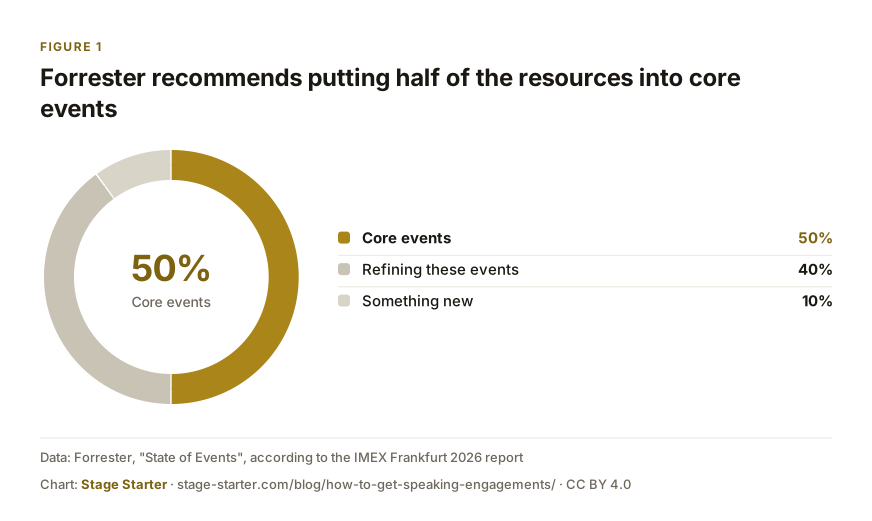
The IMEX report summarizes the Forrester findings by saying that satisfaction with events has fallen for three years. Many marketing chiefs focus on new leads and overlook the value an event creates across a customer's whole buying group. According to the report, Forrester recommends splitting resources 50 percent to core events, 40 percent to refining them and 10 percent to something new. From these figures we conclude that those responsible for events have to prove their value, and that this pressure reaches down to the individual item on the program.
Figure 1
Forrester recommends putting half of the resources into core events
Source: Forrester, "State of Events", according to the IMEX Frankfurt 2026 report
Why organizers look for measurable value when you want to get speaking engagements
According to the figures that the IMEX report reproduces from Cvent's Planner Sourcing Report 2026, 90 percent of event programs face increasing scrutiny. Only 28 percent have a robust measurement framework, and nearly 30 percent work without KPIs. As the most important measure of success, 63 percent of planners worldwide name engagement. We read the Cvent figures only as reproduced by IMEX and did not open the report itself.
What follows is an interpretation that the sources do not draw expressly, and we flag it as our own. A program committee that has to justify its program to its own marketing department or its sponsors is more likely to choose a talk whose participation and value can be described than a talk on a general topic. How committees assess proposals is described in our article What a program committee looks for, and the IMEX figures fit with it.
To get speaking engagements, name the success of the talk in advance
Getting a speaking engagement means that a program committee accepts your talk proposal and gives you a place in the program. Your proposal competes with all the other submissions, from which the committee picks the talk it can best justify to its own backers. A proposal that already supplies arguments for this takes work off the committee.
A calculation makes this tangible, and it rests on assumptions. Suppose your slot has 150 listeners, and you offer the organizer that you will involve 40 percent of them with a question during the session and afterwards provide a handout that 30 percent of those present will download. After the conference, the organizer can then read off 60 participants and 45 downloads, which makes two figures for engagement, the measure that 63 percent of planners name as most important according to Cvent. A talk that builds these figures into the proposal gives the committee an argument for choosing it.
Smaller formats make measuring easier. According to the IMEX report, Forrester and Skift Meetings both pointed out that formats with fewer than 200 participants are growing fastest, and the report mentions organizations moving to sessions of 200 to 300 attendees. For you, this is an opportunity, because with 150 people you can hold conversations after the talk with a large part of the audience, which is hardly possible in a hall of 2,000, and because the organizer can count participation more easily in a smaller room. How such a talk is built is explained in How to build a good talk for the stage.
How to get speaking engagements: five steps for your next submission
- Define the result of the talk in one sentence: describe what a listener can do differently after 30 minutes, and name the figure or the case from your own work that substantiates it.
- Write the measurable part into the proposal: name one interaction and one follow-up material that the organizer can count after the conference.
- Build the title around the result: a title that names the problem and the benefit shows the committee the value at once. How to do that is explained in Conference talk title.
- Choose suitable organizers: conferences with smaller formats and a clear audience give you the best conditions for showing impact. How to find them is covered in How to find the right conferences.
- Plan several submissions: Marin Niehues, the founder of Stage Starter, started out with a success rate under 2 percent on his submissions and is now at around 10 percent. Suppose you also reach 10 percent, then about one talk follows from every ten submissions, and How many abstracts to submit for one acceptance works that out in more detail.
Frequently asked questions
How do I get speaking engagements at conferences?
You submit a talk proposal with a title, an abstract and details about yourself to a call for papers or call for speakers, and the program committee then decides whether to accept it. A convincing proposal describes a concrete problem that you solve with a substantiated result, and a benefit that the organizer can recognize after the conference.
What do conference organizers look for in speakers?
Organizers look for talks whose value can be justified, because they have to defend their events to marketing and sponsors. According to the IMEX report on the Frankfurt conference in May 2026, fewer than half of organizations actively measure the impact of their events, and only 39 percent of CMOs are satisfied.
What did Forrester present at IMEX Frankfurt 2026?
Conrad Mills of Forrester presented the third annual "State of Events" survey with around 400 responses. According to IMEX, it shows that satisfaction with events has fallen for three years, that about two thirds of organizations have flat or shrinking budgets and that fewer than half actively measure impact.
Are small conferences better for starting as a speaker?
Smaller formats are growing fastest according to Forrester and Skift Meetings, and for speakers, impact and conversations are easier to achieve there. A talk in front of 150 people from your target group can bring more contacts than a slot in a large hall.
How many submissions do I need for one talk?
That depends on your acceptance rate. Marin Niehues started under 2 percent and is now at around 10 percent, which corresponds to roughly one talk for every ten submissions.

Marin Niehues is a management consultant and international speaker. With Niehues Consulting he works with organisations from scale-ups to DAX 40 corporations, and on stage he has spoken at more than 45 conferences in 23 countries.
All articles by Marin Niehues