

Measuring the success of conference talks: B2B metrics that matter
The success of conference talks can be measured along a chain of six stages: submissions, acceptances, talks, conversations, meetings and paid projects. Each stage has its own metric, and the rates between the stages show where results are produced and where they fail to appear. The first three stages sit with an agency that submits for you, while the last three happen in your own sales process after the talk and have to be recorded by you. This article names the metric for each stage, shows the ROI calculation and our own acceptance rates and describes what a speaker agency should report.

The success of conference talks can be measured along a chain of six stages: submissions, acceptances, talks, conversations, meetings and paid projects. Each stage has its own metric, and the rates between the stages show where results are produced and where they fail to appear. The first three stages sit with an agency that submits for you, while the last three happen in your own sales process after the talk and have to be recorded by you. This article names the metric for each stage, shows the ROI calculation and our own acceptance rates and describes what a speaker agency should report.
How do you measure the success of a conference talk?
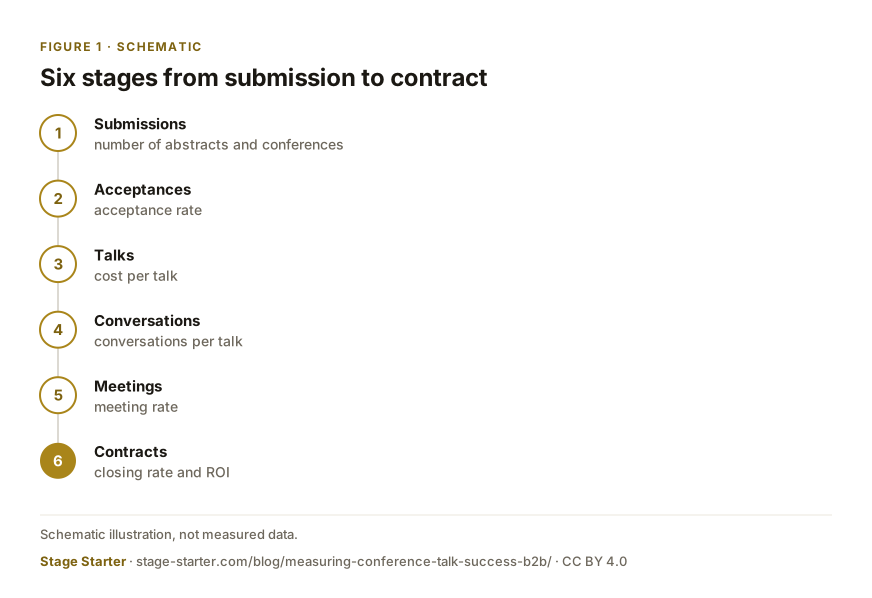
You measure the success of a conference talk by the contracts that come out of it and by the rates of the six stages before. For consultants and freelancers the contract counts, and a talk given is an intermediate stage on the way there. The chain starts with the submission, the talk proposal (the abstract) that you send in to a call for papers, the public invitation a conference uses to collect proposals. The program committee, the group that puts the program together, decides on it, and a positive decision brings an acceptance. The acceptance becomes a talk, the talk leads to conversations with listeners, the conversations to meetings and the meetings to paid projects.
The chain can be captured in an overview that names the metric, formula and data source for each stage:
Figure 1 Schematic
Six stages from submission to contract
Schematic illustration, not measured data.
Data and download
Style
Embed
Data as table
| Step | Name | Explanation |
|---|---|---|
| 1 | Submissions | number of abstracts and conferences |
| 2 | Acceptances | acceptance rate |
| 3 | Talks | cost per talk |
| 4 | Conversations | conversations per talk |
| 5 | Meetings | meeting rate |
| 6 | Contracts | closing rate and ROI |
Chart and data: Stage Starter, CC BY 4.0. Free to use with attribution and a link.
Counting submissions: volume and pending decisions
The first metric is the number of submissions, and it needs two figures: how many abstracts were sent in and to how many conferences. In a representative sample of our submissions for clients from 2024 to 2026, almost two thirds of the abstracts have been decided and the rest are waiting for an answer, because many conferences only respond weeks or months after the call closes, as the article on the timeline from call for papers to stage shows.
This leads to the most important measuring rule in this article: a rate is only calculated over decided submissions. If you divide the acceptances by all submissions, you get just over 4 percent in our sample and underestimate the result, because the answer for just over a third of the abstracts is still missing. Every submission therefore needs a status (pending or decided) and the date of the decision.
Acceptances: 7 percent per abstract, up to 19 percent per conference
Of the decided abstracts, roughly one in fourteen was accepted, which is around 7 percent acceptance per abstract. At conference level the rate is higher, because we often submit several abstracts per conference and one acceptance is enough: almost one in five of the decided conferences accepted. Per conference we reach up to 19 percent acceptances, while at this volume of submissions the market norm is 5 percent at most. A detailed analysis is in the article What is the acceptance rate for calls for papers.
The rate per abstract shows how well the proposal lands. The rate per conference shows whether the conference list fits your topic. The program committee decides on every single acceptance, which is why a good agency measures the rate across many conferences.
Talks: how many there will be and what each costs
Something can come up between acceptance and talk, such as a date that moves, so the talk itself is what counts. In our work, one to three talks are usual in the first year and four to six after that. How to find the right number for your offer is described in How many talks a year you really need.
The second metric at this stage is cost per talk, and it makes routes comparable that have little in common. With pay to speak you buy the slot from the organizer, and that quickly costs €10,000 or more for a single slot. At Stage Starter the collaboration starts from $999 net a month, which is $11,988 net a year for the entire operation. If that produces four talks, the fees come to about $3,000 per talk, and at six talks about $2,000, in each case excluding travel and your own preparation time. This is a worked example.
Stage Starter takes on this work for you: we find the right calls, write the submission and submit it. We then follow up, support you to the stage and report the first three stages of the chain to you continuously. The services a speaker agency covers and how the models on the market bill are summarized in the speaker agency guide.
What do feedback ratings and audience numbers say about a talk?
Feedback ratings and audience numbers tell you how your talk landed and how strongly your topic drew people, but they say little about contracts. Many conferences ask attendees to rate sessions in their app or by questionnaire, usually on a scale for content and delivery. Good ratings help with the next submission, because program committees take earlier ratings and recommendations into account, and weak ratings show where the talk needs sharpening.
Audience numbers mainly describe the size of the conference and where your slot sits in the program. A room with forty purchasing managers brings more conversations than one with four hundred students. Both values belong in your analysis as signals of quality and fit, and business success is only measured by the chain from the fourth stage onwards.
After the talk: the metrics only you know
The agency's view ends with the talk, because you hold the conversations with listeners yourself, so the last three stages sit in your sales process. In the example, one talk brings about five serious conversations, which lead to two meetings, and every third meeting turns into paid work. A conversation counts as serious when the other person describes a problem of their own that fits your offer.
These stages only become countable once you record the source. In your CRM you create a "source" field and enter the conference name for every new contact. When the contact later becomes an opportunity, it inherits this source, so every new client can be traced back to a talk. Follow-up takes about two weeks and is described in What happens after the conference. In B2B the buying decision often comes months later, so an analysis after one year tells you more than one after a quarter.
How do you calculate the ROI of a conference talk?
You calculate the ROI of a conference talk by setting the value of the contracts won against the cost of the talk: ROI equals contracts times contract value, minus cost, divided by cost. The cost includes the share of the agency fee per talk, travel and accommodation and your own days valued at your day rate. As contract value you count a client's contribution margin over the expected length of the relationship, for consultants usually the first engagement plus follow-on work.
Combining the stage values gives a worked example. For four to six talks at 7 percent acceptance per abstract, around 60 to 90 submissions are needed. In the example these talks bring around 20 to 30 conversations, leading to 8 to 12 meetings, and every third meeting produces a contract, almost three to four contracts in total. If a won client brings in more than the $11,988 net that Stage Starter costs at minimum per year, a single contract covers the year's fee in the example. If your first six months fall well short, the chain shows you at which stage the gap opens.
What a speaker agency measures and reports
An agency that submits for you sees the first three stages of the chain and shows them to you. The report includes submissions with conference and status, rates based on decided submissions and upcoming talks with dates. At Stage Starter, submissions and acceptances come together with us because we submit in your name, and the rates in this article come from that work. The model pays off most for experts with little time and high contract values, because for them a single contract covers the annual fee. A report on success is therefore a joint effort: you supply the source of your contacts, and the agency adds the submission figures.
A warning sign is a report that opens with reach. Social media impressions describe the reach of the conference, and whether your talk brings clients is only answered by the chain from the fourth stage.
When to announce a talk at a trade fair and why the hour afterwards matters is described in Trade fair talks: what the AUMA visitor study means for speakers.
Frequently asked questions
How do I measure the success of a conference talk?
You measure success along a chain of six stages from submission to contract and calculate the rate between each pair of stages. The key is to note the conference for every new contact, because that is the only way to link a contract to the talk months later.
Which metrics matter for conference talks in B2B?
First the acceptance rates per abstract and per conference, then cost per talk and the number of meetings and contracts per talk. Audience numbers and reach say little about business success.
What is the acceptance rate at conferences?
Across our own submissions for clients, the acceptance rate is around 7 percent per abstract and up to 19 percent per conference. At this volume of submissions the market norm is 5 percent at most. The rate is only calculated over decided submissions.
How do I calculate the ROI of a conference talk?
ROI is contracts times contract value, minus cost, divided by cost. Cost includes the share of the agency fee, travel and your own days at your day rate. At Stage Starter, in the example, a single contract above $11,988 net covers a year's fee.
How do I attribute conference leads in my CRM?
You create a source field in your CRM and enter the conference name for every new contact. Opportunities and contracts inherit this source, so months later every deal can be traced back to the talk.
What do feedback ratings and audience numbers say about a talk?
Feedback ratings show how content and delivery landed with the audience and help with the next submission. Audience numbers mainly describe the size of the conference and where your slot sits. Neither says much about contracts.
When can I tell whether a conference talk paid off?
The first conversations and meetings show up during the two weeks of follow-up after the talk. In B2B contracts often follow months later, and a reliable analysis is possible after around twelve months.
What should a speaker agency report to me?
A report shows the submissions with their status, the rates based on decided submissions and the upcoming talks. What follows the talk you record yourself, because you hold those conversations.
If you want to work through the chain for your topic and contract value, we can do that in a first conversation.

Marin Niehues is a management consultant and international speaker. With Niehues Consulting he works with organisations from scale-ups to DAX 40 corporations, and on stage he has spoken at more than 45 conferences in 23 countries.
All articles by Marin Niehues