

Panel discussions at conferences: what are they, and how do they work?
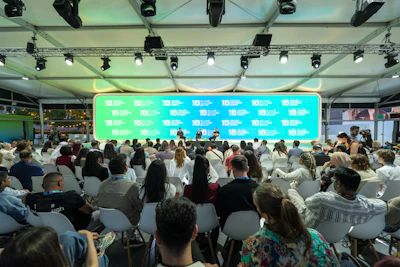
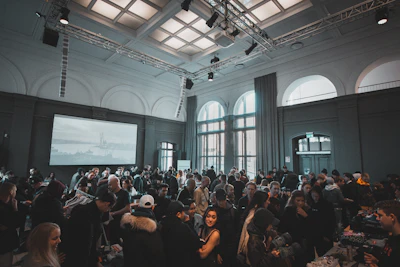
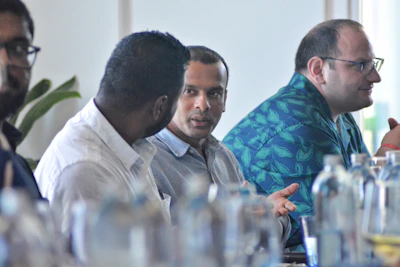
A panel discussion, usually just called a panel in the conference program, is a moderated conversation on stage in which three to five experts discuss a shared question in front of an audience. It typically lasts forty-five to sixty minutes, at some meetings up to ninety, and runs without slides, led by a moderator who asks the questions and allocates speaking time. As a result, each individual on stage has only a few minutes of their own speaking time, spread across the whole session. Whether the appearance pays off commercially depends less on this time than on whether the room can see what you stand for.
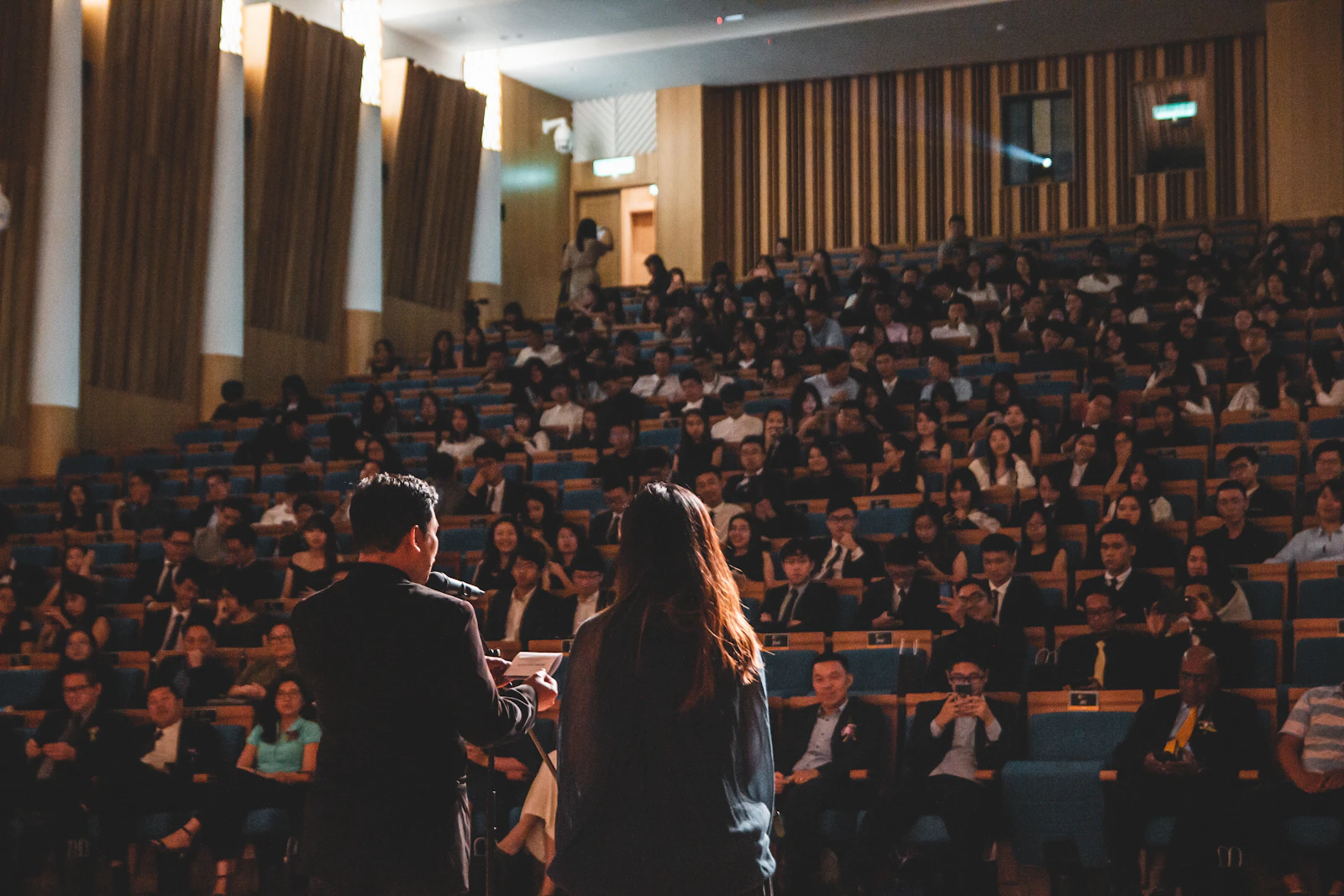
A panel discussion, usually just called a panel in the conference program, is a moderated conversation on stage in which three to five experts discuss a shared question in front of an audience. It typically lasts forty-five to sixty minutes, at some meetings up to ninety, and runs without slides, led by a moderator who asks the questions and allocates speaking time. As a result, each individual on stage has only a few minutes of their own speaking time, spread across the whole session. Whether the appearance pays off commercially depends less on this time than on whether the room can see what you stand for.
How does a panel discussion work?
A panel discussion follows the same pattern almost everywhere: an introduction by the moderator, a round of introductions, blocks of questions, audience questions and often a closing sentence from each panellist. In the introduction the moderator explains in two minutes why this question is being discussed on stage right now. In the round of introductions each participant briefly gives their name and the perspective from which they look at the matter. In the main part the moderator asks a question, directs it at a specific person, brings in one or two opposing voices and moves on to the next block.
On stage there are bar stools or armchairs, usually in a slight semicircle facing the audience, plus a place for the moderator at the side. Each of the discussants, known in the business as panellists, wears a clip-on microphone or has a handheld one in front of them. The screen stays dark or shows only the title of the session, because a panel has no slides and no running order you have set yourself.
The seating plan plays a part. Whoever sits at the edge drops out of the moderator's field of vision more easily, as the moderator looks back and forth between the middle seats, and the seat next to the moderator gets addressed more often. Small-group research has described a related finding since 1950 as the Steinzor effect: people seated opposite each other address one another more often than neighbors do. You can rarely choose your seat, but it explains why some panellists have said twice as much as others after sixty minutes.
How is a panel cast?
A panel is cast by perspectives. Organizers look for people who answer the same question from different camps, meaning someone from a company that uses the solution, someone from the vendor side and often an academic or association voice to put the dispute in context. This mix creates the friction the format thrives on, while a group of four people who think the same becomes tedious for the audience.
There are several routes onto the stage. The most common is a direct request: someone from the program organization knows you, has seen you speak or has come across something you published. A second route runs through your own session at the same conference, because organizers like to fill their panels with people who are on site anyway. With sponsorship, a financing company gets a seat on the panel and decides itself whom to send.
Panels come about through the open call less often than talks, and when they do, it is as a fully cast group that someone submits together with the moderator. The call for papers, meaning the public process through which a conference collects talk proposals, mainly asks for talks and workshops. It is not unusual for a panel to be complete only four weeks before the event, because someone dropped out. How you get onto these lists in the first place is covered in the article How do I become a speaker at conferences?, and the guide to becoming a speaker describes the whole path to the first stage.
The moderator directs
On a panel the lead lies with the moderator. They decide who answers first, who gets a follow-up question, when a topic is closed and when someone is interrupted. For someone used to giving talks this feels unfamiliar, but it has a practical advantage: if a contribution from the audience gets out of hand or a panellist overreaches, tidying up is the moderator's job.
Good moderators prepare. One to two weeks beforehand an email arrives with the planned blocks of questions, sometimes followed by a short video call with everyone involved, in which it is clarified who represents which position and where the group should disagree. This briefing is the most important appointment of the whole format, because it sets the role you play in the session and because there you can name your strongest question.
How much speaking time does each person get on a panel?
On a sixty-minute panel each person gets around eight to twelve minutes of speaking time. The introduction and the round of introductions take a good ten minutes of the hour together, and the audience questions at the end need another ten to fifteen. That leaves around thirty-five minutes for the actual discussion, divided by four people on stage, and anything beyond that comes out of the others' time.
These minutes come in pieces. An answer lasts one to two minutes, then the floor moves on, and you sit quietly for four minutes while two others work through your statement. A coherent line of thought over ten minutes, as a talk allows, is not part of a panel. A panel therefore calls for three or four positions that hold up in ninety seconds and bring evidence with them.
What does a panel discussion bring for winning clients?
For winning clients, a panel discussion mainly gives you proof of your judgment under contradiction, while it delivers less content than your own session. Ten minutes in fragments are not enough for a fully developed argument. In return the audience sees you in a situation closer to a consulting conversation than any talk: someone pushes back, you answer without preparation time, and the room judges whether there is substance behind it.
Then there is the company you keep. On a panel you sit next to people whose names are better known in your field than yours, and the audience reads this line-up as the organizer's statement about who has a say on this question. How such signals build into a reputation over time is described in the article on personal brand as a speaker.
If your position stays unclear, the appearance dilutes your profile, and the expert status on this question passes to the panellist who argued more clearly. A panel therefore has the strongest effect when you also give your own session at the same event: the panel creates attention, and the depth comes from the session. Stage Starter takes this work off your hands: we find the right calls, write the submission and submit it. We develop the talk and abstracts for your own session and approach organizers directly, from $999 net per month. Which other formats at a conference are suitable for this combination is set out in the overview.
How to recognize a poorly prepared panel
You recognize a poorly prepared panel early. If only the confirmation of the date arrives, without a briefing and without a list of questions, nobody has thought about the line-up. If six people sit on stage, the panel is too full arithmetically, because with sixty minutes each person is left with five. If the announced question is so broad that everyone can agree with it, you are in for an hour of friendly platitudes. During the session it shows in a round of introductions without a time limit and in a moderator who puts each question to everyone in turn, so that four people say the same thing one after another.
In a weak panel the temptation grows to rescue your own visibility through volume and to speak into every gap. The room holds that against the individual. A clear position per block with a concrete example from your own work comes across as more reliable, because in a tedious panel the person who says something verifiable stands out.
After a talk the audience leaves with a thought, after a panel with an impression of the people on stage. It forms from small things: who listened while someone else was speaking, who answered the question that was asked, who admitted a weakness in their own argument without seeming diminished. Research on so-called thin slices shows how quickly such impressions form: observers watching silent video clips of under thirty seconds formed judgments of teachers that predicted their ratings at the end of the semester. For decision-makers in the room these observations are close to their actual question of whom they want to work with.
Frequently asked questions
What is the difference between a panel and a panel discussion?
A panel and a panel discussion are the same format, a moderated stage conversation between several experts in front of an audience. Panel is the short form that has become established in conference programs. Panel sometimes also refers to the group of discussants themselves.
Do I need slides for a panel?
You almost never need slides for a panel. Panels run without a presentation, and the screen shows at most the title and names. You bring positions and examples in your head, plus one or two figures you can back up with confidence.
How do I prepare for a discussion whose course I do not know?
You prepare through the blocks of questions the moderator sends in advance and through the other participants. If you know which position the person next to you represents, you can sharpen your own against it. The order is decided by the moderator in the room.
Is a panel suitable for a first appearance on stage?
A panel is riskier than a talk for a first appearance, because nothing can be fixed beforehand and experienced fellow panellists fill the room. With a few sessions of your own behind you it becomes much easier.
What do I do if another panellist takes over the discussion?
If another panellist takes over the discussion, you leave the correction to the moderator, since a calm glance in their direction is usually enough. Pushing back yourself rarely comes across well. When it is your turn, a short, concrete answer counts for more than an attempt to make up lost minutes.
How do I moderate a panel discussion?
You moderate a panel discussion as its director: you prepare blocks of questions, clarify the positions in a briefing and steer speaking time, follow-ups and transitions on stage. The moderator gives the floor deliberately, follows up on evasive answers and keeps the round of introductions short. What belongs to preparation and steering is described in the article on moderating a panel discussion.
What questions are typically asked in a panel discussion?
Typical are an opening question on each participant's perspective, position questions to individual panellists, controversial questions that set two camps against each other and a forward-looking question at the end. Good moderators direct each question at a specific person and then bring in an opposing voice. Questions everyone can agree with make a panel tedious.
Do you get paid for taking part in a panel?
You are usually not paid for taking part in a panel at an industry conference, you get a ticket like the other speakers. Fees go mainly to well-known names at corporate events and to professional moderators. For experts, a single assignment from the audience is worth more than any fee.
If you want to know at which conferences in your field your own session and a panel fit together, talk to us in a first consultation. We look at your topic and the stages where your clients sit.

Marin Niehues is a management consultant and international speaker. With Niehues Consulting he works with organisations from scale-ups to DAX 40 corporations, and on stage he has spoken at more than 45 conferences in 23 countries.
All articles by Marin Niehues