

Trade fair talk: what the UFI Barometer means for speakers
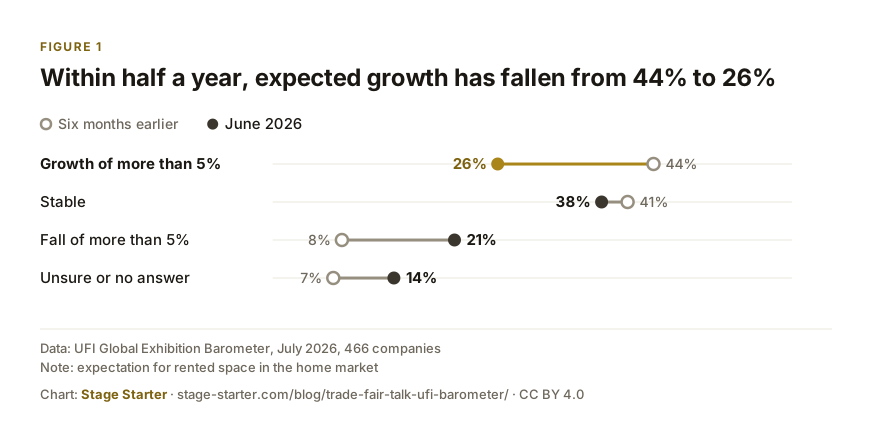
A trade fair talk in 2026 takes place in an industry that, according to the UFI Global Exhibition Barometer of July 2026, is planning more cautiously than it was six months ago. Only 26 percent of the 466 companies surveyed in 59 countries and regions expect rented space in their home market to grow by more than 5 percent, compared with 44 percent six months earlier. At the same time, 91 percent of the companies use AI, four percentage points more than in the previous half-year. In our assessment, this means that a trade fair talk that brings visitors into the hall and gives exhibitors conversations is easier to justify in a market with subdued expectations than a general talk on trends.
A trade fair talk in 2026 takes place in an industry that, according to the UFI Global Exhibition Barometer of July 2026, is planning more cautiously than it was six months ago. Only 26 percent of the 466 companies surveyed in 59 countries and regions expect rented space in their home market to grow by more than 5 percent, compared with 44 percent six months earlier. At the same time, 91 percent of the companies use AI, four percentage points more than in the previous half-year. In our assessment, this means that a trade fair talk that brings visitors into the hall and gives exhibitors conversations is easier to justify in a market with subdued expectations than a general talk on trends.
The UFI Global Exhibition Barometer of July 2026 in figures
The Barometer is published twice a year by UFI, The Global Association of the Exhibition Industry. The 37th edition of July 2026 draws on a global survey that was concluded in June 2026 and analyzes 20 individual markets and regions. The trade portal TTG MICE reported on the results on July 13, 2026. UFI itself points out that the answers are not weighted by company size, so some regional or global results cannot claim to be fully representative.
Respondents were asked what they expect for 2026 compared with 2025, and the report adds a separate analysis by the type of activity of the company. For rented space, 26 percent of respondents worldwide expect growth of more than 5 percent in their home market, 38 percent expect stable activity (plus or minus 5 percent), 21 percent expect a fall of more than 5 percent and 14 percent are unsure. For total revenue, UFI reports that 27 percent of companies expect growth of more than 5 percent and 38 percent expect stable figures. For Germany, the report gives 24 percent expecting growth and 35 percent expecting stable revenue.
The most important business issue for the next 12 to 18 months is the state of the economy in the home market (19 percent), closely followed by geopolitical challenges at 18 percent, two points more than in December 2025.
What a trade fair talk is and how it differs from a conference talk
A trade fair talk is a professional talk in the supporting program of a trade fair. It is given on a forum in the hall or in a conference room on the fairground. The audience consists of visitors who came for the exhibitors and listen between two conversations at the stands, as well as exhibitors who look after their customers. At a pure professional conference, which we compare in the article Industry conference, congress, barcamp, trade fair, the audience comes for the program instead.
This leads to a different standard for selection. To win exhibitors and visitors, an organizer needs talks that bring people into the hall and that exhibitors see as added value for their presence at the fair. The Barometer measures neither fees nor programs, so this connection is our reading of the figures and not a finding by UFI.
Trade fair talks and rented space: expectations have fallen within half a year
The Barometer compares the current survey with the one from December 2025. UFI writes that, as a result of the situation in the Middle East, the results appear more cautious than six months ago.
Figure 1
Within half a year, expected growth has fallen from 44% to 26%
Source: UFI Global Exhibition Barometer, July 2026, 466 companies
Note: expectation for rented space in the home market
Data and download
Style
Embed
Data as table
| Label | Six months earlier | June 2026 | Change |
|---|---|---|---|
| Growth of more than 5% | 44% | 26% | −18% |
| Stable | 41% | 38% | −3% |
| Fall of more than 5% | 8% | 21% | +13% |
| Unsure or no answer | 7% | 14% | +7% |
Chart: Stage Starter, CC BY 4.0. Data: UFI Global Exhibition Barometer, July 2026, 466 companies; the source's terms apply.
The share of companies expecting a fall has more than doubled in a half-yearly survey, and the share of the unsure has doubled as well. A fair that rents out less space earns less and has to argue more strongly why a stand pays off. A good supporting program is one such argument, because it holds visitors and gives exhibitors occasions for conversations. This is an assumption we derive from the figures, and it applies to different fairs to different degrees.
The picture differs by region. UFI describes that in Europe most respondents expect stable activity, and that Spain and Türkiye stand out with more than four in ten respondents expecting growth of more than 5 percent. Anyone planning fairs should therefore look at each country and each fair separately and avoid orienting on a world average.
91 percent of fair companies use AI: what this means for your abstract
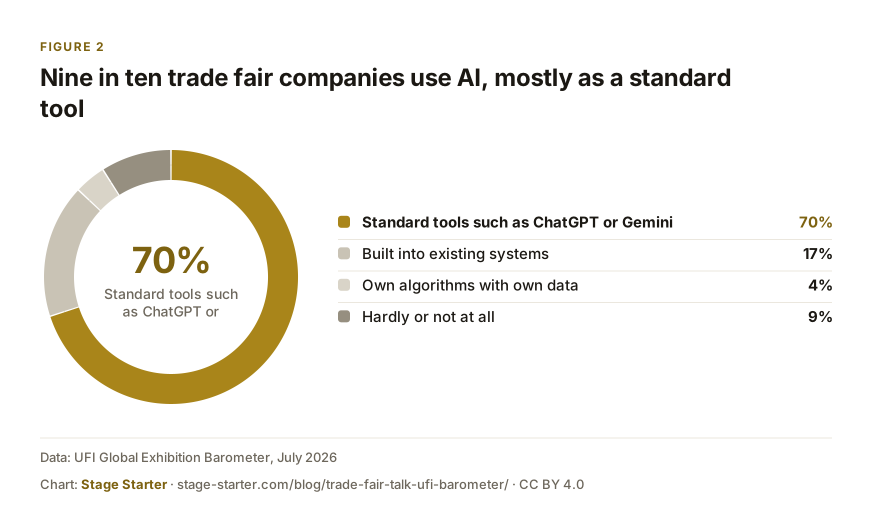
The second big figure of the Barometer concerns AI. According to UFI, 91 percent of companies in the industry now use AI, four percentage points more than six months ago. 70 percent use standard tools such as ChatGPT or Google Gemini in at least some functions. A further 17 percent have built AI tools into their existing systems, and 4 percent have developed their own algorithms with their own data. The remaining 9 percent use AI hardly or not at all.
Figure 2
Nine in ten trade fair companies use AI, mostly as a standard tool
Source: UFI Global Exhibition Barometer, July 2026
Data and download
Maturity shows where the industry stands. For efficiency within the company, 62 percent are testing or using AI solutions (ten points more than six months ago), for customer experience 53 percent (plus six points) and for products that generate revenue 28 percent (plus six points). In Germany the share for efficiency is 84 percent, among the five highest values in the survey, and according to UFI 39 percent of German respondents have reached one of the two highest levels, meaning their own algorithms or AI tools integrated into their platforms.
For your abstract, this means that an organizer who works with AI has often seen a talk about AI as a buzzword already. A trade fair talk with a case of your own, in which you describe what a company implemented with AI and what came out of it, stands apart from that.
How to apply for a trade fair talk in a cautious market
Four steps follow from the figures and from our assessment, and you can take them in this order.
- Choose fairs where your clients are visitors or exhibitors: A trade fair talk pays off for you if the audience includes people who pay for your topic. How you check this before submitting is described in the article How do I find the conferences that suit my topic?.
- Describe the benefit for visitors and exhibitors: State in the abstract what a visitor does differently after 30 minutes and what conversation an exhibitor can have with their customers afterwards.
- Keep the talk free of advertising: A professional talk with a case of your own builds trust, and a product talk loses it. Where the line runs is described in the article Expert talk or sales pitch: where the audience draws the line.
- Plan the time after the talk: At fairs, the conversations happen in the aisle and at the stand, and the sooner you follow up, the more likely people are to remember you, as we describe in What happens after the conference, and where the business comes from.
A calculation for three trade fair talks a year
Because the Barometer gives no figures on talk programs, the following calculation is an example with assumptions. Suppose you give three trade fair talks of 30 minutes each per year, 60 visitors sit in each room, and you get into conversation with every tenth. That makes six conversations per talk and 18 a year. If one in six conversations leads to an offer, three offers a year result, and if one of them becomes an order, the year pays off for you as soon as the order value exceeds the cost of all three appearances, including travel and working time. Whether a fair suits this better than a stand is worked out with prices in the article Conference Talk, Trade Fair Stand or Sponsorship: Cost per Contact Compared.
Our own figures add to the planning. Marin Niehues has spoken at more than 45 conferences in 23 countries on six continents and was listed by Sessionize as Most Active Speaker in 2024 and 2025. From this experience it follows for planning that you offer a topic to several fairs and conferences at once, so that more dates come together than if you wait for a single call.
Frequently asked questions
How do I get a trade fair talk?
You apply to the organizer, either through an open call for the supporting program or by approaching the person responsible for the program directly. An abstract with a case of your own and a clear benefit for visitors and exhibitors makes the selection easier. Expect that not every fair issues a call and that the submission often falls months before the event.
What is a trade fair talk?
A trade fair talk is a professional talk in the supporting program of a trade fair, usually on a forum or stage in the hall. The audience consists of visitors and exhibitors who listen between conversations at the stands.
What does the UFI Global Exhibition Barometer say about the fair industry in 2026?
According to the 37th edition of July 2026, 26 percent of respondents expect rented space in their home market to grow by more than 5 percent, 38 percent expect stable figures and 21 percent expect a fall. The survey covers 466 companies in 59 countries and regions and was concluded in June 2026.
Do trade fair organizers use AI?
According to the Barometer, 91 percent of the companies surveyed use AI, four percentage points more than six months ago. Most use standard tools, and 17 percent have integrated AI into existing systems.
Is a trade fair talk worthwhile for B2B consultants?
A trade fair talk is worthwhile if the audience includes people who pay for your topic and if you follow up after the talk. Whether it pays off depends on the order value in relation to travel costs and working time, and the calculation above shows how to work this out with your own figures.

Marin Niehues is a management consultant and international speaker. With Niehues Consulting he works with organisations from scale-ups to DAX 40 corporations, and on stage he has spoken at more than 45 conferences in 23 countries.
All articles by Marin Niehues