

Call for Speakers: How to Find Open Calls and Get Selected in 2027
A call for speakers is the public invitation a conference issues to collect talk proposals, and for US conferences in the spring and summer of 2027 many of these calls are open in November and December 2026. According to Sessionize, the platform that 12,400 events have used to select their speakers, organizers open their call on average 156 days before the event and keep it open for 59 days. The Society for Human Resource Management (SHRM) is accepting proposals for its HR-X Live! conference, which takes place in Chicago at the end of June 2027, until December 15, 2026, and sends its decisions in April 2027. For speakers, this means the US stages of 2027 are being awarded right now, to proposals with a clear title, a proven benefit for the audience and no sales pitch.

A call for speakers is the public invitation a conference issues to collect talk proposals, and for US conferences in the spring and summer of 2027 many of these calls are open in November and December 2026. According to Sessionize, the platform that 12,400 events have used to select their speakers, organizers open their call on average 156 days before the event and keep it open for 59 days. The Society for Human Resource Management (SHRM) is accepting proposals for its HR-X Live! conference, which takes place in Chicago at the end of June 2027, until December 15, 2026, and sends its decisions in April 2027. For speakers, this means the US stages of 2027 are being awarded right now, to proposals with a clear title, a proven benefit for the audience and no sales pitch.
What a call for speakers is and how it differs from a call for papers
A call for speakers is the process through which you apply with a talk proposal for a conference program. The name changes from organizer to organizer. Sessionize writes in its guide to submitting a session that the call for speakers page is sometimes called a call for papers, SHRM calls its process a Call for Presentations, and at SXSW in Austin the submissions are called proposals and run through the PanelPicker process. A fourth common name is call for proposals.
The call for papers comes from academia, where researchers submit a written paper that a committee reviews. At industry conferences you submit the same core material under any of these names, which is a title and a session description together with information about yourself. Some calls also ask for learning outcomes, a video or proof of earlier talks. How the process works in general is explained in our article What is a call for papers.
Where to find open calls for speakers in the US
There are three places to search, and each of them shows you a different part of the market. The first is Sessionize. Many US conferences publish their call on Sessionize, including four of the seven calls we read for this article. According to its homepage, 323,000 speakers use the platform to apply for conferences, and its page for speakers promises to help you discover events that match your profile, which stays free. Every conference there has a public call page with the event dates, the venue and the deadline in its own time zone, plus the terms for speakers such as travel, hotel and fees. Sessionize itself advises you to look for the call on the conference website and its social media channels first, and points out that plenty of events fill some or all of their slots by invitation.
For an overview across platforms, CallingAllPapers says it crawls joind.in, confs.tech, papercall.io and Sessionize daily for new calls and publishes the open ones as a list and as a calendar file. If a conference is missing from that list, its call is probably on none of those platforms, and your next stop is the conference website.
The second source is the conference website, because large US conferences run their calls on their own sites. For SXSW, which takes place March 15 to 21, 2027, in Austin, the public vote on PanelPicker proposals ran from August 5 to 23, 2026, and according to SXSW the final sessions are decided by the public together with the SXSW Advisory Board and SXSW staff. How to submit there is covered in our article Call for papers at SXSW.
Professional associations are the third source, and in the US many of them run their own conferences with their own calls. SHRM lists every event on its Call for Presentations page with the submission deadline and the date by which decisions go out, and it also points to SHRM state and affiliate conferences, which are managed independently. One example is SOAHR 2027, the annual conference of SHRM-Atlanta, whose call on Sessionize was open from October 2 to November 15, 2026.
Call for speakers deadlines: months pass between submission and stage
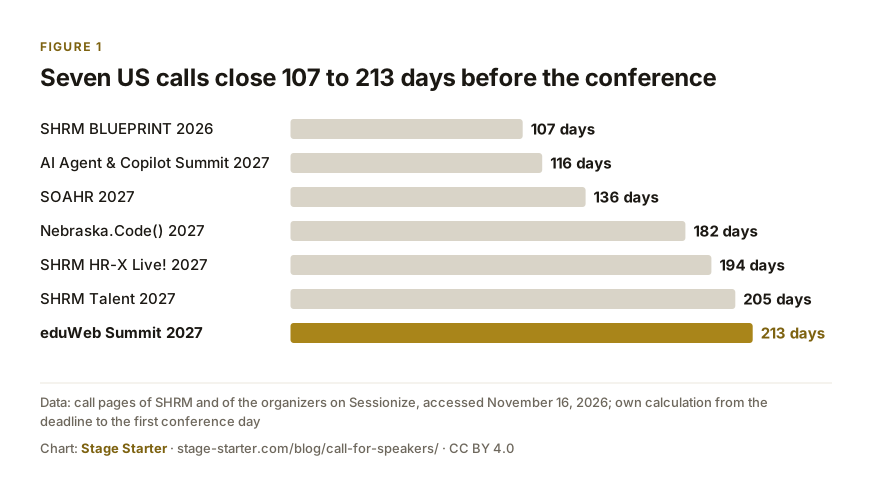
The Sessionize averages describe a steady rhythm. If you open the call 156 days before the event and keep it open for 59 days, it closes about three months before the conference. In the US calls we read on the official pages, the gap is usually even larger.
Figure 1
Seven US calls close 107 to 213 days before the conference
Source: call pages of SHRM and of the organizers on Sessionize, accessed November 16, 2026; own calculation from the deadline to the first conference day
Data and download
Style
Embed
Data as table
| Label | Value (days) |
|---|---|
| SHRM BLUEPRINT 2026 | 107 days |
| AI Agent & Copilot Summit 2027 | 116 days |
| SOAHR 2027 | 136 days |
| Nebraska.Code() 2027 | 182 days |
| SHRM HR-X Live! 2027 | 194 days |
| SHRM Talent 2027 | 205 days |
| eduWeb Summit 2027 | 213 days |
Chart: Stage Starter, CC BY 4.0. Data: call pages of SHRM and of the organizers on Sessionize, accessed November 16, 2026; own calculation from the deadline to the first conference day; the source's terms apply.
For Talent 2027, which SHRM holds in April in the Denver metro area, the deadline was already September 18, 2026, with decisions sent by December 18. Three of the conferences in the table above take place in the summer of 2027 and close their calls in December 2026. If you want to speak in the US next year, you plan your calendar twelve months ahead and sort your submissions by deadline, so that the fall and early winter become your main submission season.
Watch the time zone as well. SHRM accepts proposals until 5:00 PM Eastern Time, which is 2:00 PM for a speaker in California, while the SOAHR call closed at 11:59 PM Eastern. Sessionize also shows each closing time in your own time zone.
What program committees review in a call for speakers
Sessionize recommends that organizers publish their criteria, for example topic relevance, speaker expertise and potential impact on the audience. According to its guide to evaluations, the platform offers three evaluation modes: reviewers compare sessions against each other, rate them with stars or decide with a simple yes or no. In anonymous mode, Sessionize replaces speaker names with pseudonyms and hides photos and bios, so your text has to win on its own.
The call pages themselves show how US committees read. SOAHR states that the description you enter in the submission form is used in jury selection and later appears in marketing materials, and it prohibits speakers from using the podium to promote their product or service. Nebraska.Code() puts content above everything else and asks for a title that makes the topic clear, together with a summary of what attendees take away. Its AI guidelines add that you must be able to back up every number on your slides. SHRM aligns all session topics with its competency model SHRM BASK and asks for proof of performance that demonstrates your speaking experience.
How to choose the right call for speakers and submit
Before you write, read the terms, because many US conferences with an open call pay nothing. SOAHR explicitly looks for contributors who share their expertise without expectation of payment, and at eduWeb Summit you pay for travel and hotel yourself. Say a talk in another US city costs you $1,200 for a flight and two hotel nights. That spend pays off when the room is full of the clients your service is built for.
- Check the audience: Read the conference description and the topics of the call, and ask whether decision makers from your target market will be in the room.
- Write the title: According to Sessionize, which analyzed data from 500,000 sessions, titles of 40 to 60 characters are the sweet spot, and a good title tells attendees what the session is about as they scan the program.
- Build the description: Sessionize's tips for session descriptions recommend opening with a problem, showing how your session solves it and naming the benefits early, at 150 to 300 words if the call sets no limit. How to structure an abstract is shown in Write a conference abstract.
- Tailor every version: Write a separate description for each call that fits the focus and audience of that conference.
- Submit early: SHRM asks speakers to submit well in advance of the deadline to avoid last-minute technical issues.
A single call remains an application with an open outcome. In a representative sample of our submissions for clients, 2024 to 2026, the acceptance rate is around 7 percent per abstract and up to 19 percent per conference, compared with a market norm of at most 5 percent per conference.
Figure 2
Up to 19 percent acceptances per conference in our sample, against a market norm of at most 5 percent
Source: a representative sample of our submissions for clients, 2024 to 2026
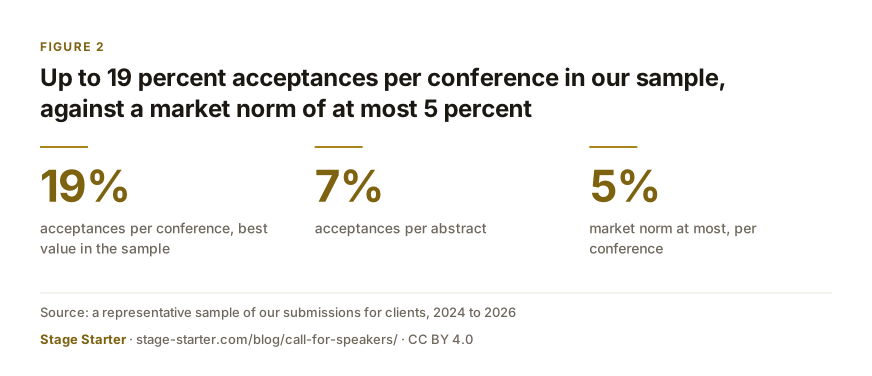
Say you submit 15 abstracts to US conferences in one season and reach around 7 percent per abstract. You can then expect roughly one acceptance. If you want several stages a year, you plan for more submissions from the start, and how to raise the rate is covered in Call for papers acceptance rate.
Common call for speakers mistakes
The most expensive mistake is the abstract that goes to every conference unchanged. Sessionize lists it among its five don'ts, together with incomplete work-in-progress descriptions in passive voice, overpromising and letting AI do the work for you. US association conferences add a second trap, the expert talk that turns into a product presentation on stage, which SOAHR rules out in its expectations for speakers. You can also avoid two smaller losses: a missed deadline because of the wrong time zone, and a number in your abstract that you cannot back up when a reviewer asks.
The role of a speaker agency in a call for speakers
A speaker agency takes over the work between your expertise and the acceptance. For US conferences, the biggest gain is an overview of deadlines spread across the whole year and of speaker terms that vary widely from one event to the next.
Frequently asked questions
What is a call for speakers?
A call for speakers is a conference's public invitation for speakers to apply with a talk proposal for its program. Depending on the organizer, the same process is also called a call for papers, a call for proposals or a call for presentations.
Where can I find open calls for speakers in the US?
Many open calls are listed on Sessionize, where every conference has its own call page with the deadline and the terms for speakers. Other sources are the websites of large conferences such as SXSW, professional associations such as SHRM and aggregators such as CallingAllPapers, which crawls several platforms daily.
When should I apply to speak at US conferences in 2027?
According to Sessionize, organizers open their call on average 156 days before the event and keep it open for 59 days. For conferences in the spring and summer of 2027, many deadlines therefore fall between September and December 2026.
Do conference speakers in the US get paid?
At many conferences with an open call there is no honorarium, and you often pay for your own travel. Some organizers cover the hotel or pay for workshops, for example Nebraska.Code() 2027 pays its workshop speakers $20 per attendee.
What do program committees look for in a call for speakers?
Program committees mainly check whether the topic is relevant to their audience, whether the benefit is clearly described and whether the speaker has credible expertise. Conferences such as SOAHR explicitly prohibit promoting your own product, and on Sessionize organizers can review proposals anonymously.

Marin Niehues is a management consultant and international speaker. With Niehues Consulting he works with organisations from scale-ups to DAX 40 corporations, and on stage he has spoken at more than 45 conferences in 23 countries.
All articles by Marin Niehues