

Expert talk: 59 percent want industry experts on stage
An expert talk convinces attendees above all through practical cases and actionable takeaways, and according to the Freeman Trends Report of April 16, 2026, that is exactly where they see the biggest gap. The event services provider Freeman surveyed more than 4,700 attendees and 185 organizers of conferences and trade shows for the report. According to the trade publication Trade Show Executive, 59 percent of attendees prefer industry experts as speakers in general sessions, and 84 percent want speakers who leave them with actionable takeaways, while only 64 percent find them doing so. For experts with practical experience, this means that an expert talk built around an evidenced case and three clear action steps delivers what attendees miss on conference stages.
An expert talk convinces attendees above all through practical cases and actionable takeaways, and according to the Freeman Trends Report of April 16, 2026, that is exactly where they see the biggest gap. The event services provider Freeman surveyed more than 4,700 attendees and 185 organizers of conferences and trade shows for the report. According to the trade publication Trade Show Executive, 59 percent of attendees prefer industry experts as speakers in general sessions, and 84 percent want speakers who leave them with actionable takeaways, while only 64 percent find them doing so. For experts with practical experience, this means that an expert talk built around an evidenced case and three clear action steps delivers what attendees miss on conference stages.
The Freeman Trends Report on the expert talk: what was measured
Freeman is a service provider for conferences and trade shows, and the report of April 16, 2026 is addressed to organizers. It is the first part of a series on learning at events and asks how knowledge lands in conference rooms and general sessions. The press release gives the basis as more than 4,700 attendees and 185 organizers surveyed.
The result Freeman puts first concerns in-person attendance. 70 percent of attendees name in-person events as their top source of professional learning, ahead of webinars, on-demand platforms and social media. Fewer than 20 percent give continuing education credits as their main reason for attending. About half of attendees go to keynote sessions, and Freeman also writes that organizers overestimate the effectiveness of their educational offerings, particularly when it comes to practical relevance and to the actionable insights attendees take away from a session. All figures are self-reported and therefore show how respondents perceive sessions, without saying anything about how often they later apply what they learned.
An expert talk is a conference contribution from your own practice, and attendees judge it on three things
An expert talk is a conference contribution in which an expert prepares a topic from their own professional practice for a specialist audience and gives the listeners concrete insights to take away. The figures that Trade Show Executive reports from the study show what attendees measure such a talk against.
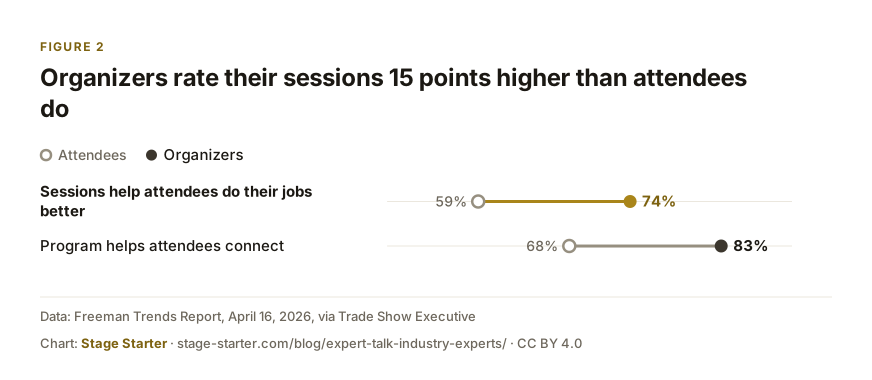
The first is the person on stage: 59 percent of attendees want to hear industry experts in general sessions and plenary addresses. The second is the case from practice: 87 percent consider speakers who show real challenges important, but only 75 percent find speakers effective at it. The third is what attendees take with them: 84 percent want speakers to leave the audience with actionable takeaways, and only 64 percent see that fulfilled. How keynotes and plenary talks at conferences are built and who gives them is described in our article What is a keynote at a conference.
Figure 1
84 percent want actionable takeaways, only 64 percent see that fulfilled
Source: Freeman Trends Report, April 16, 2026, via Trade Show Executive
Attendees and organizers rate the expert talk differently
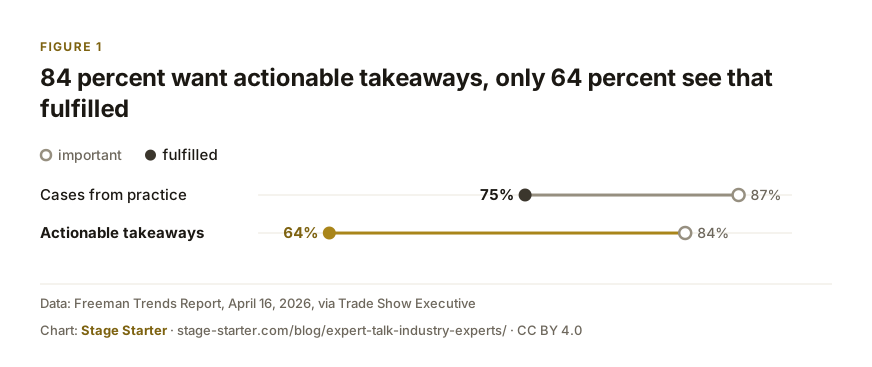
The comparison of the two groups of respondents is revealing, because both have the same sessions in view and still reach different verdicts.
The figures come from the report by Trade Show Executive. Both gaps amount to 15 percentage points. That only 47 percent of attendees see general sessions adding to the ROI of their visit shows how much a single main-stage talk has to prove. For you as a speaker, this is an advantage, because a talk that visibly changes something stands out from a program that attendees rate with some reserve on average, and anyone who narrows this gap with an evidenced case gives the program committee a reason to put the talk on the program.
Figure 2
Organizers rate their sessions 15 points higher than attendees do
Source: Freeman Trends Report, April 16, 2026, via Trade Show Executive
Data and download
What the gap costs your expert talk: a calculation with assumptions
The following calculation is an example and not a measurement, and it transfers the values of the overall survey to an assumed audience. Suppose you give six expert talks a year to 100 listeners each, which puts 600 people in your sessions. If 84 of 100 listeners expect actionable takeaways and only 64 receive them, 20 of 100 listeners miss the takeaways. That is one fifth of the audience and means 120 people a year at 600 seats who leave with an unmet expectation.
If you close half of this gap, that is ten percentage points, you reach 60 more people at the same 600 seats who take away something they can apply on the next working day. Which listeners you meet at a specialist event is described in the article Who sits in the audience at an industry conference.
How to build an expert talk that delivers takeaways
Five preparation steps follow from the figures, and you settle them before the first slide is made and before the abstract goes to the organizer.
- Write down three takeaways before you build slides: Each takeaway begins with a verb and describes something a listener can do the following Monday, such as changing a procedure, measuring a figure or asking a question in the team. These three sentences belong in the abstract and on the closing slide.
- Choose a single case from your practice: 87 percent of attendees consider real-world examples important. A case with a starting point, an approach and a figure before and after your intervention convinces more than three briefly sketched examples.
- Show the path in steps: The case becomes applicable for listeners when they can see the sequence of your steps and transfer it to their own situation. One slide with the three to five steps does more for this than a long narrative.
- Offer the organizer a second form: According to Trade Show Executive, the report advises organizers to offer the same content in different formats, such as a short talk, group work or a hands-on session. If you offer a workshop variant in the abstract alongside the talk, you give the program committee more ways to say yes. Which formats conferences know is covered in the article Which session formats exist at a conference.
- Close with a slide titled "What you do tomorrow": It repeats the three takeaways and names the first step for each, so that listeners only need to take a photo of it.
How to submit your expert talk as an industry expert
That 59 percent of attendees want to hear industry experts also applies to the abstract, because the program committee first reads there which experience you bring. The bio therefore belongs in the submission in concrete terms, with your industry, your role and a result from your own work that a committee member can follow in one sentence without knowing you. What committees look for in an abstract is summarized in the article What a program committee looks for in an abstract.
Marin Niehues, the founder of Stage Starter, has spoken at more than 45 conferences in 23 countries on six continents and was listed by Sessionize as Most Active Speaker in 2024 and 2025. He has spoken at more than 45 conferences in 23 countries.
Frequently asked questions
What is an expert talk, and how does it differ from a keynote?
An expert talk is a conference contribution in which an expert prepares a topic from their own practice for a specialist audience and conveys concrete insights. A keynote is the main talk in the plenary, usually at the start or end of a conference, and frames the theme of the whole event. An expert talk, by contrast, often runs as a session on one of several stages.
What do attendees expect from an expert talk according to the Freeman Trends Report?
According to the Freeman Trends Report of April 16, 2026, as reported by Trade Show Executive, 87 percent of attendees consider real-world examples important and 84 percent want to take away actionable insights. 59 percent prefer to hear industry experts in general sessions.
How many attendees did Freeman survey for the Trends Report?
In its press release of April 16, 2026, Freeman names more than 4,700 attendees and 185 organizers surveyed, and all figures are self-reported accounts of how respondents perceive sessions.
How do I prepare an expert talk?
Write down three takeaways first that a listener can apply on the next working day, then choose a case from your practice with a figure before and after your intervention. Next you show the steps that led to the result and close with a slide that names the first step for each takeaway.
How do I submit an expert talk to a conference?
You send the organizer an abstract with your topic and the takeaways in the call for papers, plus a short bio with your experience in the field. The more concretely the case and the closing step are described, the more easily the program committee can see the benefit for the audience.

Marin Niehues is a management consultant and international speaker. With Niehues Consulting he works with organisations from scale-ups to DAX 40 corporations, and on stage he has spoken at more than 45 conferences in 23 countries.
All articles by Marin Niehues