

Getting Mentioned in AI Answers Through Conference Talks: ChatGPT, Perplexity and Google
Conference talks bring your name into AI answers because programs, speaker pages and recordings are third-party sources that link your name to a topic. ChatGPT, Perplexity and Google's AI summaries build their answers from web pages and training data and name experts who appear on independent pages about a topic. The program page of a professional conference is such a page, written by someone else, with a date and a place. This article shows which traces a talk leaves behind, what research says about visibility in generative answers, how GEO differs from SEO and how you check whether AI assistants name you.

Conference talks bring your name into AI answers because programs, speaker pages and recordings are third-party sources that link your name to a topic. ChatGPT, Perplexity and Google's AI summaries build their answers from web pages and training data and name experts who appear on independent pages about a topic. The program page of a professional conference is such a page, written by someone else, with a date and a place. This article shows which traces a talk leaves behind, what research says about visibility in generative answers, how GEO differs from SEO and how you check whether AI assistants name you.
How do you get named as an expert in ChatGPT?
ChatGPT names you as an expert when your name appears together with your topic on several independent pages, and conference program pages are among the strongest of these. ChatGPT names people in two ways: from pages it retrieves live from the web while answering, and from what it read during training. Conference program pages work in both ways, because they are public and dated.
Imagine a managing director asks ChatGPT who in the German-speaking world speaks about supply chain risk in mid-sized companies. The system searches for pages on the question, summarizes them and names the sources it relies on. Perplexity always works with live search and shows its sources as numbered references. Google's AI Overviews draw on Google's search index and link to the pages they quote from. No provider discloses exactly which pages a system selects.
What can be observed is that an answer to a question about experts needs names, and the system finds names where they appear together with a topic. Your own website has both, but you wrote it yourself. The program page of a conference has both because an organizer put you in its program, which makes it a statement about you that a third party has given a date and a place. How to set up your own channels for search is covered in Getting found online as a speaker.
What is the difference between SEO and GEO?
SEO gets a page into a search engine's results list, while GEO gets content and names into the answer of a generative system. Generative engine optimization, GEO for short, means preparing content so that AI systems pick it up and cite it. The term comes from research on generative search systems and has become established in the industry since 2024.
The two are connected, because systems with live search rely on search indexes, and a page that ranks well gets read more often. They differ in what they measure: SEO tracks positions and clicks, GEO tracks whether a name or a statement appears in the answer. For experts this has its own logic, because a system is more likely to name a person the more independent sources link them to a topic.
What research shows about visibility in AI answers
A widely noted research paper tested how changes to the text of a web page affect whether generative search systems include the page in their answer. It measured the relative visibility of the page in test answers, in an experimental setup with its own metric.
Figure 1
Quotations and statistics raise visibility, keyword stuffing lowers it
Source: Aggarwal and colleagues, GEO: Generative Engine Optimization, KDD 2024
Note: Change in relative visibility in the experiment
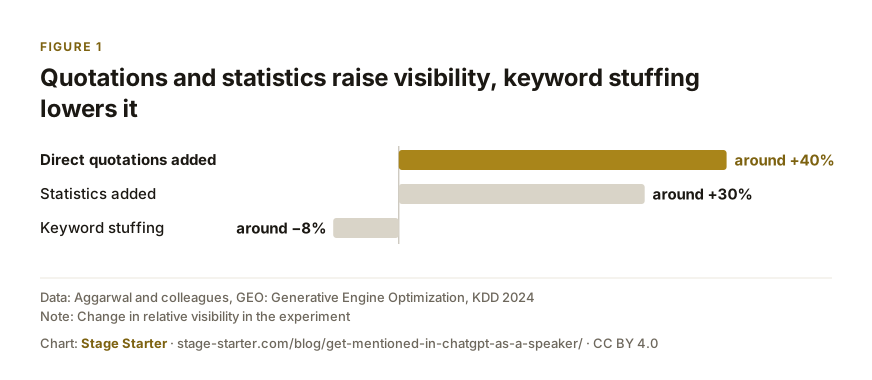
Named sources also increased visibility in the experiments, while cramming in search terms reduced it. The study looked at text features, and applied to conference programs this means that answer engines favor concrete, supported statements with a named origin. A program page consists of exactly such details, because it states who speaks about what, when and in which room. A self-description full of superlatives gives a system little it could quote.
What traces a talk leaves behind
A talk starts with an abstract, the short description of the planned talk that you submit to a conference's call for papers. The call for papers is the public invitation a conference uses to collect talk proposals, and the program committee, the organizer's body that puts the program together, decides on acceptance or rejection.
After an acceptance, several pages appear. The program page lists you with the title and description of your talk, and many organizers keep earlier editions online, so it stays findable for years. Often there is also a speaker page with photo and bio that links your name to your company and your field. After the conference come recordings, where the organizer publishes them, with descriptions or transcripts, and for a text-based system the text around a video is more reliably readable than the video itself. Write-ups by attendees add to this, which you neither write nor control. How the bio works here is covered in What a speaker bio has to do, because organizers often copy it almost unchanged.
How traces turn into a mention
A system that reads several pages is more likely to name a person when the name appears on independent pages about the same topic. A single program page is one trace, while several program pages from different conferences over two years form a pattern that is hard to read as chance. Your name should therefore be spelled the same everywhere, with the same title and the same company, and the topic should be named similarly in every source. If you choose a different label for every submission, you spread the traces across many terms.
Pay to speak delivers less here than it costs. A speaker buys a slot, usually as part of a sponsorship package, and that quickly costs €10,000 or more for a single slot. Sponsored talks are often not marked in the program, and the price still buys only one trace on one program page. Paid slots are discussed in detail in Sponsored talks and pay to speak.
Why these traces need lead time
A conference talk comes through open calls, and they close well before the conference. In our analysis of 2,415 conferences that publicly advertise speaking slots for 2026, the time between submission deadline and conference start is 50 days at the median and 65 days on average. This period covers the weeks until the decision and the publication of the program page, while the recording and write-ups only follow after the conference.
Across our submissions for clients we reach up to 19 percent acceptances per conference, because we submit several abstracts per conference and one acceptance is enough, while at this volume of submissions the market norm is 5 percent at most. Per abstract it is around 7 percent. How such rates come about is explained in What is the acceptance rate for calls for papers?. A pattern of several program pages therefore builds up over months and from a larger number of submissions, and an agency takes on that volume.
How do I check whether AI assistants name me?
You check by asking the questions your clients would ask and recording the answers at fixed intervals. These are questions such as "Who are the experts on supply chain risk in mid-sized companies?" or "Who in Germany speaks about B2B pricing strategy?", asked in ChatGPT, Perplexity, Gemini and Google search with AI Overviews. Use an account without history or a private browser window, because personalized answers distort the result.
For each question and system, note whether your name appears and which source the system cites. Once a month is enough, because answers vary from query to query and only a series over several months shows a direction. The cited sources are the most valuable part of the analysis, because they show which pages a system draws on for your topic.
What an agency takes on for visibility
The work behind these traces is more extensive than it looks from outside. Someone has to shape the talk topic so that a program committee sees value for its audience. Abstracts and the conference search follow, then forms that differ from conference to conference, and finally the follow-up.
Stage Starter takes on this work for you: we find the right calls, write the submission and submit it. We then follow up and support you all the way to the stage. From you we need your expertise and a one-time approval of talk and abstracts before the start, and because we write every submission from one source, your name and topic read the same everywhere. The collaboration starts from $999 net a month, and if you want a written roadmap first, you start with the Speaker Audit from $549 net, which is credited when you book the agency. The path to becoming a speaker as a whole is described in the guide to becoming a speaker.
Frequently asked questions
How do I get mentioned in ChatGPT?
ChatGPT names you when your name appears together with your topic on several independent pages. The system draws on pages it retrieves live and on what it read during training. Conference program pages and speaker pages work in both ways.
What is generative engine optimization?
Generative engine optimization, GEO for short, means preparing content so that generative search systems include it in their answers. In experiments, direct quotations increased a page's visibility by around 40 percent, and statistics and named sources helped as well. Keyword stuffing reduced it.
What is the difference between SEO and GEO?
SEO gets a page into a search engine's results list, GEO gets content and names into an AI system's answer. SEO measures positions and clicks, GEO measures mentions and citations. The two are linked, because AI systems with live search rely on search indexes.
How do I check whether AI assistants name me?
Once a month, ask your clients' questions in ChatGPT, Perplexity, Gemini and Google search with AI Overviews, in a private window without history. For each question, note whether your name appears and which sources are cited. Only a series over several months shows a direction.
Which sources does ChatGPT use for its answers?
ChatGPT uses its training data and, with web search enabled, pages it retrieves while answering and links as sources. For questions about experts, third-party pages that link a name to a topic matter most. Conference programs are among them, as are trade articles.
How do I get named in Google AI Overviews or Perplexity?
Google's AI Overviews draw on the Google search index, while Perplexity searches the web live for every question. Both name pages that answer a question concretely and with evidence. Conference program pages that link your name to your topic are among the sources both systems find.
How long does it take for a talk to show up in AI answers?
In our analysis, the median time between submission deadline and conference is 50 days, and the program page usually appears before the conference. Recordings and write-ups follow afterwards. A pattern of several talks builds up over months, and every further talk strengthens it.
If you want to know at which professional conferences your topic would leave traces, we can clarify that in a first conversation.

Marin Niehues is a management consultant and international speaker. With Niehues Consulting he works with organisations from scale-ups to DAX 40 corporations, and on stage he has spoken at more than 45 conferences in 23 countries.
All articles by Marin Niehues