

How to Get Booked as a Speaker: A Step-by-Step Plan for Experts
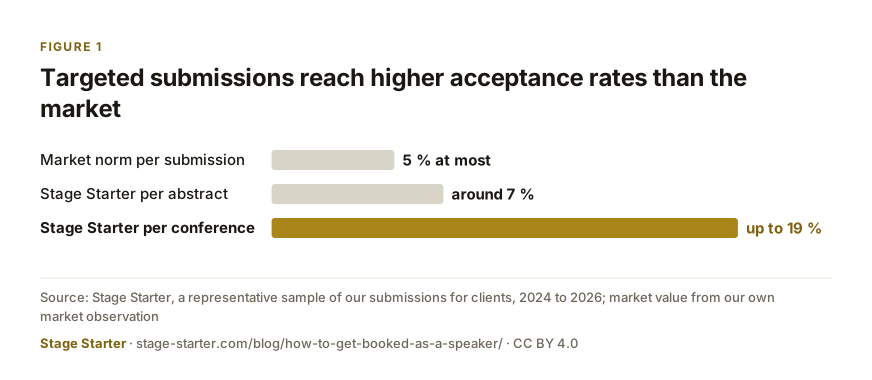
How to get booked as a speaker comes down to two routes: an organizer invites you (often as a keynote through a speakers bureau) or you apply with a talk proposal to a call for speakers. For experts without a famous name, applying is the realistic way in, and the odds are tight, because according to the Cloud Native Computing Foundation, KubeCon + CloudNativeCon North America 2024 accepted 11 percent of 1,937 submissions. In a representative sample of our submissions for clients, 2024 to 2026, the acceptance rate is around 7 percent per abstract and up to 19 percent per conference, while the market norm is 5 percent at most. Getting booked therefore takes a plan that runs from your topic to the follow-up, plus six to nine months of lead time before your first talk.

How to get booked as a speaker comes down to two routes: an organizer invites you (often as a keynote through a speakers bureau) or you apply with a talk proposal to a call for speakers. For experts without a famous name, applying is the realistic way in, and the odds are tight, because according to the Cloud Native Computing Foundation, KubeCon + CloudNativeCon North America 2024 accepted 11 percent of 1,937 submissions. In a representative sample of our submissions for clients, 2024 to 2026, the acceptance rate is around 7 percent per abstract and up to 19 percent per conference, while the market norm is 5 percent at most. Getting booked therefore takes a plan that runs from your topic to the follow-up, plus six to nine months of lead time before your first talk.
How to get booked as a speaker: being invited and applying are two different routes
Getting booked as a speaker means that an organizer gives you a fixed slot in the program of their conference, whether as a keynote, as a breakout session in a track or as a guest on a panel. The two routes there differ so much in speed and prerequisites that you should choose one before you start.
Invitations go mainly to people whose name already draws an audience. In the US, organizers often book keynotes through a speakers bureau, an agency that places paid speakers with corporations and associations. The California bureau BigSpeak states in its FAQ that event planners pay no fees for the bureau's services, because the speakers give the bureau a commission for every booking it manages. According to the same page, most companies book their keynote speakers four to six months before their event. Getting onto a bureau's roster requires a reputation: on its speaker submission page, Eagles Talent asks for a link to a current demo video of at least a five to ten minute live presentation. On top of that come at least three topics, a full bio and your current fee and expenses. The bureau also says that its services are generally not geared towards speakers who are starting their careers.
Applying, by contrast, is open to you right away. A call for speakers is a conference's public invitation to submit talk proposals with an abstract and details about yourself, which a program committee then reviews and selects from. For experts in B2B fields, a speaking career almost always starts here. Invitations come later, from talks that the right audience has seen.
Steps 1 and 2: your topic and your speaker profile
Your topic is a problem you have solved yourself and that your target audience recognizes as its own. Content Marketing World, a large US marketing conference, explains on its speaker page that it analyzes attendee feedback, session ratings and post-event surveys every year. The sessions with the highest scores are original, customized for that audience and full of actionable takeaways, because they answer what your challenge was, what you did, how it worked and how the attendee's brand can do it too. How to narrow down your subject is covered in Finding your speaking topic.
Your speaker profile is the package a committee reviews alongside your abstract. It consists of a bio, a headshot, video of past talks and a speaking sample. Content Marketing World requires a bio and a high-resolution headshot of 500 x 500 pixels for every speaker, and it states that speaking examples are required. If you have no link to a previous speaking engagement, the page asks you to create a simple recording on your phone for the selection team. That kind of speaking sample is enough to get started, whereas a bureau such as Eagles Talent expects a recorded live presentation. What belongs in the bio is explained in What a speaker bio needs to do.
Steps 3 and 4: your abstract and your target conferences
An abstract is the short description of your talk that the committee reads during selection and that appears in the program once you are accepted. Content Marketing World points out that the title and description you enter will be displayed on the agenda as written. It therefore asks for clear and explanatory text that tells attendees what the session is about, why they should attend and what they will learn. For consultants, the same page contains a sentence that says a lot about selection: the organizers love agencies and consultants, but co-presenting with a client gives you a much better chance of being selected, because peers love to hear from peers.
When choosing target conferences, fit with your clients counts for more than size. Our conference database tracks more than 23,000 conferences. For a goal of six talks a year, you need a list of about 30 conferences whose audience is made up of your buyers and whose deadlines you know. Check the terms as well. Content Marketing World, for instance, covers neither travel expenses nor speaker fees except for workshops and keynotes, and accepted speakers are required to attend in person.
Step 5: submit and approach organizers directly
You submit through the conference's own form or through platforms such as Sessionize, and every submission needs an abstract tailored to that event. The effort becomes clear in a calculation whose assumptions you can adjust. Suppose you want six talks a year through open calls. At a market norm of 5 percent at most, you need at least 120 submissions, and at around 7 percent per abstract from our sample, about 86. If each tailored submission takes two hours and you value your time at $150 an hour, 120 submissions represent $36,000 of working time and 86 submissions about $25,800. Because we often submit several abstracts per conference, the rate per conference reaches up to 19 percent, so in the best case about 32 conferences are enough for six acceptances.
Figure 1
Targeted submissions reach higher acceptance rates than the market
Source: Stage Starter, a representative sample of our submissions for clients, 2024 to 2026; market value from our own market observation
Few conferences publish their selection figures. KubeCon has done so for years. For the 2024 edition in Salt Lake City, the CNCF reports that 218 talks were accepted from 1,937 submissions by 2,110 unique speakers, while the transparency report for Atlanta 2025 lists 2,247 submissions for 409 sessions, with 94 program committee members working on the selection. A rate of 11 percent at a conference of that size is higher than what we see across the broader market. The CNCF also notes that many committee members are willing to talk with rejected submitters and give feedback.
Direct outreach complements open calls for conferences without a public call or with a curated program. You write to the person responsible for the program with a concrete talk for their audience and a link to your profile. If you sell a product, many US conferences will route you to sponsorship: Content Marketing World asks MarTech and ContentTech providers to get in touch about sponsored speaking opportunities.
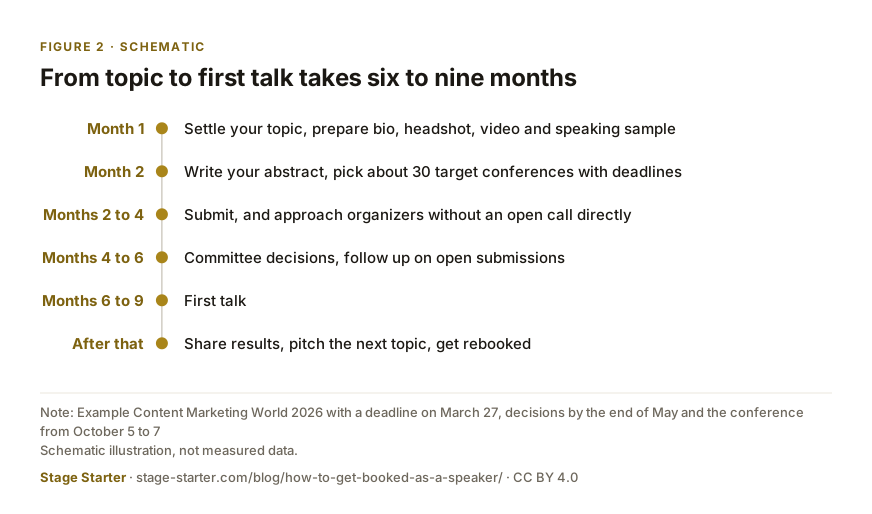
Figure 2 Schematic
From topic to first talk takes six to nine months
Note: Example Content Marketing World 2026 with a deadline on March 27, decisions by the end of May and the conference from October 5 to 7
Schematic illustration, not measured data.
Data and download
Style
Embed
Data as table
| Date | Event |
|---|---|
| Month 1 | Settle your topic, prepare bio, headshot, video and speaking sample |
| Month 2 | Write your abstract, pick about 30 target conferences with deadlines |
| Months 2 to 4 | Submit, and approach organizers without an open call directly |
| Months 4 to 6 | Committee decisions, follow up on open submissions |
| Months 6 to 9 | First talk |
| After that | Share results, pitch the next topic, get rebooked |
Chart and data: Stage Starter, CC BY 4.0. Free to use with attribution and a link.
Steps 6 and 7: follow up and get rebooked as a speaker
Weeks often pass between the deadline and the decision. Content Marketing World promised to respond to all submitters by the end of May and asked anyone who did not hear back to send an email. Following up at this stage means checking politely on open submissions, confirming an acceptance right away and asking for feedback after a rejection. The details are in Following up after a call for papers.
Rebooking is decided after your talk. Because organizers such as Content Marketing World analyze session ratings to understand what resonates with their audience, a strong rating is your argument for next year. Send the program team your thanks together with the rating and the response from the room, and pitch a follow-up topic before the next call opens. Talks like these also produce the invitations that are missing at the start of the journey.
What role an agency plays in getting booked
A speakers bureau places well-known speakers with paying organizers, whereas a speaker agency such as Stage Starter gets experts onto conference stages through submissions and direct outreach. The difference is explained in more detail in Speaker agency or speakers bureau.
Frequently asked questions
How do I get booked as a speaker?
You get booked as a speaker through an invitation or through an application to a call for speakers. Without a known name, applying is the usual way in: you submit an abstract with your speaker profile to suitable conferences and approach organizers without an open call directly.
What is the acceptance rate for a call for speakers?
According to the CNCF, KubeCon + CloudNativeCon North America 2024 accepted 11 percent of 1,937 submissions. In a representative sample of our submissions for clients, 2024 to 2026, the rate is around 7 percent per abstract and up to 19 percent per conference, against a market norm of 5 percent at most.
What is the difference between a speakers bureau and a speaker agency?
A speakers bureau places well-known speakers with organizers for a fee and, according to BigSpeak, receives a commission from the speaker for each booking. A speaker agency such as Stage Starter gets experts onto conference stages through submissions to calls for speakers and through direct outreach.
How long does it take to get your first speaking booking?
Plan on six to nine months from the start to your first talk. At Content Marketing World 2026, the deadline was March 27, decisions came by the end of May and the conference took place from October 5 to 7.
What should a speaker profile include?
A speaker profile includes a bio, a headshot, video of past talks and a speaking sample. Content Marketing World accepts a simple phone recording from newcomers, while speakers bureaus such as Eagles Talent require a demo video of at least a five to ten minute live presentation.

Marin Niehues is a management consultant and international speaker. With Niehues Consulting he works with organisations from scale-ups to DAX 40 corporations, and on stage he has spoken at more than 45 conferences in 23 countries.
All articles by Marin Niehues