


Stage fright: what really happens before you go on
Stage fright is the physical activation before an appearance your body has classified as significant, and it happens whether you asked for it or not. Your pulse rises, your breathing becomes shallower and your attention narrows to what is about to happen. Psychologically, waiting at the side of the stage is the hardest part, while physical arousal peaks with your first sentence and then drops markedly within the first few minutes. Experienced speakers are hardly calmer than you in this situation; they interpret it differently and have a fixed plan for the first minutes.

Stage fright is the physical activation before an appearance your body has classified as significant, and it happens whether you asked for it or not. Your pulse rises, your breathing becomes shallower and your attention narrows to what is about to happen. Psychologically, waiting at the side of the stage is the hardest part, while physical arousal peaks with your first sentence and then drops markedly within the first few minutes. Experienced speakers are hardly calmer than you in this situation; they interpret it differently and have a fixed plan for the first minutes.
What happens in your body during stage fright?
During stage fright your body releases stress hormones such as adrenaline, in most speakers' experience a good half hour before the appearance. Your heart beats faster, your blood pressure rises, more blood flows to your muscles and digestion slows down. Then come the familiar side effects such as a dry mouth, cold or shaky hands and a sense of time that falls out of step. Your body is making energy available for something it considers important.
The same reaction runs before a competition and before any negotiation where a lot is at stake. The body starts the same basic reaction for danger and for opportunity, and your appraisal decides how it plays out. Stress research distinguishes a challenge response, in which the heart pumps more blood through open vessels, from a threat response with constricted vessels. Experiments at Harvard show that people who interpret their arousal before a speech as helpful have a measurably more favorable cardiovascular pattern, closer to the challenge response.
On stage this state has a tangible advantage. A completely relaxed speaker tends to come across as sluggish rather than confident, because they lack the presence that comes from this activation. In its ordinary form, stage fright is therefore good for your appearance, as long as it directs your attention outwards.
Tension that helps you and fear that blocks you
Tension and fear differ in where they direct your attention. Tension points it outwards, at your content, at the people in the room, at whether your argument is landing. With fear, the same attention turns inwards, towards yourself: how do I come across, is my voice shaking, what do the people in the front row think of me? The activation feels similar in both cases, and the direction of your attention has the greatest influence on how your session goes.
Watching yourself while speaking uses up working memory. Part of your attention constantly checks your own performance and is missing when you think, and this produces the typical patterns: you get faster and louder than in rehearsal, you cling to your slides and lose eye contact with the room. A speaker with a concrete task, such as a first sentence they have built or three faces in the room they deliberately look at, directs their attention outwards, and the physical activation remains without getting in their way.
When is stage fright at its strongest?
Stage fright is strongest at the transition to speaking: psychologically, waiting at the side of the stage is the hardest part, while physical arousal peaks with the first sentence. The communication researchers Ralph Behnke and Chris Sawyer described this pattern through heart rate measurements, and a follow-up study involving both shows that in highly anxious speakers the physical peak comes in the first minute of the speech. You stand at the side, listen to your introduction and can do nothing while your body has long been in action mode. How a conference day runs for you therefore helps determine how long this wait will be.
With your first sentences the situation changes. You act, your body gets a task for the energy it has made available, and the room responds: someone nods, someone else takes notes, and somewhere in the room someone laughs at the point where you hoped they would. Feedback replaces uncertainty, and the level of arousal drops markedly in the first minutes of the session.
The second reliable effect is repetition. At your first appearance the whole sequence is new, from walking on through the technology to the Q&A. From the fifth onwards you know the order, and your body reacts to a situation it has already come through, with the same release that simply no longer surprises you.
What helps quickly against stage fright before a talk?
What helps quickly against stage fright is anything that gives your body and your attention a task. Experienced speakers rely on four measures:
- Breathing: A long exhale, longer than the inhale, lowers your pulse within minutes. The so-called physiological sigh, two short breaths in through the nose and one long breath out through the mouth, reduced breathing rate and improved mood more than mindfulness meditation in a Stanford University study.
- A fixed first sentence: The opening is fixed word for word because it was created when the session was built, and it has nothing to do with stock greetings.
- A slow start: In the first minute they find their volume and pace and deliberately speak more slowly than feels natural.
- Visual anchors: They look early for the faces that are visibly engaged, spread across the whole room so that their gaze can move.
Reappraisal adds to this. People who tell themselves before a performance that they are excited do better in experiments at Harvard Business School than those who force themselves to calm down, because the body is activated anyway and the interpretation shifts more easily than the pulse. A speaker who has built their session properly knows its structure and transitions, and this certainty does more against stage fright than any trick at the side of the stage.
Experienced speakers treat mishaps as minor matters. A clicker that stops working or a monitor that fails is named in a sentence or two and then they carry on, while a fumbled word goes unmentioned, because mentioning it would draw more attention than the mistake itself.
Figure 1 Schematic
Three minutes of a 45-minute slot decide
Note: 45-minute slot followed by Q&A
Schematic illustration, not measured data.
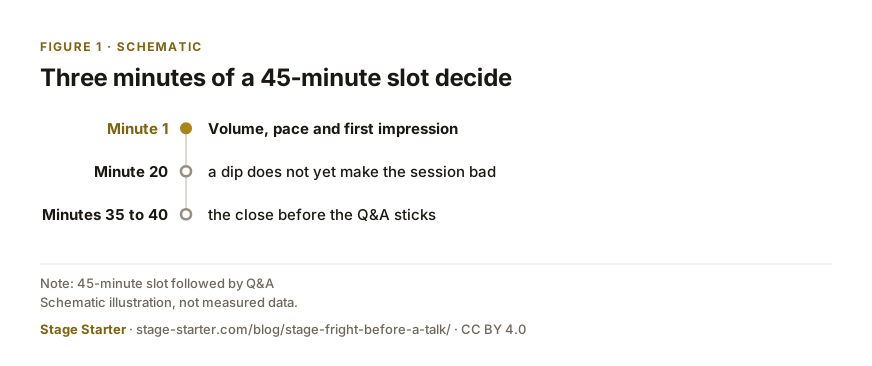
The markers in the figure are values from experience on stage, calculated for a 45-minute slot followed by Q&A.
Why the usual advice against stage fright backfires
The best-known piece of advice is to imagine the audience naked. It asks you for an additional act of imagination in the middle of your appearance, draws attention away from your content and treats the room as a threat. At a specialist conference the people sitting there have come voluntarily to learn something about your topic, and that is the friendliest starting point a speaker can get.
Learning your talk by heart is more costly. A text memorized word for word has only one valid sequence, so a blank turns into a crash instead of a pause. While reciting, you listen to yourself, which turns your attention inwards again, and you lose the flexibility a session needs when you have to cut towards the end.
Finally, the suggestion to mention your nervousness right at the start sounds harmless. It makes your state the first content the room gets from you and draws attention to something nobody would otherwise have noticed. A speaker who clowns around at the front to drown out their insecurity seems more insecure than one who starts calmly.
Does the audience notice that you are nervous?
The audience notices very little of your nervousness, because it has no normal state of yours to compare with. Your heartbeat stays invisible, as does your dry mouth, and slightly shaky hands are barely noticed by anyone in the room. Most listeners do not register a brief stumble at all.
Conversely, a nervous speaker reads judgments into the faces in the room that nobody has made. A concentrated face without nodding or smiling looks bored from the stage, and anyone who interprets it that way throws themselves off course mid-session for no reason. What individual reactions mean is covered under the question of how a specialist audience works. When someone leaves in the middle of the session, it usually has to do with an appointment or a parallel session, and only when distraction spreads across a whole section of the room does it say something about your content.
What changes with more appearances
The physical process stays the same over the years, while your relationship to it shifts. After the fifth or tenth time you know from experience that your pulse drops after the first few minutes, that the concentrated faces in row two mean nothing bad and that a mishap is forgotten in the room after ten seconds. You only gather these experiences on stage, which is why the number of appearances per year has the strongest effect, and small stages such as meetups and association evenings are a good place to practice.
Stage Starter organizes the appearances themselves for you: we find the right calls, write the submission, submit it and support you all the way to the stage, so that your energy goes into the talk. The whole route from topic to first appearance is described in the guide to becoming a speaker.
Frequently asked questions
What helps quickly against stage fright before a talk?
The quickest help is a long exhale, a carefully built first sentence and a deliberately slow start. Reappraisal adds to this: people who interpret their nerves as excitement do better in experiments than those who force themselves to calm down.
Which breathing exercise helps against nerves before a talk?
Any breathing in which the exhale lasts longer than the inhale helps against nerves. The physiological sigh is well studied: two short breaths in through the nose and one long breath out through the mouth, repeated for a few minutes. It lowers your breathing rate and calms your pulse without requiring practice.
Do beta blockers or pills help against stage fright?
Beta blockers such as propranolol dampen physical symptoms like a racing heart and trembling, but they are prescription-only and should only be taken after medical advice. They do nothing against your thoughts, and breathing and preparation are enough for the ordinary nerves before a specialist talk. This article does not replace medical advice.
Is stage fright good or bad?
In its ordinary form stage fright is good for your appearance, because it gives you energy and presence. It becomes a hindrance when it permanently turns your attention towards yourself.
What is the difference between stage fright and fear of public speaking?
Stage fright is the normal activation before an appearance and eases in the first few minutes. Fear of public speaking, clinically called glossophobia, shapes everyday life for weeks and leads people to avoid appearances, and it calls for professional treatment.
Does stage fright ever go away completely?
For most speakers some residual tension remains permanently. What changes with the number of appearances is the interpretation: your body still reacts, but the reaction no longer surprises you and therefore blocks you less often.
Does the audience notice that I am nervous?
The audience notices far less than you assume, because it does not know your normal state. What becomes visible are mainly the consequences, such as speaking too fast, missing eye contact or a speaker clinging to their slides.
Does it help to learn the talk word for word?
Learning by heart usually does harm. A memorized text collapses at the first gap and takes away your ability to cut along the way, while a robust structure whose transitions you know gives you security.
What happens if I lose my thread in the middle of a talk?
If you lose your thread, very little happens as a rule, because the audience does not know your planned text. A short pause, a glance at the current slide and the next point are enough, and from the room the pause looks more composed than it feels.
If you want to know which stages you could speak on with your topic, talk to us in an initial consultation.

Marin Niehues is a management consultant and international speaker. With Niehues Consulting he works with organisations from scale-ups to DAX 40 corporations, and on stage he has spoken at more than 45 conferences in 23 countries.
All articles by Marin Niehues