

Thought leadership: what AI summaries change for speakers
Thought leadership influences, according to B2B buyers, whether a vendor makes the shortlist, and buyers now have AI summarize the content for them. According to a report by ContentGrip of November 11, 2026 on the 2026 Edelman-LinkedIn B2B Thought Leadership Impact Report, 84 percent of the B2B decision-makers surveyed used AI to summarize thought leadership during vendor evaluation, and 59 percent of final decision-makers said that missing or weak thought leadership had contributed to a vendor dropping out of consideration. The survey covered 1,135 business professionals in seven markets, and the values are self-reported. For speakers this means that a talk should contain statements that survive a summary, namely data of your own, a clearly named client problem and a reasoned judgment.

Thought leadership influences, according to B2B buyers, whether a vendor makes the shortlist, and buyers now have AI summarize the content for them. According to a report by ContentGrip of November 11, 2026 on the 2026 Edelman-LinkedIn B2B Thought Leadership Impact Report, 84 percent of the B2B decision-makers surveyed used AI to summarize thought leadership during vendor evaluation, and 59 percent of final decision-makers said that missing or weak thought leadership had contributed to a vendor dropping out of consideration. The survey covered 1,135 business professionals in seven markets, and the values are self-reported. For speakers this means that a talk should contain statements that survive a summary, namely data of your own, a clearly named client problem and a reasoned judgment.
Edelman-LinkedIn report 2026: what the study shows according to the reports of November 11, 2026
According to ContentGrip, the 2026 Edelman-LinkedIn B2B Thought Leadership Impact Report is based on a survey of 1,135 business professionals in seven markets, while Social Media Today speaks of more than 1,100 management-level professionals. The figures in this article follow the two reports on the Edelman report, which agree on the value of 82 percent. The statements on influence are self-assessments, so a causal link between more thought leadership and more orders is not established. The 84 percent, too, is an answer about the use of AI in vendor evaluation and does not say that 84 percent of all B2B purchases begin in an AI assistant.
On impact, ContentGrip gives two values from the buyers’ point of view: 76 percent said thought leadership in the buying group had helped them judge whether a vendor understands their needs, and 52 percent said it had helped with vendor selection. If you sell to a buying center with several participants, you reach those participants, in our view, first through content and afterwards in conversation.
Thought leadership is expert content that publishes insights on the client’s problem
Thought leadership means expert content in which a person or a company publishes insights of their own on their clients’ problems without promoting a product. For specialists this includes articles and studies, as well as talks at conferences and their recordings. What the term covers in B2B and what role the stage plays in it is explained in our article What is thought leadership in B2B, and what does the stage have to do with it?.
Thought leadership is summarized by AI first
That 84 percent of respondents use AI for summaries changes the first contact. A decision-maker can receive your paper or the description of your talk as a summary produced by a language model. According to ContentGrip, Annie Dunleavy, U.S. Head of Content Strategy at Edelman, says in essence that valuable thought leadership delivers original research and practical experience as well as judgment that a generic AI answer cannot provide on its own. ContentGrip only paraphrases the statement, so we do not quote it verbatim.
For the design of a talk it follows, in our view, that the central statements should be short, understandable on their own and each name a figure with its origin. A sentence such as “84 per cent of the B2B decision-makers surveyed used AI to summarise thought leadership during vendor evaluation” survives a summary, whereas a slide with the keyword “innovation” probably does not. How conference appearances show up in AI answers is covered in the article Get mentioned in ChatGPT as a speaker.
Thought leadership travels through private channels
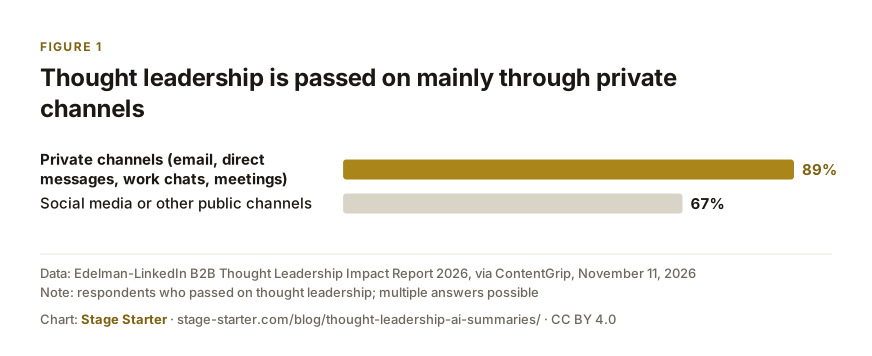
According to ContentGrip, 89 percent of the respondents who passed on thought leadership named private channels: email, direct messages, work chats or meetings. 67 percent named social media or other public channels, and some used both. As their reason, 73 percent of those sharing privately named useful research, data or evidence, and 57 percent relevance to a decision under way.
Figure 1
Thought leadership is passed on mainly through private channels
Source: Edelman-LinkedIn B2B Thought Leadership Impact Report 2026, via ContentGrip, November 11, 2026
Note: respondents who passed on thought leadership; multiple answers possible
Data and download
Style
Embed
Data as table
| Label | Value (%) |
|---|---|
| Private channels (email, direct messages, work chats, meetings) | 89% |
| Social media or other public channels | 67% |
Chart: Stage Starter, CC BY 4.0. Data: Edelman-LinkedIn B2B Thought Leadership Impact Report 2026, via ContentGrip, November 11, 2026; the source's terms apply.
A conference talk therefore often keeps working in channels you cannot see. A participant sends your slides or a summary to the colleague who has a say in purchasing. For that to work she needs material she can forward: a page with your central figure and its source and an answer to the question of what to do.
Thought leadership helps decide the shortlist
59 percent of final decision-makers said, according to ContentGrip, that missing or weak thought leadership had contributed to a vendor dropping out of consideration. The figure is self-reported, and it shows which risk buyers see: anyone who has no useful content to offer in the research phase can drop out of the selection.
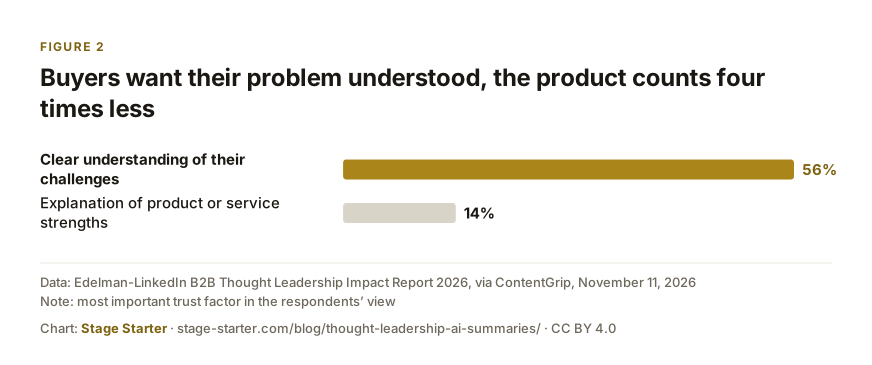
The look at trust is instructive. As the most important factor, 56 percent named a clear understanding of their challenges and circumstances, while 14 percent chose the explanation of product or service strengths. The ratio is 4 to 1. The study sets no rule for talks, and the following calculation is our own transfer with an open assumption: suppose your talk lasts 30 minutes and you split the time in the ratio of the two values, then you devote 24 minutes to the client’s problem and 6 minutes to your offer. Where an expert audience draws the line between a specialist talk and an advertisement is described in the article Expert talk or sales pitch.
Figure 2
Buyers want their problem understood, the product counts four times less
Source: Edelman-LinkedIn B2B Thought Leadership Impact Report 2026, via ContentGrip, November 11, 2026
Note: most important trust factor in the respondents’ view
Data and download
Style
Embed
Data as table
| Label | Value (%) |
|---|---|
| Clear understanding of their challenges | 56% |
| Explanation of product or service strengths | 14% |
Chart: Stage Starter, CC BY 4.0. Data: Edelman-LinkedIn B2B Thought Leadership Impact Report 2026, via ContentGrip, November 11, 2026; the source's terms apply.
How to build thought leadership through conference appearances
- Name the client problem: Put into one sentence the problem your clients have to solve right now, in their own language.
- Collect your own evidence: Fix one figure, one case and one judgment from your practice that cannot be found anywhere else.
- Write a one-pager: Summarize the talk on one page with the core statement, figure and source, so that listeners can forward it.
- Publish the recording: Ask the organizer for the recording and put it on your website with a transcript.
- Check the effect: Ask an AI system for a summary of your topic and check whether your central statement appears in it.
Frequently asked questions
What is thought leadership in B2B?
Thought leadership is expert content in which a person or company publishes insights of their own on their clients’ problems, for instance in articles, studies or talks. It is meant to show buyers whether a vendor understands their situation.
What does the Edelman-LinkedIn study 2026 say about thought leadership?
According to ContentGrip on November 11, 2026, 84 percent of the B2B decision-makers surveyed used AI to summarize thought leadership during vendor evaluation, and 82 percent believe thought leadership is becoming more valuable. 59 percent of final decision-makers say that missing or weak thought leadership contributed to a vendor dropping out.
How do B2B buyers use AI for thought leadership?
They have AI summarize vendors’ content before they make a selection. According to ContentGrip, 84 percent of the B2B decision-makers surveyed did so. Statements with a figure and a source and a clear link to a client problem survive such a summary best.
How do I build thought leadership as a speaker?
Put a client problem at the center of your talk, back it with figures and cases of your own and publish a summary that listeners can forward. The recording with a transcript on your website adds material for AI summaries.
How reliable are the figures of the study?
The values are self-reports from 1,135 business professionals in seven markets, as ContentGrip reports. They show how buyers describe their behavior and do not prove a causal link between more thought leadership and more orders.

Marin Niehues is a management consultant for AI transformation and business architecture and an international speaker. With Niehues Consulting he works with organisations from scale-ups to DAX 40 corporations, and as a speaker he has been invited to 50+ conferences in 20+ countries.
All articles by Marin Niehues