

What is realistic in your first year as a speaker
Twelve months are enough for one to three appearances, and most of them fall in the second half of the year. The reason lies in the conference calendar: between your submission and the talk there are a few weeks to nine months depending on the conference, and before that comes the time you need to find suitable calls at all. The first client engagements from these contacts usually fall in the second year. What happens before then is harder to see and nonetheless significant in economic terms.
Twelve months are enough for one to three appearances, and most of them fall in the second half of the year. The reason lies in the conference calendar: between your submission and the talk there are a few weeks to nine months depending on the conference, and before that comes the time you need to find suitable calls at all. The first client engagements from these contacts usually fall in the second year. What happens before then is harder to see and nonetheless significant in economic terms.
How long does it take to get your first speaking slot?
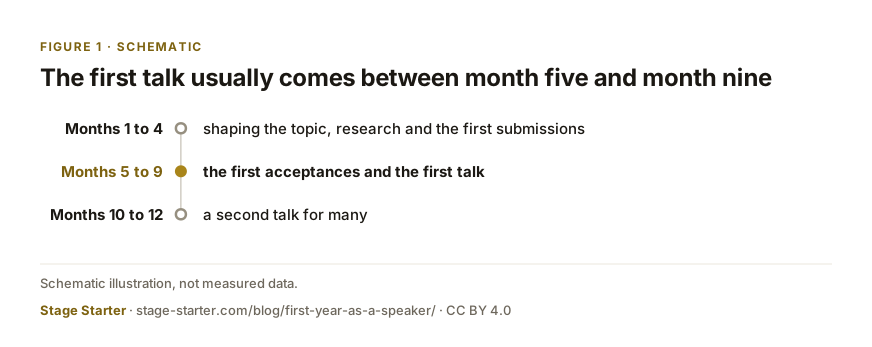
Alongside day-to-day work, your first talk usually comes five to nine months after you start, because your research and submissions come before the conferences plan their programs. An industry conference collects talks through a call for papers, a public invitation whose submission window opens for a few weeks. After the deadline the program committee, the group that assesses proposals, decides, and the program is usually fixed a few weeks to three months before the event. A call you find in January therefore often leads to a talk in early summer or autumn.
This gives your first year its shape. The first weeks go on finding suitable events and making the first submissions, with nothing visible from the outside. Then come months in which you keep submitting and wait for decisions that arrive at unpredictable times. The first talk then falls in the second half of the year, and a second often follows faster, because the spring submissions move up.
Figure 1 Schematic
The first talk usually comes between month five and month nine
Schematic illustration, not measured data.
Data and download
How many rejections are normal in the first year?
In the first year most answers are rejections, because at open calls the usual market rate is 5 percent at most per conference. Our own submissions for clients reach up to 19 percent per conference, and even there four out of five conferences say no. At the large open calls, several hundred proposals compete for a few slots. How these rates come about is shown in the article on the acceptance rate for calls for papers.
The market rate determines the volume a first year works with. Anyone who wants four to six talks a year via open calls needs around one hundred to three hundred submissions. The quantitative operation an agency runs starts with at least one hundred submissions in the first month across around twenty conferences and then continues with at least fifty a month. This only works because each submission comes from a set of proposals built once and takes minutes rather than hours. Anyone who writes every proposal from scratch never reaches the volume at which the rate takes effect.
The direct email to program managers, the usual route in industry, classic consulting and the association world, follows different numbers. Ten to fifteen inquiries a week are feasible once the conference list is in place and the cover letter is finished except for the opening. The rate is higher than at the large calls, because someone on the other side has a program to fill.
The missing reasons weigh more than the rate. A rejection reaches you as a friendly two-liner with no hint of whether your topic was off, someone else had cut the same idea more sharply or the track was simply full. Over many submissions a picture still emerges, because one session regularly gets through while another never makes it into a program. Anyone who gives up after the fifth no breaks off the start-up phase and never learns whether the channel works for them.
What does the first year as a speaker bring?
A solid first year brings one to three talks, a reference list and one or two dozen contacts from which engagements develop. The talks mostly take place at community-driven events and smaller industry meetings. With the reference list you apply differently from now on, because an organizer can see that you work in front of an audience, and in many cases a recording is publicly available.
On the business side, one to three talks typically turn into five to fifteen serious conversations, from which some meetings develop over the months. One signed engagement in the first year is realistic. The usual B2B cycle continues after the first meeting, so most commissions from first-year contacts land in the second year.
The audience in the first year consists mostly of professional peers. Many community conferences assess submissions without names and are therefore the first to open their stage to newcomers, but their attendees hire you less often themselves. How much the names matter was measured in an experiment at a computer science conference: reviewers who saw the names recommended papers by well-known authors and renowned institutions considerably more often than reviewers without this information. They carry your talk into their own companies, and the inquiries come later through recommendations. Which conference types bring which audience is set out in the overview of industry conferences.
What changes before your first talk
The underestimated part of the first year happens at your desk. Anyone who builds an abstract, the short talk description for a submission, has to name in a few hundred words which problem they solve for whom. Few consultants have answered this so precisely before, and working on it changes how you talk about your offer in the next sales conversation.
Then comes an inventory of your own material. A session needs a case with real numbers, a decision that cost something and a detail that makes the story credible. For most people this material is scattered across twenty projects, and once you have prepared it, it is available to you in every channel.
Where the time goes in the first year
The effort of the first year is distributed unevenly. Building the conference list takes the first evenings, because you check for each event who sits in the room. Then the load shifts to volume: a single submission from the set takes minutes, and fifty a month add up to the volume at which the rate takes effect. After an acceptance the session itself is built, the largest single block of the whole year.
The event costs two travel days around one conference day, plus the two weeks afterwards in which you contact the people you met. A fee is rare for the first talks, and whether hotel and travel are covered is up to each conference; in the SME and association world you usually pay them yourself. What a talk can be expected to deliver economically is worked out in the article on how speakers get paid.
Is speaking worth it for consultants in the first year?
The first year pays off most for consultants and business owners with high deal values who want to reach an expert audience and have few free days. A single won engagement covers the investment of a whole year for them. Anyone who needs revenue this quarter plans with the second year, because in most cases several months lie between shaping the topic, submitting and the first talk.
Capacity sets the pace. Two to three days per talk plus the evenings for submissions and follow-up are the price, and anyone who finds this time themselves takes the more laborious route and should cost it at their day rate. Stage Starter does this work for you: we find the right calls, write the submission and submit it, at the volume where the rate takes effect from the first month. The engagement starts from $999 net a month, and your days stay free for client work. You hold the conversations with your contacts after the talk yourself, because that is where contacts become clients.
What changes in the second year
In the first year you build everything for the first time: the conference list, the abstract, the session and the conversation after the session. A year later all of it exists, and the work shifts from production to selection. Production research has described this effect since the 1930s as the learning curve, by which the effort per unit falls by a fixed share each time the quantity produced doubles. Your submissions draw on finished texts, your session is solid, and some invitations arrive without an application, because an organizer has already seen you at work. Anyone who takes stock at the start of the second year finds a channel in place, where the set-up effort is gone and only selection, submission and the talk remain. The whole route from topic to stage is described in the guide to becoming a speaker.
What your first year with an agency would look like and which stages suit your topic is something we can discuss in an initial consultation.
Frequently asked questions
When should I start submitting?
As soon as you have a topic that addresses a real problem of your target group. Waiting for the perfect moment costs you months, because lead times are long anyway. The first submission is the cheapest way to find out whether your angle lands with a committee.
How many submissions can I manage alongside day-to-day work?
With a finished set of abstracts, fifty submissions a month are feasible in the evenings; without a set it is one or two a month. The quantitative operation plans at least one hundred submissions in the first month and at least fifty a month after that. On the email route to program managers it is ten to fifteen a week. One or two individually crafted proposals a month are barely enough for a single acceptance over the whole year.
How long does it take until my first talk as a speaker?
Starting alongside day-to-day work, the first talk usually comes five to nine months after you begin. Between the deadline and the conference there are a few weeks to three months depending on the event, and research and submission come before that. With an agency that submits at volume from the first month, the start-up time is what shrinks most.
How many rejections are normal at the start?
At open calls the usual market rate is 5 percent at most per conference, while our own submissions for clients reach up to 19 percent per conference. Across twenty conferences, fifteen to nineteen rejections are therefore normal. A rejection only becomes meaningful as part of a series.
Do I get a speaker fee in my first year?
Industry conferences generally pay no fee for talks selected through a call for papers; fees go to invited keynote speakers with well-known names. For a consultant, one commission from a single talk is worth more than any fee. Some conferences cover travel or hotel, and each event decides that for itself.
How much time does speaking take in the first year overall?
If you submit yourself, expect two to three days per talk plus evenings for submissions and follow-up. The session itself is the largest single block. Anyone who hands off research and submission keeps only the talk with its preparation and the conversations afterwards.
How many talks a year do you need to win clients?
Four to six talks a year typically cover the share the stage takes in a consultant's business development. In the first year one to three are realistic, because lead times slow the start. The stage complements the other channels.
Do I need a big stage in my first year?
You do not need a big stage in the first year, and for business development it is often the weaker choice. An industry meeting with thirty attendees from your target group brings you more usable conversations than a well-known conference where your target group is a minority. A small room produces conversations in which people talk more openly about their own situation.
What do I do if no acceptance has come after twelve months?
Then the evaluation shows where to adjust. Check the volume of your submissions first, then the choice of conferences and finally the angle of your topic. The most common causes lie in this order, and the first two can be changed faster than the third.

Marin Niehues is a management consultant and international speaker. With Niehues Consulting he works with organisations from scale-ups to DAX 40 corporations, and on stage he has spoken at more than 45 conferences in 23 countries.
All articles by Marin Niehues