

Give a conference talk: why your own cases matter in the age of AI
If you want to give a conference talk, build it on cases of your own, because according to a survey commissioned by the event software provider Cvent and published on June 15, 2026, 85 percent of 901 marketers and event professionals agree that AI-generated content has made it harder to build trust. 27 percent name generic or AI-generated content as the greatest risk to trust, and 81 percent report that trust in their brand rose after an in-person event run by their own organization. Censuswide carried out the online survey in March 2026 in twelve markets, including Germany. For speakers this means that a conference talk drawing on experience from your own work offers organizers and audiences what they miss in AI content. If you want to give a talk at a specialist conference, plan several cases from your own practice into every talk.

If you want to give a conference talk, build it on cases of your own, because according to a survey commissioned by the event software provider Cvent and published on June 15, 2026, 85 percent of 901 marketers and event professionals agree that AI-generated content has made it harder to build trust. 27 percent name generic or AI-generated content as the greatest risk to trust, and 81 percent report that trust in their brand rose after an in-person event run by their own organization. Censuswide carried out the online survey in March 2026 in twelve markets, including Germany. For speakers this means that a conference talk drawing on experience from your own work offers organizers and audiences what they miss in AI content. If you want to give a talk at a specialist conference, plan several cases from your own practice into every talk.
The Cvent survey on AI content and trust in numbers
Cvent is a provider of software for events. The company commissioned the survey from Censuswide. When you weigh the results, bear in mind that a software provider has an interest in strong events. The 901 respondents are marketers and event professionals at organizations with at least 250 employees in technology, financial services, life sciences, and associations and non-profits. The twelve markets range from the USA through Germany, Austria and Switzerland to India and Singapore.
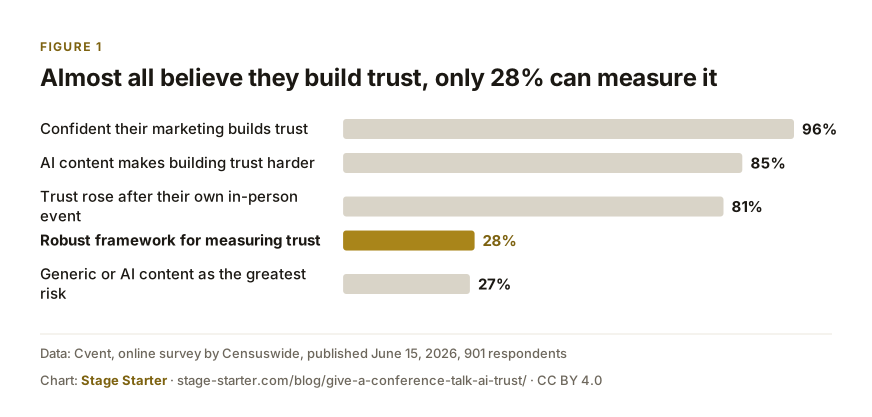
Figure 1
Almost all believe they build trust, only 28% can measure it
Source: Cvent, online survey by Censuswide, published June 15, 2026, 901 respondents
Data and download
Style
Embed
Data as table
| Label | Value (%) |
|---|---|
| Confident their marketing builds trust | 96% |
| AI content makes building trust harder | 85% |
| Trust rose after their own in-person event | 81% |
| Robust framework for measuring trust | 28% |
| Generic or AI content as the greatest risk | 27% |
Chart: Stage Starter, CC BY 4.0. Data: Cvent, online survey by Censuswide, published June 15, 2026, 901 respondents; the source's terms apply.
The respondents see the situation with mixed feelings. According to the release, 87 percent say that increased use of AI has made them more confident in AI-generated content, and 43 percent are scaling up their own use of AI. Asked why AI-generated content makes trust harder to build, 30 percent say that audiences question whether content is genuinely human-created, and 29 percent report growing scepticism about the accuracy of information. The organizations use AI themselves and at the same time see that it triggers distrust.
To give a conference talk is to build trust in the room
To give a conference talk means to present a topic from your own practice to a specialist audience within a fixed time slot at a conference. The audience sees a person who states her reasons and answers questions. These qualities count for more the more easily texts and images can be produced.
The survey suggests that organizers see it in a similar way. 81 percent of respondents say trust in their brand rose after an in-person event run by their own organization, 98 percent regard in-person and community events as an important part of their marketing strategy, and 91 percent expect events to become more central to their strategy over the next 12 to 24 months. Felicia Asiedu, Marketing Director at Cvent, says in the release that AI saturation is adding to audience scepticism and changing the environment in which organizations have traditionally built trust. The figures are the marketers’ own account. They do not show the effect on audiences.
For speakers this leads to a reading that we flag as our own interpretation: an organizer who treats trust as a goal of an event needs program items in which a named person with verifiable experience stands at the front. A talk that only repeats what can be read in any industry report does this job less well than one that contains material only the speaker has.
Give a conference talk with cases of your own: what an audience can check
A case of your own describes where a client stood, what you did and what came of it, each with a figure, so that the audience can test the story against it. The following overview sets three kinds of evidence side by side that a talk can contain.
The figure from a study stays important because it places the topic in context, and you give it with source and date. The two right-hand columns make the difference, because they contain material that a text generator cannot produce without your work.
A calculation with open assumptions shows the effort. Suppose your talk lasts 30 minutes and you set a piece of evidence roughly every five minutes, which makes six per talk, of which three should come from your own work. If you give six talks a year you arrive at 18 case appearances. Six well-documented cases, each used three times in changing combinations, cover that need. The effort therefore consists of documenting six projects that fill 18 appearances.
How program committees read a proposal for a talk
A program committee decides on proposals that it reads in a few minutes, and we describe the question it asks in the article What a program committee looks for in an abstract. An abstract whose first sentence names a concrete case with a figure answers that question sooner than one that opens with a description of the market. The Cvent survey provides no data on this. It is our experience from working with submissions.
Where the case ends and the advertising begins is decided by the audience, and how to keep that line is explained in the article Expert talk or sales pitch. A case proves a thesis and ends with what others can apply without buying your offer, which holds for the committee reading the abstract and for the audience in the room alike, because both judge whether they take something away.
Five steps to build your next talk around cases of your own
- Start a case book: note six completed projects with the starting point, the intervention and a metric before and after the project.
- Clear the permissions: ask every client whether you may name them and give the figures, and otherwise describe only the industry and the size of the company.
- Write the abstract around the case: the first sentence names the result and the rest explains what the audience takes away. How to structure such a talk is shown in the article How do I build a good talk for the stage?.
- Name your sources and your use of AI openly: figures from others go on the slide with source and date, and if you used AI to produce slides you say so. 35 percent of the Cvent respondents agree that transparency about AI use will be critically important for maintaining trust.
- Measure the effect: only 28 percent of respondents have a robust framework for measuring the impact of events on trust. After each talk, count the conversations that result, as described in the article Measuring the success of conference talks.
Frequently asked questions
How can I give a conference talk that convinces?
You build the talk around cases from your own work, in which the audience can see what the starting point was and what the intervention achieved. Figures from sourced studies place the topic in context, and a closing section says what the audience will do differently the next day.
What does the Cvent survey say about AI content and trust?
According to Cvent on June 15, 2026, 85 percent of 901 marketers and event professionals agree that AI-generated content has made it harder to build trust. 27 percent name generic or AI-generated content as the greatest risk to trust, and 81 percent report higher trust after in-person events run by their own organization.
May I use AI when I prepare a talk?
The survey prohibits nothing and says nothing about talks. It only shows that 35 percent of respondents consider transparency about AI use critical for maintaining trust. You can use AI for the outline and for rehearsal and you say so where it produced content. The cases and figures come from your own work.
How many cases of my own does a talk need?
There is no fixed number. As a planning assumption you set a piece of evidence every five minutes and take half of them from your own work, which makes three cases in a 30-minute talk.
How do I get the chance to give a talk at a specialist conference?
The usual route is the conference’s call for papers, in which you submit a talk proposal, or a direct inquiry to the organizer. How calls work is explained in our article What is a call for papers.

Marin Niehues is a management consultant and international speaker. With Niehues Consulting he works with organisations from scale-ups to DAX 40 corporations, and on stage he has spoken at more than 45 conferences in 23 countries.
All articles by Marin Niehues