

The Q&A: why it helps decide how your appearance turns out
The Q&A is the five to ten minutes after your talk in which the audience asks questions, and it matters because it shows who in the room has an urgent problem. Anyone who asks a question voluntarily says something about their own situation in front of sixty people. For winning clients, this is the densest information of the entire appearance, denser than anything you could read from faces during the talk. These minutes also decide which thought people take out of the room, because what was said last sticks most and a weak final answer overshadows your ending.
The Q&A is the five to ten minutes after your talk in which the audience asks questions, and it matters because it shows who in the room has an urgent problem. Anyone who asks a question voluntarily says something about their own situation in front of sixty people. For winning clients, this is the densest information of the entire appearance, denser than anything you could read from faces during the talk. These minutes also decide which thought people take out of the room, because what was said last sticks most and a weak final answer overshadows your ending.
Whoever asks reveals their need in front of witnesses
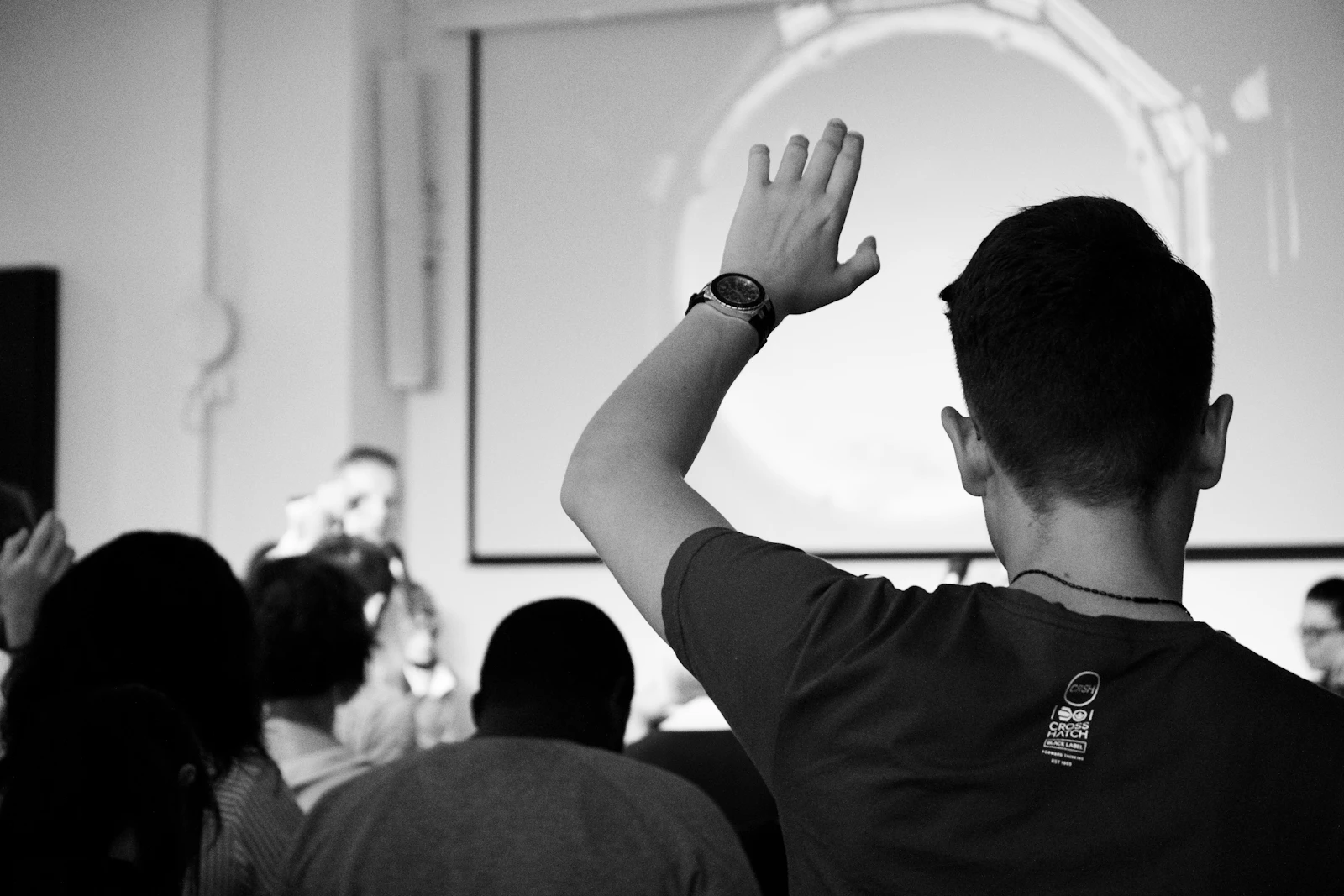
A question in the plenary is a public act. The person raises a hand, often gives their name and company, and accepts that colleagues, competitors and occasionally their own manager are listening. This threshold means that questions from the audience almost always reflect a genuine concern; courtesy questions mostly come from the moderator.
For you, this contains two pieces of information at once. The first concerns the content, meaning the point in your session where an assumption was not accepted or a part was too brief. The second concerns the people in the room. You get a face, a name and a problem, and afterwards you know whom to look for in the break and how to open the conversation. During the talk, the room remains a surface of faces whose expressions are hard to read.
That is why, for the business return of an appearance, the Q&A is often more productive than the talk itself. The talk builds trust with everyone, and the Q&A reveals the few for whom that trust meets an urgent problem right now.
What does a question reveal about the person asking?
A question reveals how urgently the person has a problem, and the specific question with their own numbers is the strongest commercial signal. Someone describes their own situation with an order of magnitude or an upcoming deadline and wants to know how your point applies to it. That person has already applied your session to their own company during the last few minutes.
The general question about the principle sits one level below. It often comes from listeners who find your topic interesting and are under no concrete pressure. A peer's test question targets the case in which your argument breaks. Hostility is rarely behind it, because practitioners probe theses this way, and an honest account of the limits of your evidence works better with this audience than a smooth answer.
Then there is the contribution without a question mark. Someone describes their own view, sometimes for three minutes, and closes by asking whether you see it the same way. A follow-up about something you have already said is also common. If it comes from two different people, there is a passage that should look different next time.
What do I do if nobody asks a question?
If nobody asks, you pose the question you are asked most often yourself and answer it in one minute. The seconds after you open the floor stretch longer for the speaker than for the audience, and the causes of silence have little to do with the quality of your session. Experiments on the so-called illusion of transparency also show that speakers clearly overestimate how visible their nervousness is to the audience.
The first cause is social. The first question costs more than the second, because the first person speaks into a room that is still silent, and once someone has started, the next questions come faster. An analysis of almost 250 academic seminars in ten countries shows how strongly the first contribution shapes the rest: whoever asks first influences who raises their hand afterwards. The second is the room itself: people ask more easily in a room of thirty than in one of three hundred, and a standing microphone in the aisle raises the threshold again.
The third cause weighs most for winning clients. The most urgent problem in the room often goes unspoken, because a public question about it would expose a weakness in the asker's own company. A silent room and an empty corridor are therefore two different outcomes, and the people with this problem come to the stage afterwards.
How do I respond to an aggressive question?
You answer an aggressive question calmly and briefly on the substance and offer to continue the conversation afterwards. In front of an experienced audience, a contribution meant to test the speaker publicly comes up regularly. The tone is sharp, the question already contains its answer, and the person asking looks into the room more often than at the stage.
Usually it is about the asker's position in their own field, a method they have championed for years, or visibility in front of colleagues. The room reads this faster than the person addressed, because it sees the scene from outside. Any visible defense therefore costs more than it gains, because a contribution turns into a duel and the room watches two people argue. If your argument does contain a real error, you concede it in one sentence, which earns credibility with an expert audience.
Where a moderator is present, they direct the Q&A. They decide who speaks, and they can clear a contribution without the stage having to do anything. In a breakout session without moderation, this authority is missing.
What an overlong answer does to the room
The time for an answer is taken from the whole room, even if the question came from one person. A question aimed at the special situation of a single company is of little interest to the other listeners, and the longer the answer runs, the more visible this becomes: the first people stand up, hands in the back rows go down again, and the person who wanted to ask second has changed their mind.
The second price concerns content. If the Q&A drifts into a side topic after your ending, the audience leaves with that side topic, and your key sentence is twenty minutes old by then. Then there is the clock. The Q&A sits inside your slot, and anyone who plans their material for the full time either overruns or rushes through the last third. Organizers remember an overrun faster than any error of content, because it shifts the whole track. How tight the window is already shows when you build your session.
A Q&A done out of habit also costs the reason for a conversation. A question half-answered in the plenary brings nobody to the stage afterwards, because the asker considers the matter settled. The quarter of an hour after the session is the most valuable stretch of a conference day in business terms.
How do I prepare for the Q&A?
Preparing for the Q&A has three parts: the questions you can expect, an opening question of your own for a silent room and a closing sentence after the last answer. You know the expected questions from client conversations, because what clients ask you after a project, a room asks too. The opening question bridges the silence without you having to beg for questions. The closing sentence brings back the key thought of your session once the last question is answered and gives you the last word.
These parts are created while building the session, weeks before the talk. Stage Starter develops the session with you, Q&A included, finds the right calls, writes the submission and submits it, so you go on stage with an appearance planned to the last minute. How the Q&A fits into the whole route to becoming a speaker is covered in the guide to becoming a speaker.
How your session, Q&A included, gets onto the right stages is something we are happy to discuss in an initial consultation.
How to get onto corporate events as a speaker when companies plan fewer events is shown in Corporate event speaker.
Frequently asked questions
Does the Q&A count towards my speaking time?
In most programs the Q&A counts towards your speaking time. A 45-minute slot in most programs includes the questions rather than adding them on, and the briefing tells you the rule. If you build your content for the full slot length, you lose either the Q&A or the last third of the session.
Should I hold the Q&A before or after my conclusion?
The Q&A belongs before your conclusion, so the last word stays with your key thought. You announce it after the main part and close after the last answer with a prepared one-minute statement. Where the moderator only opens questions after the applause, this statement serves as a second ending.
What do I say if I don't know the answer to a question?
Say openly that you don't know, share what you do know about it and offer to follow up after the talk. An expert audience values this honesty more than a guessed answer. The offer to follow up also gives you a reason to get the asker's contact details.
How do I end a Q&A confidently?
Announce the last question, answer it briefly and close with the key thought of your session. Refer any open questions explicitly to the conversation at the stage. The slot then ends on time and with your thought.
Why do experienced speakers repeat the question?
Because the room often did not hear it, and the recording would otherwise not contain it. Without a room microphone, the asker speaks towards the stage and the back half of the room only hears the answer. Repeating it gives you a few seconds to organize your answer.
Is a silent room a bad sign?
A silent room is rarely a bad sign. Silence comes from the reluctance to speak first, from the size of the room or from a session that answered its own question cleanly. The number of people who seek you out at the stage afterwards says more than the number of questions.
Why are very specific questions better left for the conversation afterwards?
Because their answer has little value for the rest of the room and needs more time than a Q&A allows. Referring them to a later conversation protects the other listeners' time and moves the exchange to where there is room for more substance.
How do I win client contacts from the Q&A?
Remember who asked a specific question about their own situation and approach that person right after the session. The question gives you the opening for the conversation, and the offer to send material gives you the reason to stay in touch. How these conversations become commissions is described in the article on what happens after the conference.

Marin Niehues is a management consultant and international speaker. With Niehues Consulting he works with organisations from scale-ups to DAX 40 corporations, and on stage he has spoken at more than 45 conferences in 23 countries.
All articles by Marin Niehues