

Conference moderator: what the Skift survey says about panels
A conference moderator decides to a large extent whether a panel leaves anything behind with the audience: according to the Skift survey published on May 11, 2026 among more than 1,000 people in the travel industry, 43 percent criticize panels that end without anything being said that they would repeat to their own team. Only 36 percent of regular conference-goers say their last event clearly delivered ROI, and Skift describes a typical scene in which a moderator runs out of time just as the conversation gets interesting. For experts who want to appear at trade conferences as a moderator or panellist, that is a precise job description, because anyone who leads a panel so that one sentence is left at the close that the audience takes away delivers what the respondents are missing. Moderating is also a route onto the stage that does not require a talk of your own.
A conference moderator decides to a large extent whether a panel leaves anything behind with the audience: according to the Skift survey published on May 11, 2026 among more than 1,000 people in the travel industry, 43 percent criticize panels that end without anything being said that they would repeat to their own team. Only 36 percent of regular conference-goers say their last event clearly delivered ROI, and Skift describes a typical scene in which a moderator runs out of time just as the conversation gets interesting. For experts who want to appear at trade conferences as a moderator or panellist, that is a precise job description, because anyone who leads a panel so that one sentence is left at the close that the audience takes away delivers what the respondents are missing. Moderating is also a route onto the stage that does not require a talk of your own.
The Skift conference survey: panels end without a takeaway
Skift is a company in the travel industry with stage formats of its own, and the author Camille Wagner published the results under the title "What 1,000+ Travel Executives Really Think About Conferences" on May 11, 2026. The article gives no survey period. Skift writes that more than 1,000 people in the travel industry were surveyed. The figures therefore apply to that industry, and whether they look the same in the software, industrial or consulting scene cannot be read from the survey.
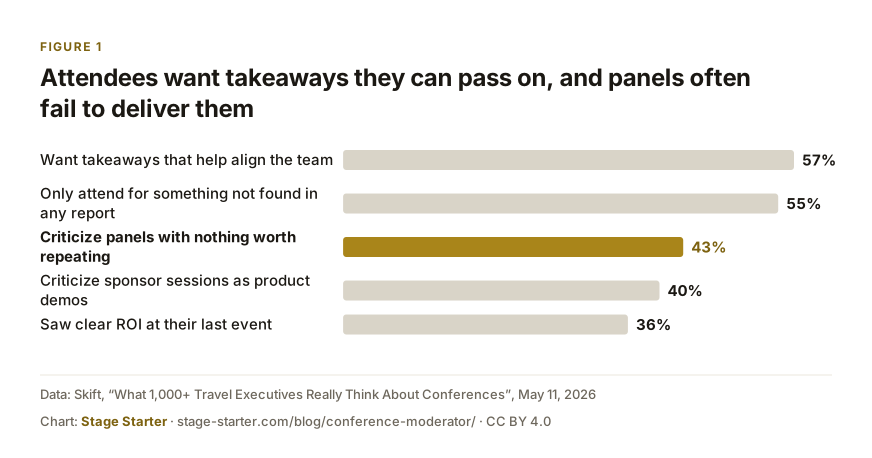
The core figures of the article: 43 percent name panels "that wrap without saying anything you'd actually repeat to your team", and another 40 percent criticize sponsor sessions that quietly turn into product demos. 55 percent say that attending in person only makes sense if they hear something they could not have picked up from a report. 57 percent want takeaways that make it easier to align their teams after the event, and 71 percent attend at least two events a year. On everyday practice, Skift writes that you usually end up sitting through panels where everyone circles the same talking points, and that a moderator runs out of time right when the conversation might have gone somewhere.
Figure 1
Attendees want takeaways they can pass on, and panels often fail to deliver them
Source: Skift, “What 1,000+ Travel Executives Really Think About Conferences”, May 11, 2026
Data and download
Style
Embed
Data as table
| Label | Value (%) |
|---|---|
| Want takeaways that help align the team | 57% |
| Only attend for something not found in any report | 55% |
| Criticize panels with nothing worth repeating | 43% |
| Criticize sponsor sessions as product demos | 40% |
| Saw clear ROI at their last event | 36% |
Chart: Stage Starter, CC BY 4.0. Data: Skift, “What 1,000+ Travel Executives Really Think About Conferences”, May 11, 2026; the source's terms apply.
Conference moderator: leading a conversation to a result
Moderating a conference means leading a program item, usually a panel, a discussion or an interview on stage, as a person who does not give the main talk themselves. The conference moderator introduces the guests and manages the time. The moderator also asks the questions and makes sure the audience knows after the session what it takes away from it. How a panel is built as a format and how it differs from a single talk is described in the article Panel discussion at a conference, and Session formats at a conference gives an overview of the other program formats.
The survey suggests a task for moderators that Skift itself does not formulate as a rule: every panel needs a moment in which something is said that a listener can repeat to the team the next day. That is our interpretation of the 43 percent. You can test it on your own moderating by asking three people in the room after the panel what they would pass on.
How to plan as a conference moderator in five steps
This task leads to a routine you can repeat for every panel:
- Agree the audience and duration with the organizer beforehand, as well as the guiding question of the session. Which points to discuss with them is covered in the article What to clarify with the organizer before you speak.
- Speak to each panellist beforehand for twenty minutes and ask for the one statement they want to make on stage, so that the guests do not repeat the same talking points.
- Formulate a guiding question that forces a decision or an opinion, for example which step a company should approach differently next quarter.
- Fix the schedule before the panel and protect the closing round by cutting somewhere else in the conversation.
- In the closing round, ask each panellist for one sentence the audience can repeat to their team.
Panel schedule: where the minutes go
A panel can lose its takeaway in the last minutes if the discussion overruns and the closing round is dropped. An example with assumptions shows how 45 minutes with four panellists can be divided without the ending suffering.
Figure 2 Schematic
The discussion gets almost half of the panel time
Note: Example plan for 45 minutes with four panellists
Schematic illustration, not measured data.
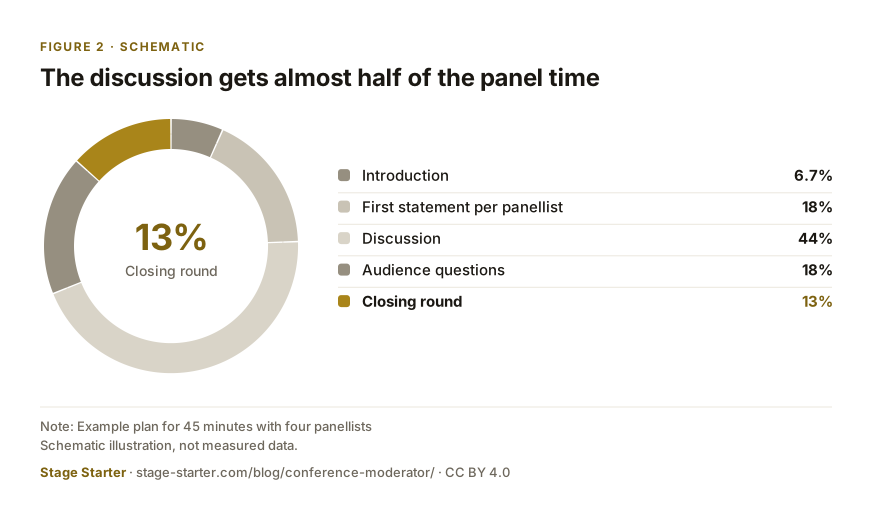
The division is a suggestion that you can adapt to the format. What matters is that the 6 minutes of the closing round are fixed and the discussion acts as the reserve. If you are the timekeeper, you cut the audience questions from 8 to 5 minutes when time runs over and leave the closing round untouched, so that every guest gets to their one sentence. The ending stays plannable.
Why 57 percent want takeaways they can pass on
That 57 percent of respondents want takeaways that help align their team after the event fits the question of ROI, where only 36 percent of regular attendees see a clear answer. A visitor who invests travel time and a conference fee has to explain back at the office what it brought, and a sentence from the closing round is easier to use than an hour of notes. As a moderator or panellist you give them that sentence, and how to address an audience of professionals more generally is described in the article The audience at industry conferences.
The task applies just as much to panellists. 40 percent of respondents are bothered by sponsor sessions that turn into product demos, and an expert on a panel therefore sticks to their topic and experience and leaves their own offer out of it. That raises the chance of staying in the audience's memory as a specialist, and it matches what respondents expect from a session, namely a thought they would not know from a report or from their own network.
Becoming a conference moderator: a route onto the stage
Moderating gets you onto the stage of a trade conference without your having to submit a talk of your own, which helps especially if your topic is not yet worked out into a full talk or you first want to gain experience on stages, and it can be reached in two ways. You can propose to the organizer, in your submission, a panel that you moderate yourself, with a guiding question and two or three guests, or you can ask directly whether the conference is looking for moderators for its panels. Which route works for a given conference is usually stated in the call or can be asked of the organizer.
Our founder Marin Niehues started out below 2 percent with his submissions and now reaches around 10 percent, and Sessionize listed him as Most Active Speaker in 2024 and 2025. Assume you submit to ten conferences and also reach around 10 percent, then those ten submissions lead to roughly one appearance, and whether it comes as a talk or as moderation depends on the program. Our article on how many abstracts to submit for one acceptance works out this order of magnitude in more detail.
Frequently asked questions
What does a conference moderator do?
A conference moderator introduces the guests, asks the questions, manages the time and closes the session. Good moderators speak to the panellists beforehand and plan a closing round in which every guest gives one sentence for the audience.
What does the Skift survey say about panels at conferences?
According to the Skift survey of May 11, 2026 among more than 1,000 people in the travel industry, 43 percent name panels that end without anything being said that they would repeat to their team. 36 percent of regular conference-goers say their last event clearly delivered ROI.
How do I prepare to moderate a conference session?
Agree the audience and duration with the organizer as well as the guiding question, and speak to each panellist beforehand about their key statement. Also fix a schedule with a protected closing round, for example 6 of 45 minutes, and cut the audience questions if time runs short.
How do I end a panel so that something sticks?
Ask each panellist in the closing round for one sentence that listeners can repeat to their team, and sum the sentences up in one line. That gives the audience exactly what 43 percent of respondents miss at panels.
Can I become a conference moderator as an expert?
Yes, you can propose a panel with yourself as moderator to the organizer or ask whether the conference is looking for moderators for its panels. Whether and how that works at a given conference is usually stated in the call for papers or can be asked of the organizer.

Marin Niehues is a management consultant and international speaker. With Niehues Consulting he works with organisations from scale-ups to DAX 40 corporations, and on stage he has spoken at more than 45 conferences in 23 countries.
All articles by Marin Niehues